Monostori Péter, Klinke Glynis, Richter Sylvia, Baráth Ákos, Fingerhut Ralph, Baumgartner Matthias R, Kölker Stefan, Hoffmann Georg F, Gramer Gwendolyn, Okun Jürgen G
Department of General Pediatrics, Division of Neuropediatrics and Metabolic Medicine, Center for Pediatric and Adolescent Medicine, University Hospital Heidelberg, Heidelberg, Germany.
Department of Pediatrics, University of Szeged, Szeged, Hungary.
PLoS One. 2017 Sep 15;12(9):e0184897. doi: 10.1371/journal.pone.0184897. eCollection 2017.
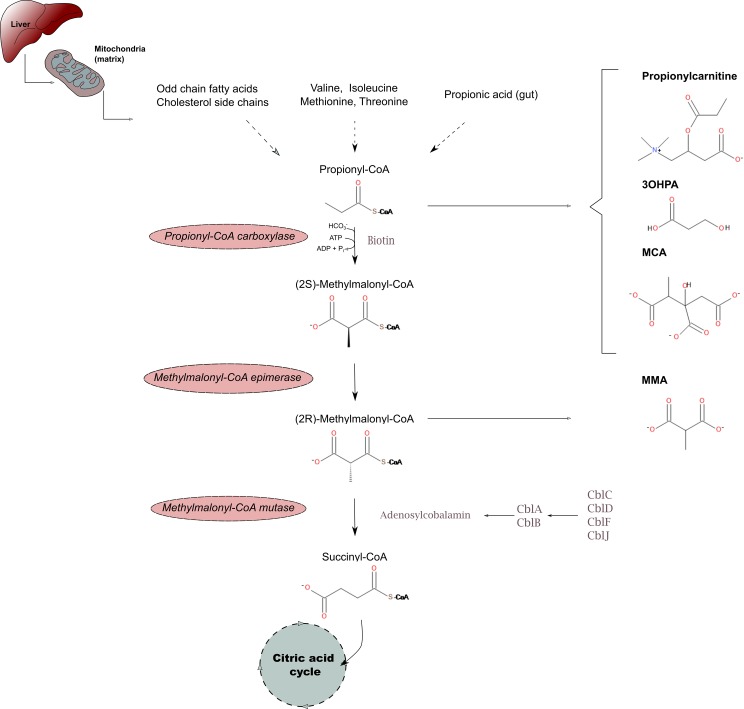
Increased propionylcarnitine levels in newborn screening are indicative for a group of potentially severe disorders including propionic acidemia (PA), methylmalonic acidemias and combined remethylation disorders (MMACBL). This alteration is relatively non-specific, resulting in the necessity of confirmation and differential diagnosis in subsequent tests. Thus, we aimed to develop a multiplex approach for concurrent determination of 3-hydroxypropionic acid, methylmalonic acid and methylcitric acid from the same dried blood spot (DBS) as in primary screening (second-tier test). We also set out to validate the method using newborn and follow-up samples of patients with confirmed PA or MMACBL.
The assay was developed using liquid chromatography-tandem mass spectrometry and clinically validated with retrospective analysis of DBS samples from PA or MMACBL patients.
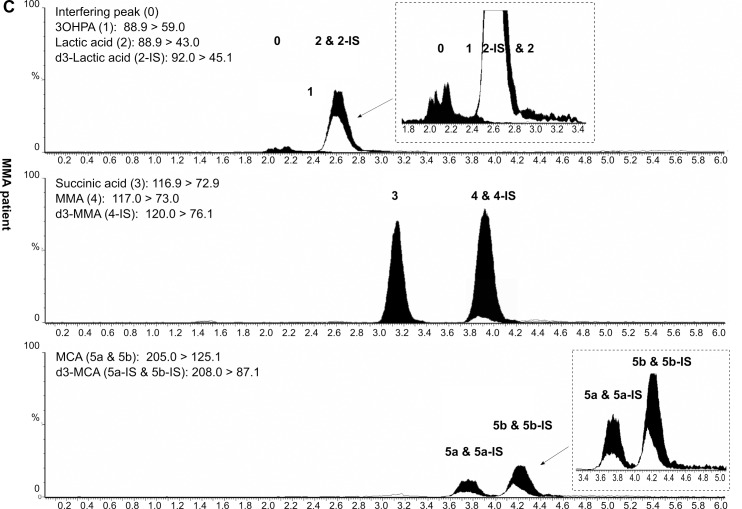
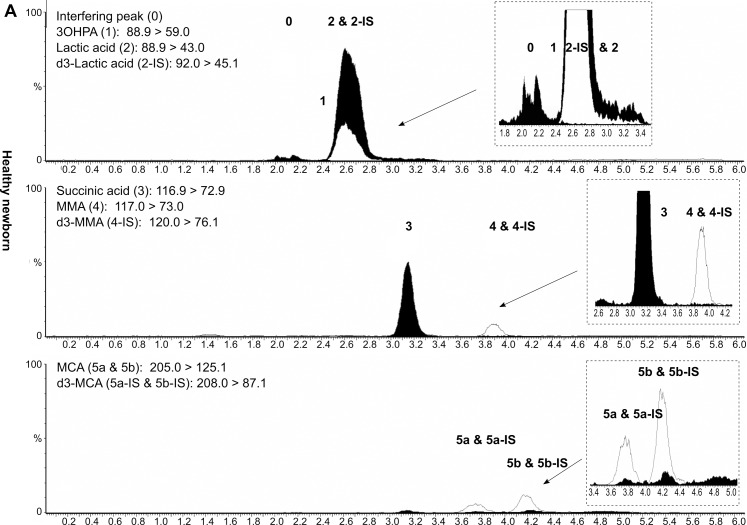
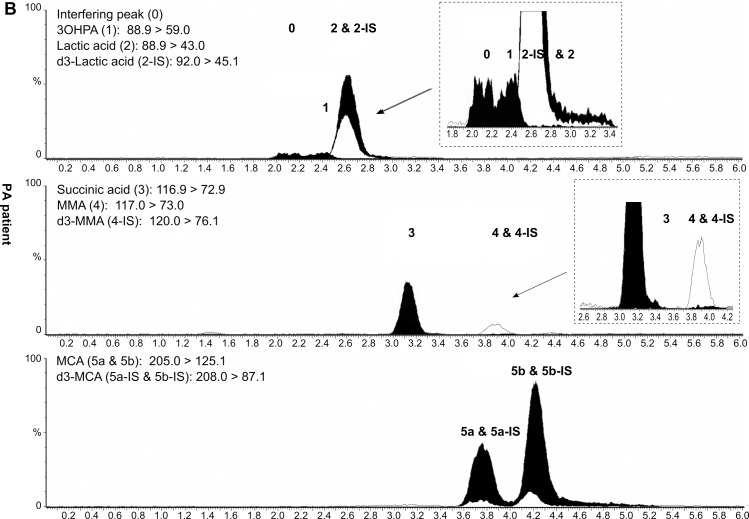
Reliable determination of all three analytes in DBSs was achieved following simple and fast (<20 min) sample preparation without laborious derivatization or any additional pipetting steps. The method clearly distinguished the pathological and normal samples and differentiated between PA and MMACBL in all stored newborn specimens. Methylcitric acid was elevated in all PA samples; 3-hydroxypropionic acid was also high in most cases. Methylmalonic acid was increased in all MMACBL specimens; mostly together with methylcitric acid.
A liquid chromatography-tandem mass spectrometry assay allowing simultaneous determination of the biomarkers 3-hydroxypropionic acid, methylmalonic acid and methylcitric acid in DBSs has been developed. The assay can use the same specimen as in primary screening (second-tier test) which may reduce the need for repeated blood sampling. The presented preliminary findings suggest that this method can reliably differentiate patients with PA and MMACBL in newborn screening. The validated assay is being evaluated prospectively in a pilot project for extension of the German newborn screening panel (‟Newborn screening 2020"; Newborn Screening Center, University Hospital Heidelberg).
新生儿筛查中丙酰肉碱水平升高提示一组潜在的严重疾病,包括丙酸血症(PA)、甲基丙二酸血症和联合甲基化障碍(MMACBL)。这种改变相对非特异性,因此在后续检测中需要进行确认和鉴别诊断。因此,我们旨在开发一种多重检测方法,用于同时测定与初次筛查(二级检测)相同干血斑(DBS)中的3-羟基丙酸、甲基丙二酸和甲基柠檬酸。我们还着手使用确诊为PA或MMACBL患者的新生儿及随访样本对该方法进行验证。
采用液相色谱-串联质谱法开发该检测方法,并通过对PA或MMACBL患者的DBS样本进行回顾性分析进行临床验证。
经过简单快速(<20分钟)的样本制备,无需繁琐的衍生化或任何额外的移液步骤,即可在DBS中可靠地测定所有三种分析物。该方法能够清晰地区分病理样本和正常样本,并在所有储存的新生儿标本中区分PA和MMACBL。所有PA样本中甲基柠檬酸升高;大多数情况下3-羟基丙酸也升高。所有MMACBL标本中甲基丙二酸升高;大多与甲基柠檬酸一起升高。
已开发出一种液相色谱-串联质谱检测方法,可同时测定DBS中的生物标志物3-羟基丙酸、甲基丙二酸和甲基柠檬酸。该检测方法可使用与初次筛查(二级检测)相同的样本,这可能减少重复采血的需求。初步研究结果表明,该方法能够在新生儿筛查中可靠地区分PA和MMACBL患者。目前正在一个试点项目中对经过验证的检测方法进行前瞻性评估,以扩展德国新生儿筛查项目(“2020年新生儿筛查”;海德堡大学医院新生儿筛查中心)。