Terashima Masanori, Ichikawa Wataru, Ochiai Atsushi, Kitada Koji, Kurahashi Issei, Sakuramoto Shinichi, Katai Hitoshi, Sano Takeshi, Imamura Hiroshi, Sasako Mitsuru
Division of Gastric Surgery, Shizuoka Cancer Center, Shimonagakubo, Nagaizumi-cho, Sunto-gun, Shizuoka, Japan.
Division of Medical Oncology, Showa University Fujigaoka Hospital, Kanagawa, Japan.
Oncotarget. 2017 Mar 4;8(34):57574-57582. doi: 10.18632/oncotarget.15895. eCollection 2017 Aug 22.
To identify factors related to relapse sites, we carried out an exploratory biomarker analysis of data from the Adjuvant Chemotherapy Trial of TS-1 for Gastric Cancer study, which is a randomized, controlled trial comparing postoperative adjuvant S-1 therapy with surgery alone in 1,059 patients with stage II/III gastric cancer.
Surgical specimens from 829 patients were retrospectively examined, and 63 genes involved in a variety of biological processes were analyzed by quantitative real-time PCR. Gene expression normalized to reference genes was categorized as lower or higher than the median, and association with relapse sites was analyzed based on 5-year relapse-free survival.
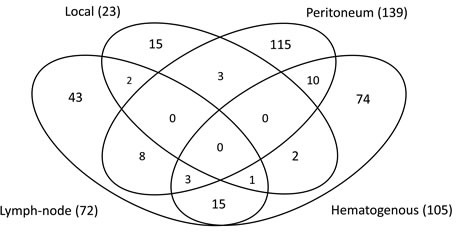
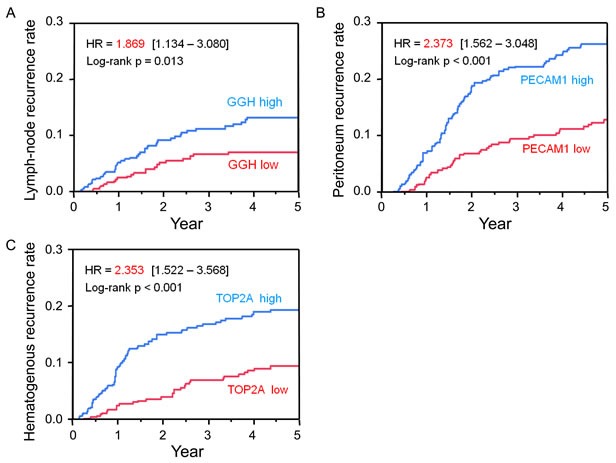
Hematogenous, lymph node, and peritoneal recurrence developed in 72, 105, and 138 of the 829 patients, respectively; hazard ratios were 0.79 (95% confidential interval: 0.54-1.16), 0.51 (0.31-0.82), and 0.60 (0.42-0.84), respectively. Expression of platelet/endothelial cell adhesion molecule 1 (PECAM1) and topoisomerase II alpha () was strongly correlated with hematogenous recurrence and peritoneal recurrence, respectively (false discovery rate = 7.7×10 and 0.002, respectively). Gamma-glutamyl hydrolase () expression was moderately correlated with lymph node recurrence (false discovery rate = 0.34). Relapse-free survival was worse in patients expressing high levels of (hazard ratio = 2.37, 1.65-3.41), (hazard ratio = 2.35, 1.55-3.57), or (hazard ratio = 1.87, 1.13-3.08), respectively. A multivariate analysis revealed that these were stronger independent risk factors than tumor histological type.
In patients with stage II/III gastric cancer, , , and levels in primary tumors are linked to high risk of hematogenous, lymph node, and peritoneal recurrence, respectively.
为了确定与复发部位相关的因素,我们对胃癌TS-1辅助化疗试验的数据进行了探索性生物标志物分析,该试验是一项随机对照试验,比较了1059例II/III期胃癌患者术后辅助S-1治疗与单纯手术治疗的效果。
对829例患者的手术标本进行回顾性检查,并通过定量实时PCR分析了涉及多种生物学过程的63个基因。将标准化为参考基因的基因表达分为低于或高于中位数,并基于5年无复发生存率分析与复发部位的关联。
829例患者中分别有72例、105例和138例发生血行转移、淋巴结转移和腹膜复发;风险比分别为0.79(95%置信区间:0.54-1.16)、0.51(0.31-0.82)和0.60(0.42-0.84)。血小板/内皮细胞粘附分子1(PECAM1)和拓扑异构酶IIα()的表达分别与血行转移复发和腹膜复发密切相关(错误发现率分别为7.7×10和0.002)。γ-谷氨酰水解酶()的表达与淋巴结复发中度相关(错误发现率=0.34)。分别表达高水平的(风险比=2.37,1.65-3.41)、(风险比=2.35,1.55-3.57)或(风险比=1.87,1.13-3.08)的患者无复发生存率较差。多变量分析显示,这些是比肿瘤组织学类型更强的独立危险因素。
在II/III期胃癌患者中,原发肿瘤中的、和水平分别与血行转移、淋巴结转移和腹膜复发的高风险相关。