Kwon Soohyun, Heo Shinhee, Kim Dongjun, Kang Seunghyun, Woo Jong-Min
Guideline Center for Korean Medicine, National Institute of Korean Medicine, Namsan Square 173, Toegye-ro, Jung-gu, Seoul, 04554, South Korea.
School of Korean Medicine, Pusan National University, Yangsan, 50612, South Korea.
BMC Complement Altern Med. 2017 Sep 16;17(1):463. doi: 10.1186/s12906-017-1969-8.
Korean medicine (KM) has been widely used in Korea. This study aimed to assess the general perceptions of KM, to investigate the patterns of its usage in 2014, and to compare the results with those of an earlier survey from 2011.
A cross-sectional study was conducted with 1000 Korean people. The questionnaire included items regarding trust in KM, reasons for distrust of KM, and visit frequency to KM clinics. This study used methods consistent with those of a 2011 survey to examine changes in attitudes over 3 years.
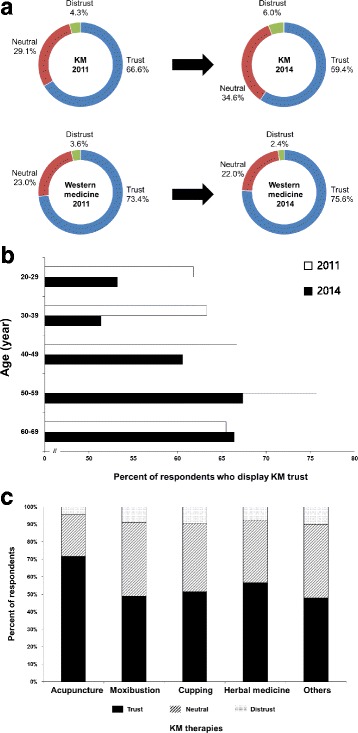
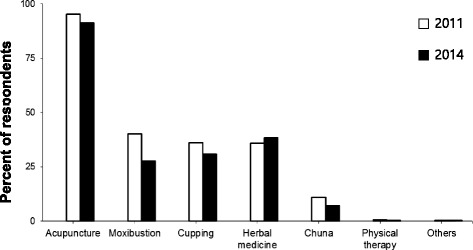
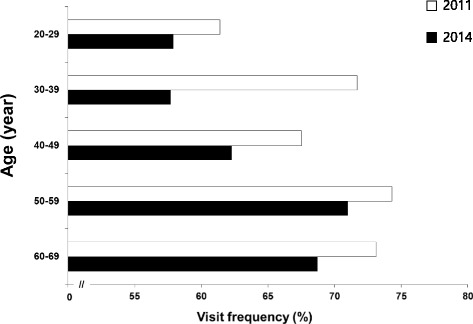
Despite high rates of trust in KM, the visit frequency decreased from 69.3% in 2011 to 63.2% in 2014. Usage among young adults (in their 20s and 30s) was significantly reduced compared to all other age groups. The KM modality most commonly used by participants was acupuncture, whereas the use of moxibustion and cupping therapies has decreased since 2011. Men and women were most likely to distrust KM due to a "lack of scientific evidence" (59.3%) and "suspicion of KM safety" (47.4%), respectively.
The findings suggested that KM use and trust in KM were slightly lower in 2014 than in 2011. The decreases were most notable among individuals in their 30s and in the use of moxibustion in KM therapy. This study aimed to produce practical insights by reviewing patterns of KM use and perceptions over time. Additional surveys must be considered to produce a more in-depth analysis.
韩医学在韩国已被广泛使用。本研究旨在评估对韩医学的总体认知,调查2014年其使用模式,并将结果与2011年的早期调查结果进行比较。
对1000名韩国人进行了一项横断面研究。问卷包括有关对韩医学的信任、不信任韩医学的原因以及去韩医诊所就诊频率的项目。本研究采用与2011年调查一致的方法来考察3年间态度的变化。
尽管对韩医学的信任率较高,但就诊频率从2011年的69.3%降至2014年的63.2%。与所有其他年龄组相比,年轻人(20多岁和30多岁)的使用率显著降低。参与者最常使用的韩医学方式是针灸,而自2011年以来艾灸和拔罐疗法的使用有所减少。男性和女性最不信任韩医学的原因分别是“缺乏科学证据”(59.3%)和“怀疑韩医学安全性”(47.4%)。
研究结果表明,2014年韩医学的使用和对韩医学的信任略低于2011年。下降在30多岁的人群以及韩医学疗法中艾灸的使用方面最为显著。本研究旨在通过回顾韩医学使用模式和随时间变化的认知来产生实际见解。必须考虑进行更多调查以进行更深入的分析。