Chenausky Karen V, Norton Andrea C, Schlaug Gottfried
Music, Neuroimaging, and Stroke Recovery Laboratory, Department of Neurology, Beth Israel Deaconess Medical CenterBoston, MA, United States.
Department of Neurology, Harvard Medical SchoolBoston, MA, United States.
Front Hum Neurosci. 2017 Sep 4;11:426. doi: 10.3389/fnhum.2017.00426. eCollection 2017.
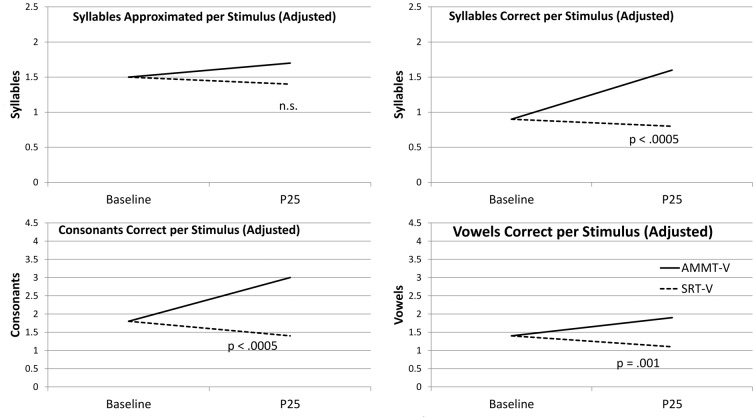
We tested the effect of Auditory-Motor Mapping Training (AMMT), a novel, intonation-based treatment for spoken language originally developed for minimally verbal (MV) children with autism, on a more-verbal child with autism. We compared this child's performance after 25 therapy sessions with that of: (1) a child matched on age, autism severity, and expressive language level who received 25 sessions of a non-intonation-based control treatment Speech Repetition Therapy (SRT); and (2) a matched pair of MV children (one of whom received AMMT; the other, SRT). We found a significant Time × Treatment effect in favor of AMMT for number of Syllables Correct and Consonants Correct per stimulus for both pairs of children, as well as a significant Time × Treatment effect in favor of AMMT for number of Vowels Correct per stimulus for the more-verbal pair. Magnitudes of the difference in post-treatment performance between AMMT and SRT, adjusted for Baseline differences, were: (a) larger for the more-verbal pair than for the MV pair; and (b) associated with very large effect sizes (Cohen's > 1.3) in the more-verbal pair. Results hold promise for the efficacy of AMMT for improving spoken language production in more-verbal children with autism as well as their MV peers and suggest hypotheses about brain function that are testable in both correlational and causal behavioral-imaging studies.
我们测试了听觉-运动映射训练(AMMT)对一名语言能力较强的自闭症儿童的效果。AMMT是一种新颖的、基于语调的口语治疗方法,最初是为极少言语(MV)的自闭症儿童开发的。我们将该儿童在接受25次治疗后的表现与以下情况进行了比较:(1)一名年龄、自闭症严重程度和表达语言水平相匹配的儿童,其接受了25次非基于语调的对照治疗——言语重复治疗(SRT);(2)一对相匹配的MV儿童(其中一名接受AMMT;另一名接受SRT)。我们发现,对于两组儿童,每刺激音节正确数和辅音正确数方面均存在显著的时间×治疗效应,支持AMMT;对于语言能力较强的那组儿童,每刺激元音正确数方面也存在显著的时间×治疗效应,支持AMMT。针对基线差异进行调整后,AMMT和SRT治疗后表现的差异幅度为:(a)语言能力较强的那组儿童大于MV组儿童;(b)语言能力较强的那组儿童的效应量非常大(科恩d>1.3)。研究结果为AMMT改善语言能力较强的自闭症儿童及其MV同伴的口语表达能力的疗效带来了希望,并提出了关于脑功能的假设,这些假设在相关和因果行为成像研究中均可进行检验。