
利福昔明重复治疗可改善肠易激综合征相关生活质量:一项随机、双盲、安慰剂对照试验的二次分析
Repeat treatment with rifaximin improves irritable bowel syndrome-related quality of life: a secondary analysis of a randomized, double-blind, placebo-controlled trial.
作者信息
Cash Brooks D, Pimentel Mark, Rao Satish S C, Weinstock Leonard, Chang Lin, Heimanson Zeev, Lembo Anthony
机构信息
University of South Alabama, Digestive Health Center, 75 S. University Blvd, Suite 6000-B, Mobile, AL 36608, USA.
GI Motility Program, Division of Gastroenterology, Cedars-Sinai Medical Center, Los Angeles, CA, USA.
出版信息
Therap Adv Gastroenterol. 2017 Sep;10(9):689-699. doi: 10.1177/1756283X17726087. Epub 2017 Sep 11.
BACKGROUND
Diarrhea-predominant irritable bowel syndrome (IBS-D) impairs patient quality of life (QOL). Rifaximin is an oral, nonsystemic antibiotic indicated for IBS-D. The objective of this secondary analysis was to evaluate rifaximin retreatment on IBS-related QOL in patients with IBS-D.
METHODS
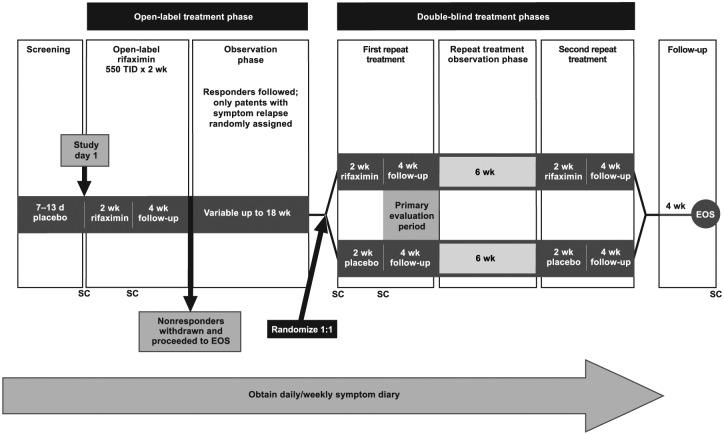
Patients received open-label rifaximin 550 mg three times daily for 2 weeks. Clinical responders [simultaneously meeting weekly response criteria for abdominal pain (⩾30% improvement from baseline in mean weekly pain score) and stool consistency (⩾50% decrease from baseline in number of days/week with Bristol Stool Scale (BSS) type 6 or 7 stools) during ⩾2 of first 4 weeks posttreatment] who relapsed during an up to 18-week treatment-free observation phase were randomly assigned to receive two 2-week courses of double-blind rifaximin or placebo, separated by 10 weeks. A validated 34-item IBS-QOL questionnaire examined patient responses in 8 domains.
RESULTS
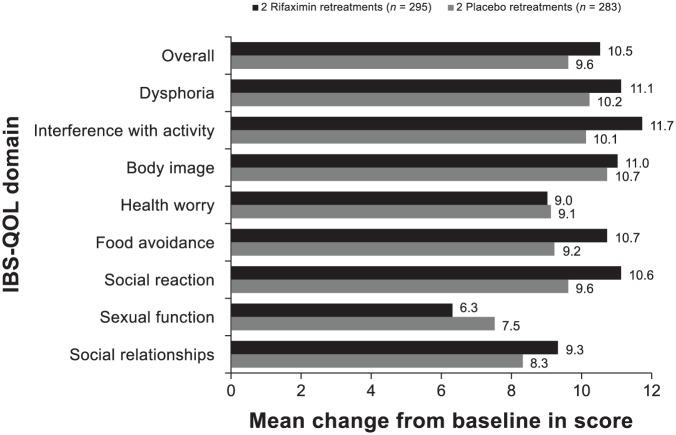
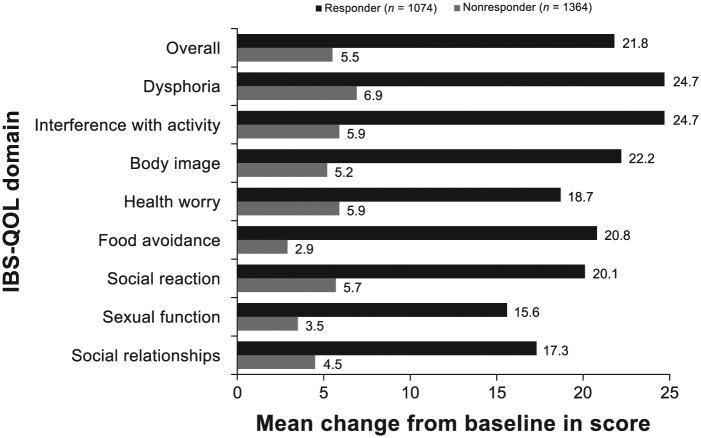
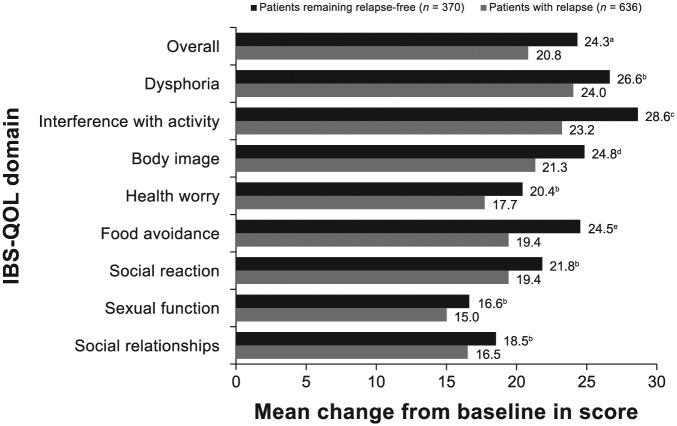
The 2579 patients receiving open-label rifaximin experienced a mean improvement from baseline in IBS-QOL overall score of 54.9%. Responders to open-label rifaximin ( = 1074 of 2438 evaluable; 44.1%) had significantly greater improvement from baseline in IBS-QOL overall and all eight subdomain scores, including dysphoria, food avoidance, interference with activity, body image, and sexual function nonresponders at 4 weeks posttreatment ( = 1364; < 0.001 for all comparisons). A significantly greater percentage of responders to open-label rifaximin achieved the minimally clinically important difference (MCID; ⩾14-point improvement from baseline) in the overall IBS-QOL score nonresponders [ = 561 (52.2%) = 287 (21.0%); < 0.0001]. Among 636 patients with IBS-D relapse, the MCID in the overall IBS-QOL score was achieved by a significantly greater percentage of patients receiving double-blind rifaximin placebo (38.6% 29.6%, respectively; = 0.009).
CONCLUSIONS
Open-label and blinded retreatment with a short course (2 weeks) of rifaximin improved IBS-QOL in patients with IBS-D [ClinicalTrials.gov identifier: NCT01543178].
背景
腹泻型肠易激综合征(IBS-D)会损害患者的生活质量(QOL)。利福昔明是一种口服的非全身性抗生素,适用于IBS-D。这项二次分析的目的是评估利福昔明再治疗对IBS-D患者IBS相关生活质量的影响。
方法
患者接受开放标签的利福昔明550毫克,每日三次,共2周。临床缓解者(在治疗后前4周中的至少2周内同时达到腹痛的每周缓解标准[平均每周疼痛评分较基线改善⩾30%]和大便性状标准[每周布里斯托大便分类法(BSS)6型或7型大便天数较基线减少⩾50%]),在长达18周的无治疗观察期内复发的患者被随机分配接受两个为期2周的双盲利福昔明或安慰剂疗程,中间间隔10周。一份经过验证的34项IBS-QOL问卷评估了患者在8个领域的反应。
结果
2579名接受开放标签利福昔明治疗的患者IBS-QOL总体评分较基线平均改善了54.9%。开放标签利福昔明的缓解者(2438名可评估患者中的1074名;44.1%)在IBS-QOL总体评分以及所有八个子领域评分(包括烦躁不安、食物回避、对活动的干扰、身体形象和性功能)方面较基线有显著更大的改善,而治疗后4周的未缓解者(1364名;所有比较P<0.001)。开放标签利福昔明的缓解者在IBS-QOL总体评分中达到最小临床重要差异(MCID;较基线改善⩾14分)的比例显著高于未缓解者[分别为561名(52.2%)对287名(21.0%);P<0.0001]。在636名IBS-D复发患者中,接受双盲利福昔明治疗的患者在IBS-QOL总体评分中达到MCID的比例显著高于接受安慰剂治疗的患者(分别为38.6%对29.6%;P = 0.009)。
结论
短期(2周)利福昔明开放标签和双盲再治疗改善了IBS-D患者的IBS-QOL[ClinicalTrials.gov标识符:NCT01543178]。

 Zotero 插件