Poplaukhin Pavel, Tiekink Edward R T
Chemical Abstracts Service, 2540 Olentangy River Rd, Columbus, Ohio 43202, USA.
Centre for Crystalline Materials, Faculty of Science and Technology, Sunway University, 47500 Bandar Sunway, Selangor Darul Ehsan, Malaysia.
Acta Crystallogr E Crystallogr Commun. 2017 Jul 21;73(Pt 8):1246-1251. doi: 10.1107/S2056989017010568. eCollection 2017 Jul 1.
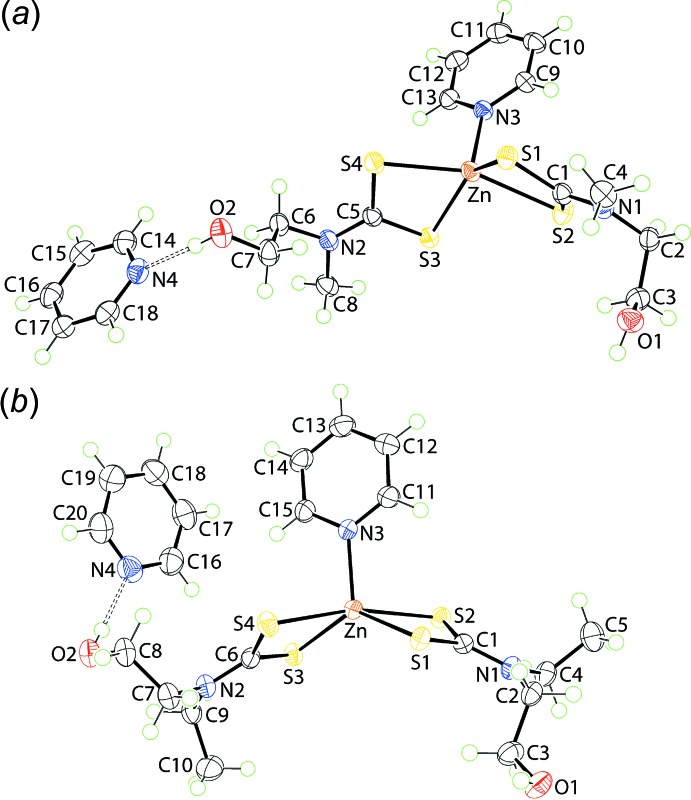
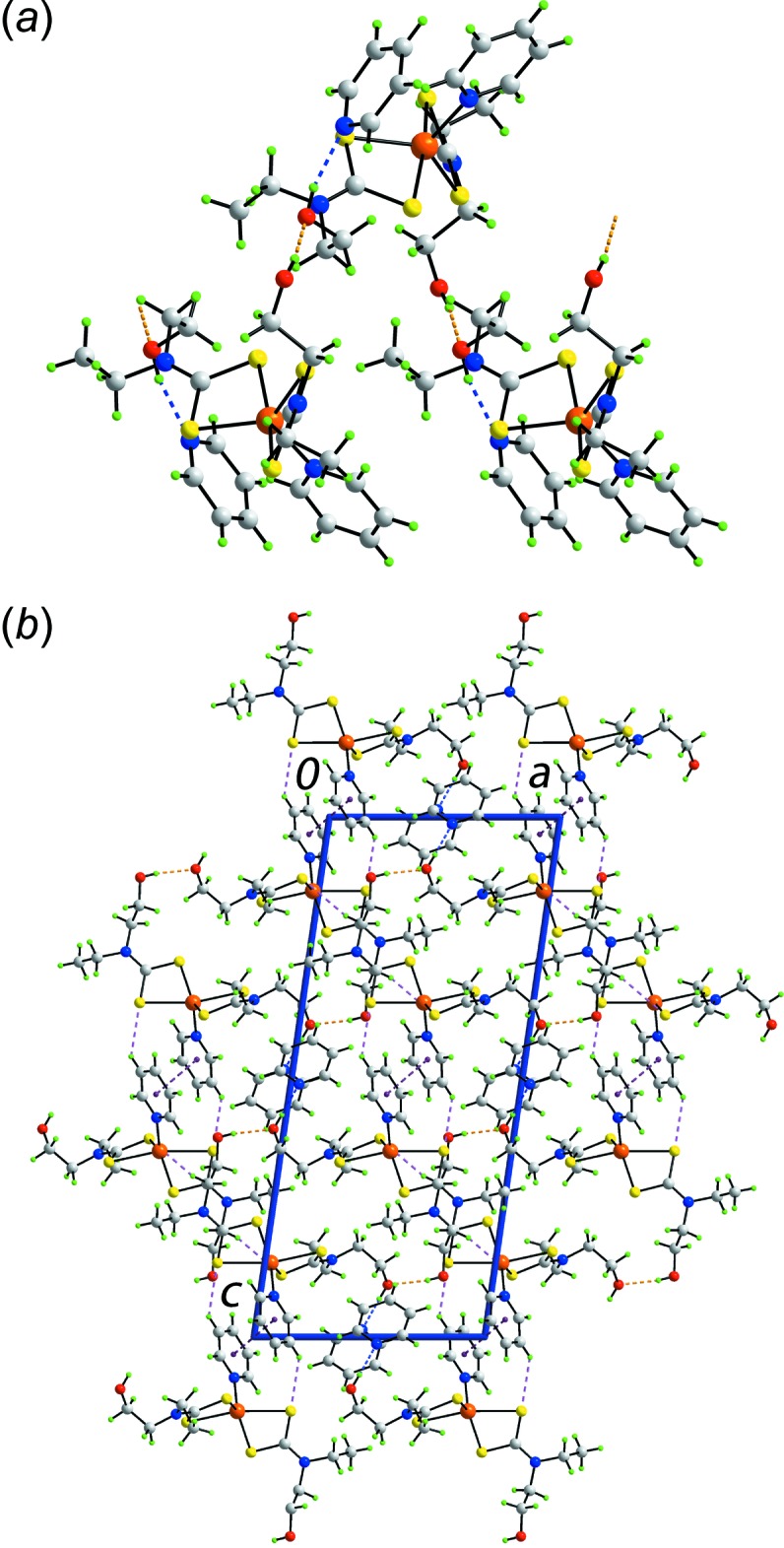
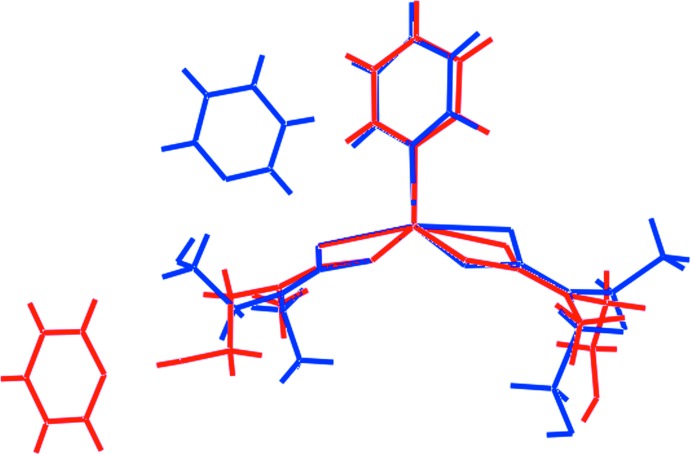
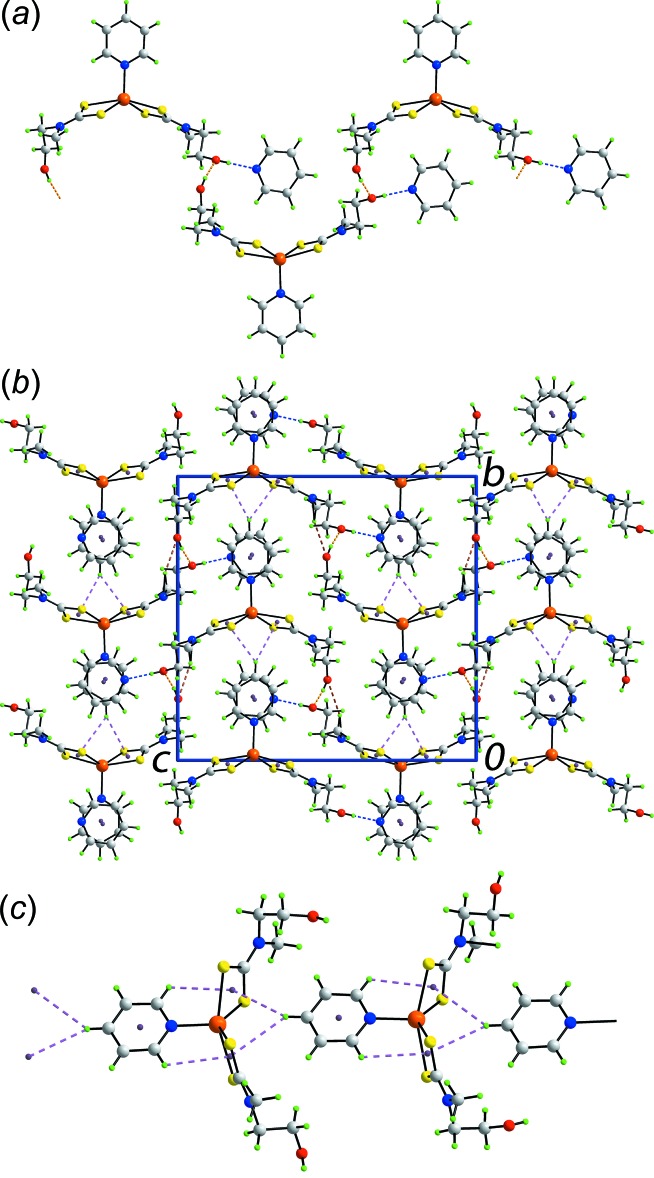
The common structural feature of the title compounds, [Zn(CHNOS)(CHN)]·CHN (I) and [Zn(CHNOS)(CHN)]·CHN (II), which differ by having di-thio-carbamate N-bound methyl (I) and ethyl (II) groups, is the coordination of each Zn atom by two non-symmetrically chelating di-thio-carbamate ligands and by a pyridine ligand; in each case, the non-coordinating pyridine mol-ecule is connected to the Zn-containing mol-ecule a (hy-droxy)O-H⋯N(pyridine) hydrogen bond. The resulting NS coordination geometry is closer to a square-pyramid than a trigonal bipyramid in the case of (I), but almost inter-mediate between the two extremes in (II). The mol-ecular packing features (hy-droxy)O-H⋯O(hy-droxy) hydrogen bonds, leading to supra-molecular chains with a zigzag arrangement along [10-1] (I) or a helical arrangement along [010] (II). In (I), π-π [inter-centroid distances = 3.4738 (10) and 3.4848 (10) Å] between coordinating and non-coordinating pyridine mol-ecules lead to stacks comprising alternating rings along the axis. In (II), weaker π-π contacts occur between centrosymmetrically related pairs of coordinating pyridine mol-ecules [inter-centroid separation = 3.9815 (14) Å]. Further inter-actions, including C-H⋯π(chelate) inter-actions in (I), lead to a three-dimensional architecture in each case.
标题化合物[Zn(CHNOS)(CHN)]·CHN(I)和[Zn(CHNOS)(CHN)]·CHN(II)的共同结构特征是,二者的区别在于二硫代氨基甲酸盐的N-键合甲基(I)和乙基(II)基团,每个Zn原子均由两个非对称螯合的二硫代氨基甲酸盐配体和一个吡啶配体配位;在每种情况下,非配位吡啶分子通过(羟基)O-H⋯N(吡啶)氢键与含Zn分子相连。在(I)的情况下,所得的NS配位几何形状更接近四方锥而非三角双锥,但在(II)中几乎处于两种极端情况之间。分子堆积特征为(羟基)O-H⋯O(羟基)氢键,导致超分子链沿[10-1]呈锯齿状排列(I)或沿[010]呈螺旋状排列(II)。在(I)中,配位和非配位吡啶分子之间的π-π[质心间距 = 3.4738 (10) 和3.4848 (10) Å]导致沿 轴形成由交替环组成的堆积。在(II)中,中心对称相关的配位吡啶分子对之间存在较弱的π-π接触[质心间距 = 3.9815 (14) Å]。包括(I)中的C-H⋯π(螯合物)相互作用在内的进一步相互作用,在每种情况下均导致三维结构。