Plattes Mario, Köhler Christian, Gallé Tom
Luxembourg Institute of Science and Technology (LIST), Environmental Research and Innovation (ERIN), Luxembourg.
MethodsX. 2017 Aug 31;4:274-278. doi: 10.1016/j.mex.2017.08.003. eCollection 2017.
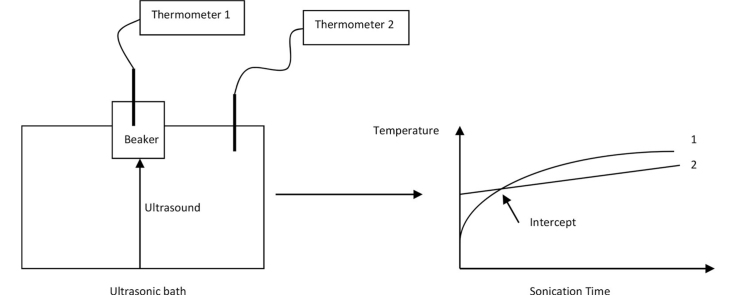
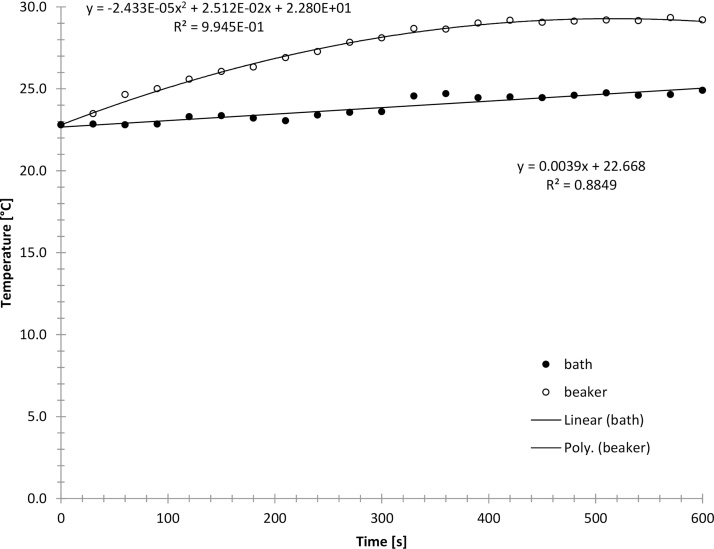
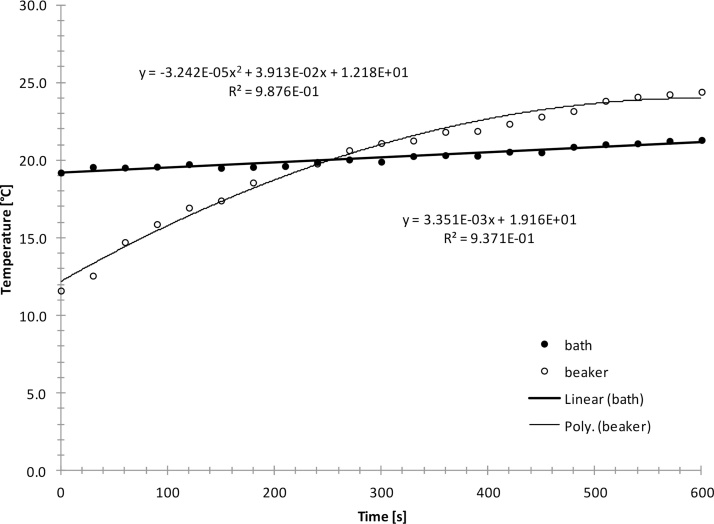
The two most characteristic properties of an ultrasonic wave are the frequency and the power. It is therefore important to determine the power in a given reactor. This can be done by calorimetry, i.e. by measuring the temperature rise in the vessel during sonication starting at thermal equilibrium with the surroundings (classic calorimetry) [1-3]. However, the classic ultrasonic calorimetry has drawbacks. In particular it is difficult to evaluate the temperature rise at thermal equilibrium, because the relevant initial time and temperature intervals are small and measurement errors in the temperature readings are large. Also the initial temperature response of the probe is complex [4]. The authors propose to start the calorimetric measurement at thermal disequilibrium, i.e. with a lower temperature in the reaction vessel. During sonication the temperature in the reaction vessel rises faster than in the surrounding and passes thermal equilibrium. The acoustic power transferred to the vessel at thermal equilibrium can then be calculated. The method consists of: •Setting up the reaction vessel at lower temperature than the surroundings (ultrasonic bath or air).•Measuring temperature rise in the reaction vessel and the surroundings during sonication.•Determine the temperature rise at intercept by interpolation and calculate the ultrasonic power in the reaction vessel.
超声波的两个最具特征的属性是频率和功率。因此,确定给定反应器中的功率很重要。这可以通过量热法来完成,即通过测量在与周围环境处于热平衡状态下开始超声处理期间容器内的温度升高(经典量热法)[1 - 3]。然而,经典的超声量热法存在缺点。特别是,很难评估热平衡时的温度升高,因为相关的初始时间和温度区间很小,并且温度读数中的测量误差很大。此外,探头的初始温度响应很复杂[4]。作者建议在热不平衡状态下开始量热测量,即在反应容器中具有较低温度时开始。在超声处理期间,反应容器中的温度比周围环境上升得更快,并通过热平衡。然后可以计算在热平衡时传递到容器的声功率。该方法包括:•将反应容器设置在比周围环境(超声浴或空气)更低的温度下。•在超声处理期间测量反应容器和周围环境中的温度升高。•通过插值确定截距处的温度升高,并计算反应容器中的超声功率。