Krtková Jana, Xu Jennifer, Lalle Marco, Steele-Ogus Melissa, Alas Germain C M, Sept David, Paredez Alexander R
Department of Biology, University of Washington, Seattle, Washington, USA.
Department of Experimental Plant Biology, Faculty of Science, Charles University, Prague, Czech Republic.
mSphere. 2017 Sep 13;2(5). doi: 10.1128/mSphere.00248-17. eCollection 2017 Sep-Oct.
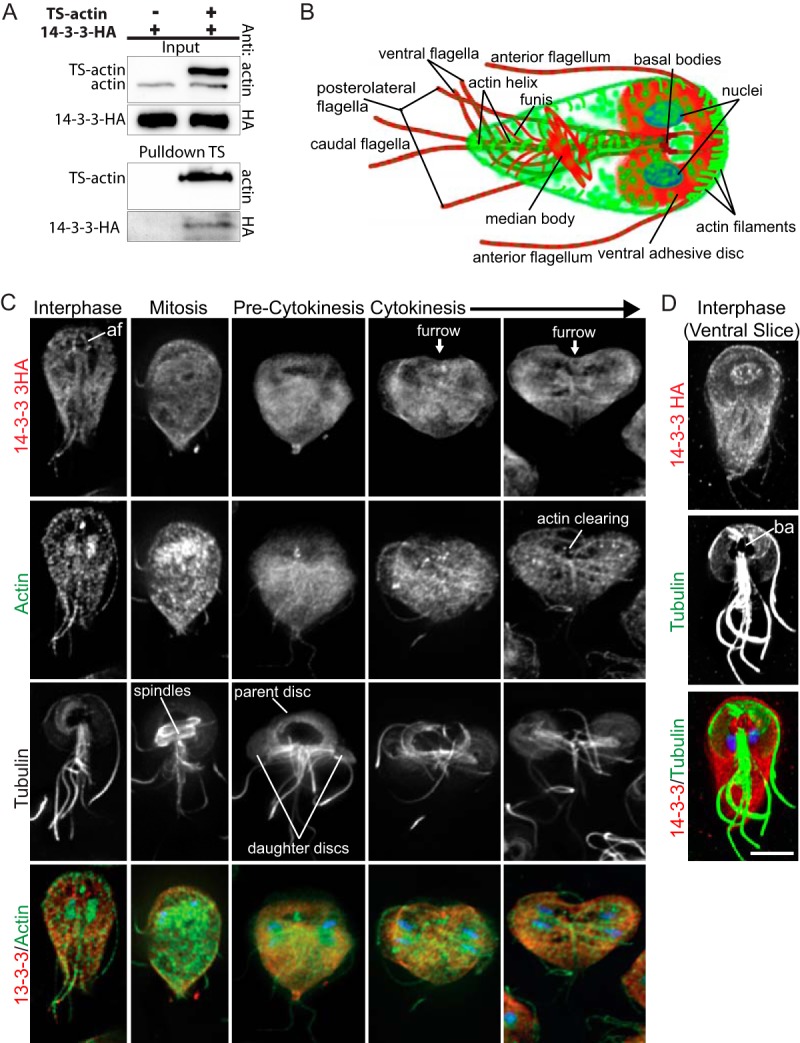
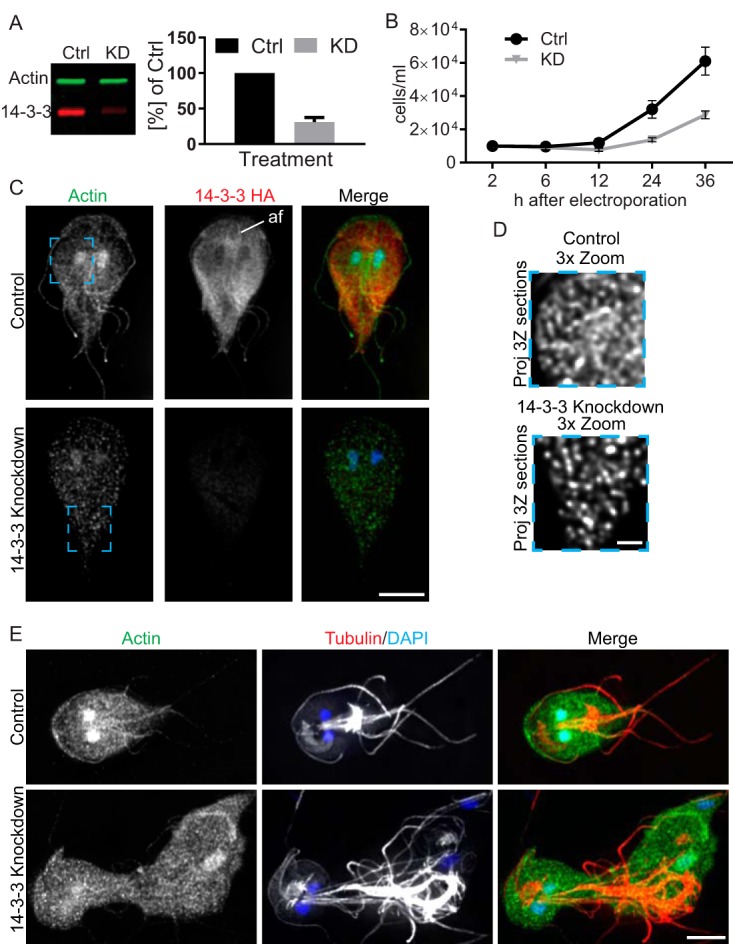
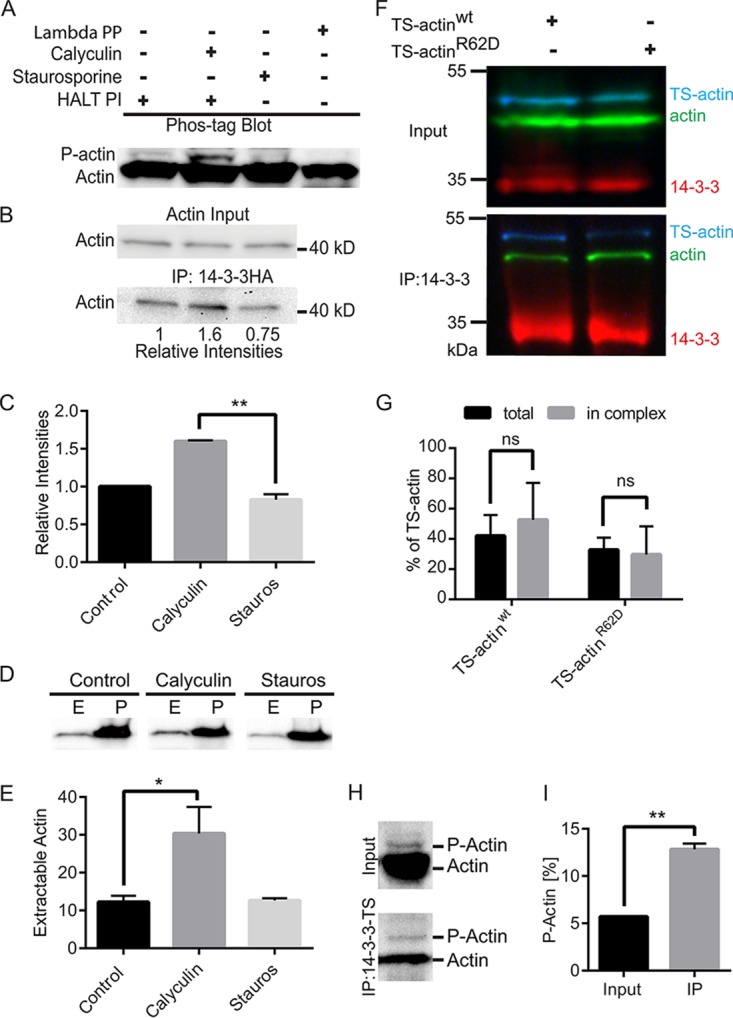
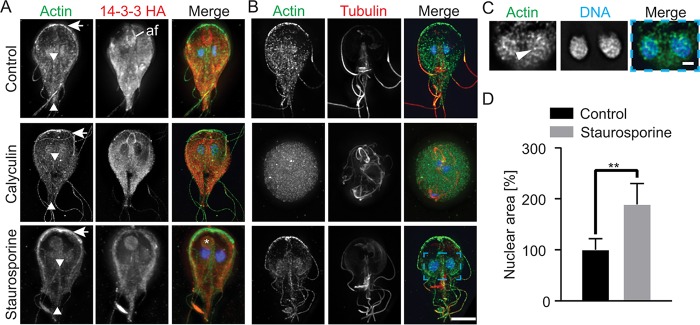
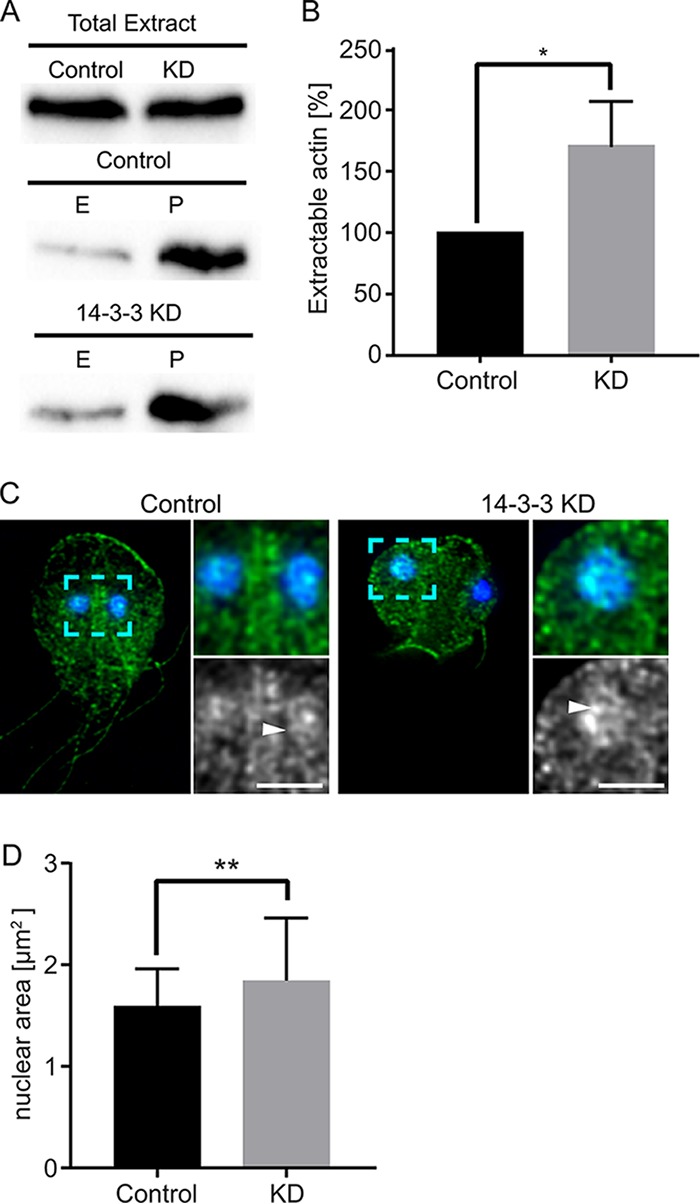
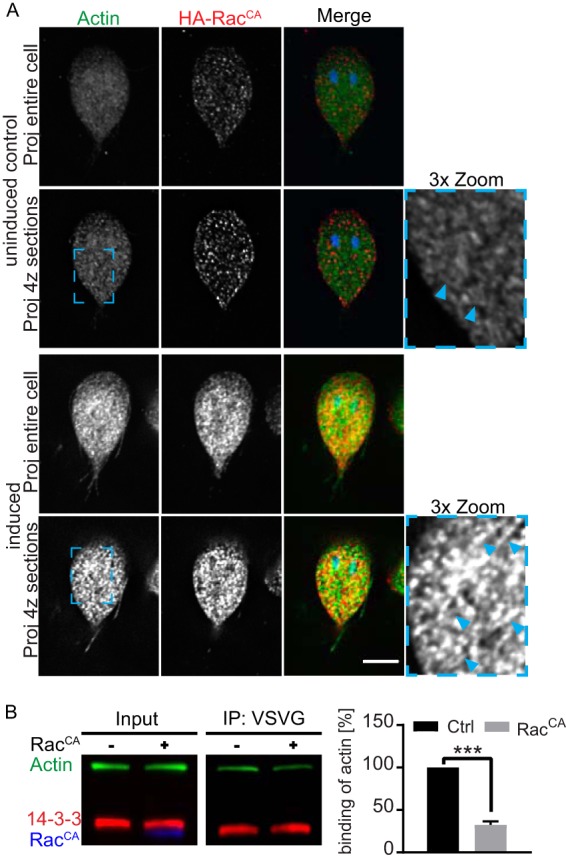
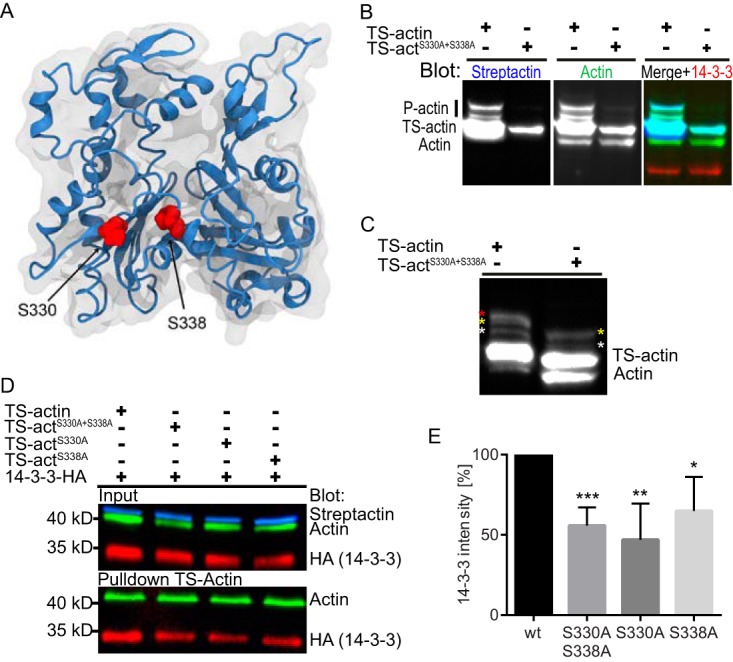
The phosphoserine/phosphothreonine-binding protein 14-3-3 is known to regulate actin; this function has been previously attributed to sequestration of phosphorylated cofilin. 14-3-3 was identified as an actin-associated protein in the deep-branching eukaryote ; however, lacks cofilin and all other canonical actin-binding proteins (ABPs). Thus, the role of 14-3-3 (Gl14-3-3) in actin regulation was unknown. Gl-14-3-3 depletion resulted in an overall disruption of actin organization characterized by ectopically distributed short actin filaments. Using phosphatase and kinase inhibitors, we demonstrated that actin phosphorylation correlated with destabilization of the actin network and increased complex formation with 14-3-3, while blocking actin phosphorylation stabilized actin filaments and attenuated complex formation. 's sole Rho family GTPase, Gl-Rac, modulates Gl-14-3-3's association with actin, providing the first connection between Gl-Rac and the actin cytoskeleton in . actin (Gl-actin) contains two putative 14-3-3 binding motifs, one of which (S330) is conserved in mammalian actin. Mutation of these sites reduced, but did not completely disrupt, the association with 14-3-3. Native gels and overlay assays indicate that intermediate proteins are required to support complex formation between 14-3-3 and actin. Overall, our results support a role for 14-3-3 as a regulator of actin; however, the presence of multiple 14-3-3-actin complexes suggests a more complex regulatory relationship than might be expected for a minimalistic parasite. lacks canonical actin-binding proteins. Gl-14-3-3 was identified as an actin interactor, but the significance of this interaction was unknown. Loss of Gl-14-3-3 results in ectopic short actin filaments, indicating that Gl-14-3-3 is an important regulator of the actin cytoskeleton in . Drug studies indicate that Gl-14-3-3 complex formation is in part phospho-regulated. We demonstrate that complex formation is downstream of 's sole Rho family GTPase, Gl-Rac. This result provides the first mechanistic connection between Gl-Rac and Gl-actin in . Native gels and overlay assays indicate intermediate proteins are required to support the interaction between Gl-14-3-3 and Gl-actin, suggesting that Gl-14-3-3 is regulating multiple Gl-actin complexes.
已知磷酸丝氨酸/磷酸苏氨酸结合蛋白14-3-3可调节肌动蛋白;该功能先前被认为是由于隔离了磷酸化的丝切蛋白。14-3-3在进化分支较深的真核生物中被鉴定为一种肌动蛋白相关蛋白;然而,它缺乏丝切蛋白和所有其他典型的肌动蛋白结合蛋白(ABP)。因此,14-3-3(Gl14-3-3)在肌动蛋白调节中的作用尚不清楚。Gl-14-3-3的缺失导致肌动蛋白组织的整体破坏,其特征是肌动蛋白细丝异位分布。使用磷酸酶和激酶抑制剂,我们证明肌动蛋白磷酸化与肌动蛋白网络的不稳定相关,并增加了与14-3-3的复合物形成,而阻断肌动蛋白磷酸化可稳定肌动蛋白细丝并减弱复合物形成。该生物唯一的Rho家族GTP酶Gl-Rac调节Gl-14-3-3与肌动蛋白的结合,这是Gl-Rac与该生物中肌动蛋白细胞骨架之间的首次联系。该生物的肌动蛋白(Gl-肌动蛋白)包含两个假定的14-3-3结合基序,其中一个(S330)在哺乳动物肌动蛋白中保守。这些位点的突变减少了但并未完全破坏与14-3-3的结合。天然凝胶和覆盖分析表明,需要中间蛋白来支持14-3-3与肌动蛋白之间的复合物形成。总体而言,我们的结果支持14-3-3作为肌动蛋白调节剂的作用;然而,多种14-3-3-肌动蛋白复合物的存在表明其调节关系比简约寄生虫预期的更为复杂。该生物缺乏典型的肌动蛋白结合蛋白。Gl-14-3-3被鉴定为一种肌动蛋白相互作用蛋白,但其这种相互作用的意义尚不清楚。Gl-14-3-3的缺失导致异位短肌动蛋白细丝,表明Gl-14-3-3是该生物中肌动蛋白细胞骨架的重要调节剂。药物研究表明,Gl-14-3-3复合物的形成部分受磷酸化调节。我们证明复合物形成是该生物唯一的Rho家族GTP酶Gl-Rac的下游事件。这一结果首次在该生物中建立了Gl-Rac与Gl-肌动蛋白之间的机制联系。天然凝胶和覆盖分析表明,需要中间蛋白来支持Gl-14-3-3与Gl-肌动蛋白之间的相互作用,这表明Gl-14-3-3正在调节多种Gl-肌动蛋白复合物。