Abla Nada, Keiser Jennifer, Vargas Mireille, Reimers Natalie, Haas Helmut, Spangenberg Thomas
Merck Global Health Institute, Ares Trading S.A., a subsidiary of Merck KGaA (Darmstadt, Germany), Coinsins, Switzerland.
Medicines for Malaria Venture, Geneva, Switzerland.
PLoS Negl Trop Dis. 2017 Sep 21;11(9):e0005942. doi: 10.1371/journal.pntd.0005942. eCollection 2017 Sep.
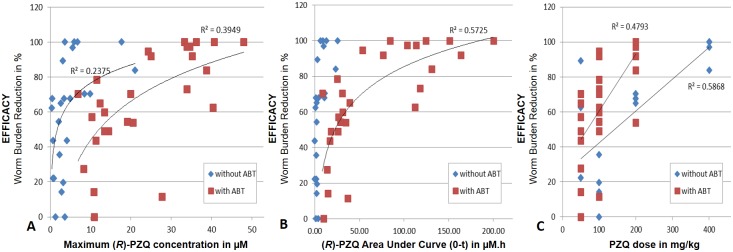
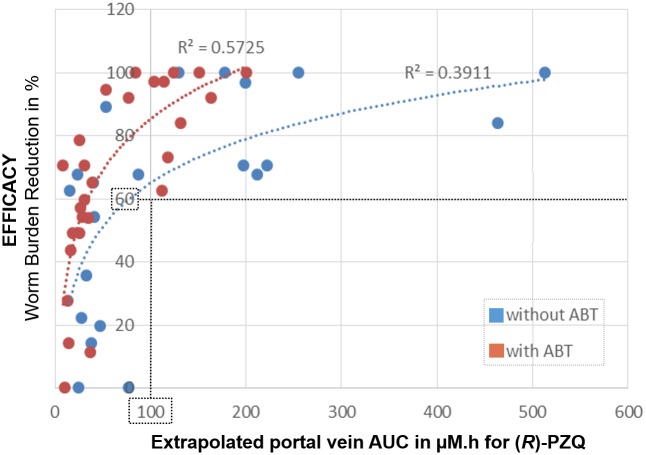
After more than 40 years of use, Praziquantel (PZQ) still remains the drug of choice for the treatment of intestinal and urogenital schistosomiasis. Its anti-parasitic activity resides primarily in the (R)-enantiomer. Hitherto neither the molecular target nor the pharmacokinetic-pharmacodynamic relationship have been fully elucidated. Here we investigated the efficacy and pharmacokinetics of PZQ in the Schistosoma mansoni mouse model to determine the key factors that drive its efficacy. Dose-response studies with racemic PZQ with or without addition of an irreversible pan-cytochrome P450 (CYP) inhibitor, 1-aminobenzotriazole (ABT), were performed. In addition, efficacy of PZQ in the presence of the CYP inducer, dexamethasone (DEX), was determined. Plasma samples were obtained by tail vein bleeding at 4 time points. The (R)-PZQ levels were determined using a LC-MS/MS method. Non-compartmental pharmacokinetic analysis was performed using PKsolver. In addition, experiments using an enhanced in vitro assay were conducted. We found that the use of ABT increased (R)-PZQ plasma exposures in the systemic circulation by ~10 to 20 fold but the latter were not predictive of efficacy. The use of DEX decreased plasma exposures of (R)-PZQ in the systemic circulation by ~10 fold without reducing efficacy. We extrapolated the (R)-PZQ concentrations in mouse portal vein / mesenteric veins from the systemic exposures and found that a free exposure of (R)-PZQ of ~ 20 μM*h in the portal vein was needed to obtain a worm burden reduction >60%. It is suggested that the high (R)-PZQ concentrations available before the hepatic first pass metabolism drive the efficacy against S. mansoni adult worms residing in the mesenteric veins. It is then possible that the current dosing regimen of 40 mg/kg in preventive chemotherapy programs may provide suboptimal concentrations in low-weight patients such as children, due to smaller total amounts of drug administered, and may consequently result in lower cure rates.
在使用超过40年后,吡喹酮(PZQ)仍然是治疗肠道和泌尿生殖系统血吸虫病的首选药物。其抗寄生虫活性主要存在于(R)-对映体中。迄今为止,其分子靶点和药代动力学-药效学关系均未得到充分阐明。在此,我们研究了PZQ在曼氏血吸虫小鼠模型中的疗效和药代动力学,以确定驱动其疗效的关键因素。进行了使用外消旋PZQ并添加或不添加不可逆的泛细胞色素P450(CYP)抑制剂1-氨基苯并三唑(ABT)的剂量反应研究。此外,还确定了PZQ在CYP诱导剂地塞米松(DEX)存在下的疗效。在4个时间点通过尾静脉采血获取血浆样本。使用液相色谱-串联质谱法测定(R)-PZQ水平。使用PKsolver进行非房室药代动力学分析。此外,还进行了使用增强体外试验的实验。我们发现,使用ABT可使全身循环中(R)-PZQ的血浆暴露量增加约10至20倍,但后者并不能预测疗效。使用DEX可使全身循环中(R)-PZQ的血浆暴露量降低约10倍,而不降低疗效。我们从全身暴露量推断小鼠门静脉/肠系膜静脉中(R)-PZQ的浓度,发现门静脉中(R)-PZQ的游离暴露量约为20 μM*h时,才能使虫体负荷降低> = 60%。提示肝首过代谢前可获得的高(R)-PZQ浓度驱动了对肠系膜静脉中曼氏血吸虫成虫的疗效。那么在预防性化疗方案中目前40 mg/kg的给药方案可能会在低体重患者(如儿童)中提供次优浓度,因为给药总量较小,可能会导致治愈率较低。