Bowdridge E C, Vernon M W, Flores J A, Clemmer M J
Department of Physiology and Pharmacology, West Virginia University, P.O. Box 4992, Morgantown, WV, 26506, USA.
Department of Obstetrics and Gynecology, West Virginia University, Morgantown, WV, 26506, USA.
Reprod Biol Endocrinol. 2017 Sep 22;15(1):76. doi: 10.1186/s12958-017-0295-9.
Mural granulosa cells from IVF patients were provided by the West Virginia University Center for Reproductive Medicine in Morgantown, WV. The effect of adenosine monophosphate activated protein kinase (AMPK) activation, primary cause of infertility, age, BMI, and pregnancy outcome on production of progesterone were examined separately.
Isolated mural sheets from IVF patients (n = 26) were centrifuged, supernatant discarded, and the pellet re-suspended in 500 μl of DMEM/F12. Mural granulosa cells were plated at 10,000 cells/well in triplicate per treatment group with 300 μl DMEM/F12 media at 37 °C and 5% CO2 in a humidified incubator to permit luteinization. Four days after initial plating, cells were treated with either an AMPK inhibitor, DM; an AMPK activator, AICAR; or hCG. Cells were cultured for 24 h after treatment when medium was collected and frozen at -20 °C until assayed for P4 by radioimmunoassay.
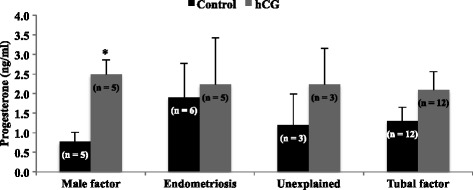
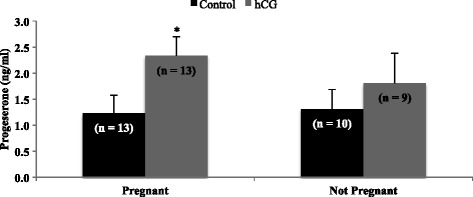
The AMPK activator, AICAR, inhibited P4 production (P < 0.001), whereas the AMPK inhibitor, DM, did not affect basal P4 (P < 0.05). Progesterone production increased when cells from patients whose primary cause of infertility was a partner having male infertility were treated with hCG compared to control (P = 0.0045), but not in patients with other primary infertility factors (P > 0.05). Additionally, hCG increased P4 production in patients between the ages 30-35 (P = 0.008) and 36-39 (P = 0.04), but not in patients ages 25-29 (P = 0.73). Patients with normal BMI had increased P4 production when treated with hCG (P < 0.0001), however there was no change in P4 production from cells of patients who were overweight or obese (P > 0.05). Cells from patients who became pregnant to IVF had greater P4 production when stimulated with hCG than those who did not become pregnant when compared to controls (P > 0.05).
Understanding how AMPK activation is regulated in ovarian cells could lead to alternative or novel infertility treatments. Human mural granulosa cells can serve as a valuable model for understanding how AMPK affects P4 production in steroidogenic cells. Additionally, when stimulated with hCG, P4 production by mural granulosa cells differed among infertility type, age, BMI, and pregnancy outcome.
来自体外受精(IVF)患者的壁颗粒细胞由西弗吉尼亚大学摩根敦生殖医学中心提供。分别研究了单磷酸腺苷激活蛋白激酶(AMPK)激活、不孕的主要原因、年龄、体重指数(BMI)和妊娠结局对孕酮产生的影响。
将来自IVF患者(n = 26)的分离壁层进行离心,弃去上清液,将沉淀重悬于500 μl DMEM/F12中。将壁颗粒细胞以每孔10,000个细胞接种,每个处理组一式三份,加入300 μl DMEM/F12培养基,在37°C、5%二氧化碳的湿度培养箱中培养以促进黄体化。初始接种4天后,细胞分别用AMPK抑制剂二甲双胍(DM)、AMPK激活剂AICAR或人绒毛膜促性腺激素(hCG)处理。处理后细胞培养24小时,收集培养基并在-20°C冷冻,直至通过放射免疫测定法检测孕酮(P4)。
AMPK激活剂AICAR抑制P4产生(P < 0.001),而AMPK抑制剂DM对基础P4无影响(P < 0.05)。与对照组相比,当不孕主要原因是配偶男性不育的患者细胞用hCG处理时,孕酮产生增加(P = 0.0045),但其他原发性不孕因素患者则不然(P > 0.05)。此外,hCG使30 - 35岁(P = 0.008)和36 - 39岁(P = 0.04)患者的P4产生增加,但25 - 29岁患者则无变化(P = 0.73)。BMI正常的患者用hCG处理时P4产生增加(P < 0.0001),然而超重或肥胖患者细胞的P4产生无变化(P > 0.05)。与对照组相比,IVF妊娠患者的细胞在用hCG刺激时比未妊娠患者产生更多的P4(P > 0.05)。
了解卵巢细胞中AMPK激活如何被调节可能会带来替代或新型的不孕治疗方法。人壁颗粒细胞可作为了解AMPK如何影响类固醇生成细胞中P4产生的有价值模型。此外,在用hCG刺激时,壁颗粒细胞的P4产生在不孕类型、年龄、BMI和妊娠结局方面存在差异。