Department of Hemato-Oncology, Chonnam National University Medical School, Gwangju, Republic of Korea.
Department of Nuclear Medicine, Chonnam National University Medical School, Gwangju, Republic of Korea.
Eur J Nucl Med Mol Imaging. 2018 Feb;45(2):170-178. doi: 10.1007/s00259-017-3836-8. Epub 2017 Sep 22.
Induction chemotherapy (ICT) with docetaxel, cisplatin, and 5-fluorouracil (TPF) followed by concurrent chemoradiotherapy (CCRT) has the advantages of organ preservation and systemic control in head and neck cancer (HNC). Early prediction of CCRT efficacy may help identify patients who will benefit more from surgery than from CCRT. We investigated the role of interim 18-fluoro-2-deoxy-glucose positron emission tomography computed tomography (FDG PET-CT) after ICT to predict the efficacy of CCRT and clinical outcomes.
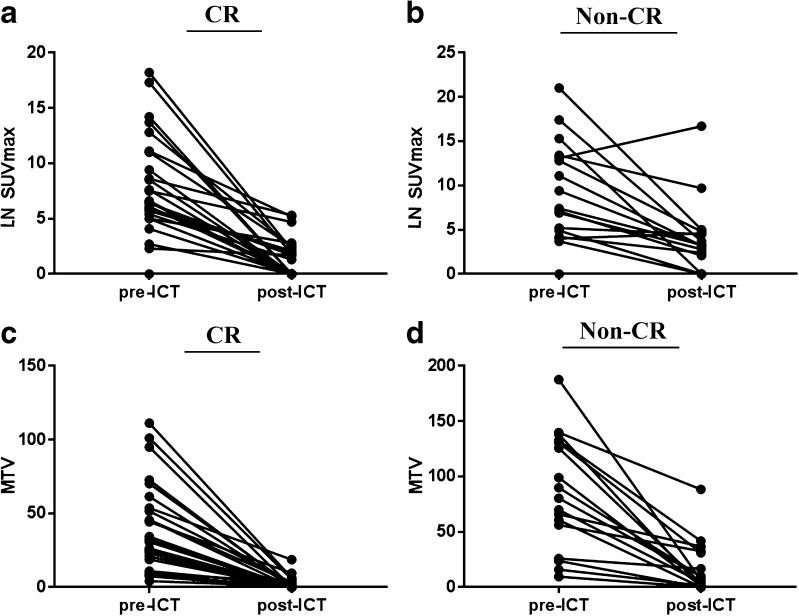
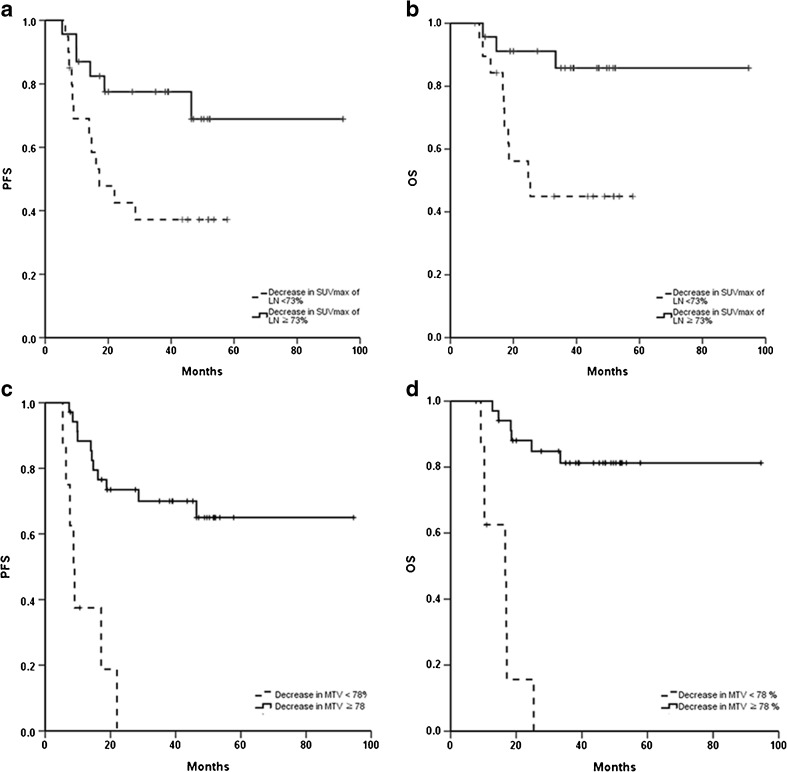
Tumor responses were retrospectively reviewed after CCRT based on the Response Evaluation Criteria in Solid Tumors. FDG PET-CT imaging was performed before and after three cycles of TPF. We examined the associations between the metabolic response (percentage decrease in the maximum standardized uptake value [SUVmax] and total metabolic tumor volume [MTV]) after ICT and complete response (CR) to CCRT, progression-free survival (PFS), and overall survival (OS).
We studied 43 HNC patients with a median follow-up of 32.7 months. Lymph node (LN) SUVmax and total MTV decreases from baseline after ICT were greater in patients with a CR to CCRT than in non-CR patients (LN SUVmax, 88.8% vs. 62.5%, respectively; total MTV, 99.7% vs. 89.9%, respectively). Decreases in total MTV ≥ 78% and LN SUVmax ≥73% after ICT predicted CR to CCRT and longer OS and PFS.
Using interim FDG PET-CT to measure SUVmax and total MTV after three cycles of ICT may be a useful technique for identifying HNC patients who will benefit from CCRT and predicting survival outcomes.
多西他赛、顺铂和 5-氟尿嘧啶(TPF)诱导化疗(ICT)联合同期放化疗(CCRT)在头颈部癌(HNC)中有保留器官和全身控制的优势。早期预测 CCRT 疗效可能有助于确定手术优于 CCRT 的患者。我们研究了 ICT 后中期 18-氟-2-脱氧葡萄糖正电子发射断层扫描计算机断层扫描(FDG PET-CT)在预测 CCRT 疗效和临床结果中的作用。
根据实体瘤反应评估标准,在 CCRT 后对肿瘤反应进行回顾性评估。在 TPF 三个周期前后进行 FDG PET-CT 成像。我们检查了 ICT 后代谢反应(最大标准化摄取值 [SUVmax]和总代谢肿瘤体积 [MTV]的百分比降低)与 CCRT 完全缓解(CR)、无进展生存期(PFS)和总生存期(OS)之间的关系。
我们研究了 43 例 HNC 患者,中位随访时间为 32.7 个月。CR 患者的淋巴结(LN)SUVmax 和总 MTV 比非 CR 患者降低更大(LN SUVmax,分别为 88.8%比 62.5%;总 MTV,分别为 99.7%比 89.9%)。ICT 后总 MTV 降低≥78%和 LN SUVmax 降低≥73%预测 CCRT 缓解和更长的 OS 和 PFS。
使用中期 FDG PET-CT 测量 ICT 三个周期后 SUVmax 和总 MTV 可能是一种有用的技术,可以识别从 CCRT 中获益并预测生存结果的 HNC 患者。