Evliyaoğlu Olcay, Ercan Oya, Ataoğlu Emel, Zübarioğlu Ümit, Özcabı Bahar, Dağdeviren Aydilek, Erdoğan Hande, De Franco Elisa, Ellard Sian
İstanbul University Cerrahpaşa Faculty of Medicine, Department of Pediatric Endocrinology, İstanbul, Turkey
University of Health Science, Haseki Training and Research Hospital, Newborn Intensive Unit, İstanbul, Turkey
J Clin Res Pediatr Endocrinol. 2018 Jun 1;10(2):168-174. doi: 10.4274/jcrpe.5162. Epub 2017 Sep 25.
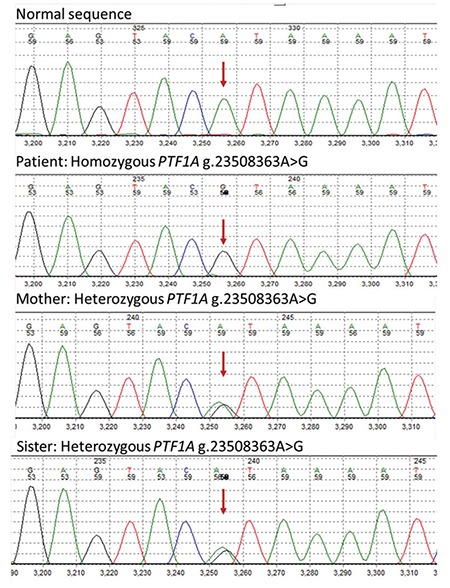
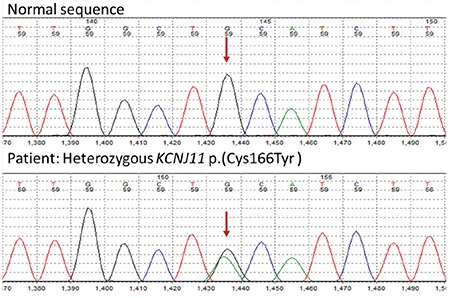
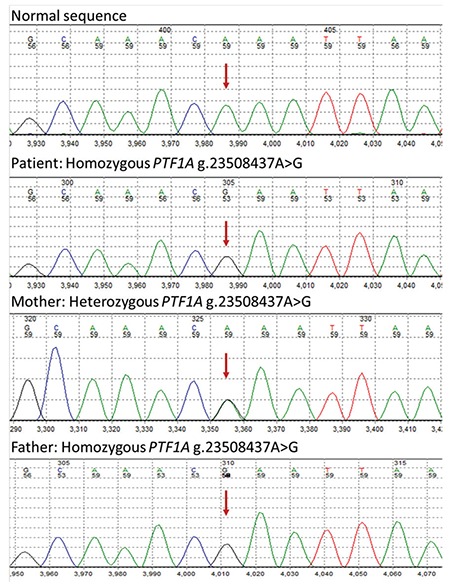
Neonatal diabetes mellitus is a rare form of monogenic diabetes which is diagnosed in the first six months of life. Here we report three patients with neonatal diabetes; two with isolated pancreas agenesis due to mutations in the pancreas-specific transcription factor 1A (PTF1A) enhancer and one with developmental delay, epilepsy, and neonatal diabetes (DEND) syndrome, due to a KCNJ11 mutation. The two cases with mutations in the distal enhancer of PTF1A had a homozygous g.23508363A>G and a homozygous g.23508437A>G mutation respectively. Previous functional analyses showed that these mutations can decrease expression of PTF1A which is involved in pancreas development. Both patients were born small for gestational age to consanguineous parents. Both were treated with insulin and pancreatic enzymes. One of these patients’ fathers was also homozygous for the PTF1A mutation, whilst his partner and the parents of the other patient were heterozygous carriers. In the case with DEND sydrome, a previosly reported heterozygous KCNJ11 mutation, p.Cys166Tyr (c.497G>A), was identified. This patient was born to nonconsanguineous parents with normal birth weight. The majority of neonatal diabetes patients with KCNJ11 mutations will respond to sulphonylurea treatment. Therefore Glibenclamide, an oral antidiabetic of the sulphonylurea group, was started. This treatment regimen relatively improved blood glucose levels and neurological symptoms in the short term. Because we could not follow the patient in the long term, we are not able to draw conclusions about the efficacy of the treatment. Although neonatal diabetes mellitus can be diagnosed clinically, genetic analysis is important since it is a guide for the treatment and for prognosis.
新生儿糖尿病是一种罕见的单基因糖尿病,在出生后的头六个月被诊断出来。在此,我们报告三例新生儿糖尿病患者;两例因胰腺特异性转录因子1A(PTF1A)增强子突变导致孤立性胰腺发育不全,一例因KCNJ11突变患有发育迟缓、癫痫和新生儿糖尿病(DEND)综合征。PTF1A远端增强子突变的两例患者分别有纯合的g.23508363A>G和纯合的g.23508437A>G突变。先前的功能分析表明,这些突变可降低参与胰腺发育的PTF1A的表达。两名患者均为近亲结婚父母的小于胎龄儿。两人均接受胰岛素和胰酶治疗。其中一名患者的父亲也是PTF1A突变的纯合子,而他的配偶和另一名患者的父母是杂合子携带者。在患有DEND综合征的病例中,鉴定出先前报道的杂合KCNJ11突变,p.Cys166Tyr(c.497G>A)。该患者出生于非近亲结婚的父母,出生体重正常。大多数患有KCNJ11突变的新生儿糖尿病患者对磺脲类药物治疗有反应。因此,开始使用磺脲类口服降糖药格列本脲。这种治疗方案在短期内相对改善了血糖水平和神经症状。由于我们无法长期随访该患者,因此无法得出关于治疗效果的结论。虽然新生儿糖尿病可以通过临床诊断,但基因分析很重要,因为它是治疗和预后的指导。