Murphy Nicholas J, Eyles Jillian, Bennell Kim L, Bohensky Megan, Burns Alexander, Callaghan Fraser M, Dickenson Edward, Fary Camdon, Grieve Stuart M, Griffin Damian R, Hall Michelle, Hobson Rachel, Kim Young Jo, Linklater James M, Lloyd David G, Molnar Robert, O'Connell Rachel L, O'Donnell John, O'Sullivan Michael, Randhawa Sunny, Reichenbach Stephan, Saxby David J, Singh Parminder, Spiers Libby, Tran Phong, Wrigley Tim V, Hunter David J
Kolling Institute of Medical Research, Institute of Bone and Joint Research, University of Sydney, Camperdown, Australia.
Department of Rheumatology, Royal North Shore Hospital, St Leonards, Australia.
BMC Musculoskelet Disord. 2017 Sep 26;18(1):406. doi: 10.1186/s12891-017-1767-y.
Femoroacetabular impingement syndrome (FAI), a hip disorder affecting active young adults, is believed to be a leading cause of hip osteoarthritis (OA). Current management approaches for FAI include arthroscopic hip surgery and physiotherapy-led non-surgical care; however, there is a paucity of clinical trial evidence comparing these approaches. In particular, it is unknown whether these management approaches modify the future risk of developing hip OA. The primary objective of this randomised controlled trial is to determine if participants with FAI who undergo hip arthroscopy have greater improvements in hip cartilage health, as demonstrated by changes in delayed gadolinium-enhanced magnetic resonance imaging (MRI) of cartilage (dGEMRIC) index between baseline and 12 months, compared to those who undergo physiotherapy-led non-surgical management.
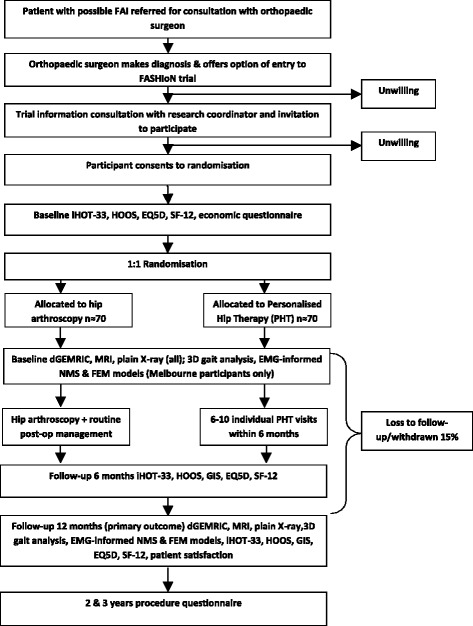
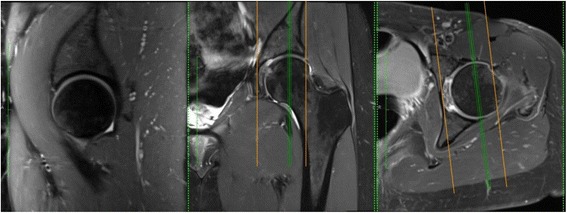
This is a pragmatic, multi-centre, two-arm superiority randomised controlled trial comparing hip arthroscopy to physiotherapy-led management for FAI. A total of 140 participants with FAI will be recruited from the clinics of participating orthopaedic surgeons, and randomly allocated to receive either surgery or physiotherapy-led non-surgical care. The surgical intervention involves arthroscopic FAI surgery from one of eight orthopaedic surgeons specialising in this field, located in three different Australian cities. The physiotherapy-led non-surgical management is an individualised physiotherapy program, named Personalised Hip Therapy (PHT), developed by a panel to represent the best non-operative care for FAI. It entails at least six individual physiotherapy sessions over 12 weeks, and up to ten sessions over six months, provided by experienced musculoskeletal physiotherapists trained to deliver the PHT program. The primary outcome measure is the change in dGEMRIC score of a ROI containing both acetabular and femoral head cartilages at the chondrolabral transitional zone of the mid-sagittal plane between baseline and 12 months. Secondary outcomes include patient-reported outcomes and several structural and biomechanical measures relevant to the pathogenesis of FAI and development of hip OA. Interventions will be compared by intention-to-treat analysis.
The findings will help determine whether hip arthroscopy or an individualised physiotherapy program is superior for the management of FAI, including for the prevention of hip OA.
Australia New Zealand Clinical Trials Registry reference: ACTRN12615001177549 . Trial registered 2/11/2015 (retrospectively registered).
股骨髋臼撞击综合征(FAI)是一种影响活跃年轻成年人的髋关节疾病,被认为是髋关节骨关节炎(OA)的主要原因。目前FAI的治疗方法包括关节镜下髋关节手术和以物理治疗为主的非手术治疗;然而,比较这些方法的临床试验证据很少。特别是,尚不清楚这些治疗方法是否会改变未来发生髋关节OA的风险。这项随机对照试验的主要目的是确定与接受以物理治疗为主的非手术治疗的参与者相比,接受髋关节镜检查的FAI参与者在髋关节软骨健康方面是否有更大改善,这通过基线和12个月之间软骨延迟钆增强磁共振成像(MRI)(dGEMRIC)指数的变化来证明。
这是一项实用的、多中心、双臂优效性随机对照试验,比较髋关节镜检查与以物理治疗为主的FAI治疗。将从参与研究的骨科医生诊所招募总共140名FAI参与者,并随机分配接受手术或以物理治疗为主的非手术治疗。手术干预包括由位于澳大利亚三个不同城市的八位专门从事该领域的骨科医生之一进行关节镜下FAI手术。以物理治疗为主的非手术治疗是一个个性化的物理治疗方案,名为个性化髋关节治疗(PHT),由一个小组制定,代表FAI的最佳非手术治疗。它需要在12周内至少进行六次个人物理治疗,在六个月内最多进行十次,由经过培训以实施PHT方案的经验丰富的肌肉骨骼物理治疗师提供。主要结局指标是在基线和12个月之间,中矢状面软骨唇过渡区包含髋臼和股骨头软骨的感兴趣区域(ROI)的dGEMRIC评分变化。次要结局包括患者报告的结局以及与FAI发病机制和髋关节OA发展相关的一些结构和生物力学指标。将通过意向性分析比较干预措施。
研究结果将有助于确定髋关节镜检查或个性化物理治疗方案在FAI管理(包括预防髋关节OA)方面是否更优。
澳大利亚新西兰临床试验注册中心编号:ACTRN12615001177549。试验于2015年11月2日注册(追溯注册)。