Faculty of Public Health and Policy, London School of Hygiene and Tropical Medicine, London, UK.
Wits Reproductive Health and HIV Institute, University of the Witwatersrand, Johannesburg, South Africa.
J Int AIDS Soc. 2017 Sep 20;20(1):21744. doi: 10.7448/IAS.20.1.21744.
Oral pre-exposure prophylaxis (PrEP) is a promising new prevention approach for those most at risk of HIV infection. However, there are concerns that behavioural disinhibition, specifically reductions in condom use, might limit PrEP's protective effect. This study uses the case of female sex workers (FSWs) in Johannesburg, South Africa, to assess whether decreased levels of condom use following the introduction of PrEP may limit HIV risk reduction.
We developed a static model of HIV risk and compared HIV-risk estimates before and after the introduction of PrEP to determine the maximum tolerated reductions in condom use with regular partners and clients for HIV risk not to change. The model incorporated the effects of increased STI exposure owing to decreased condom use. Noting that condom use with regular partners is generally low, we also estimated the change in condom use tolerated with clients only, to still achieve 50 and 90% risk reduction on PrEP. The model was parameterized using data from Hillbrow, Johannesburg. Sensitivity analyses were performed to ascertain the robustness of our results.
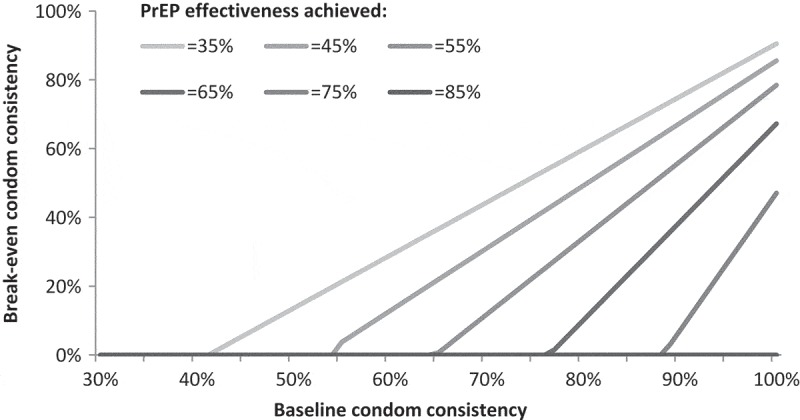
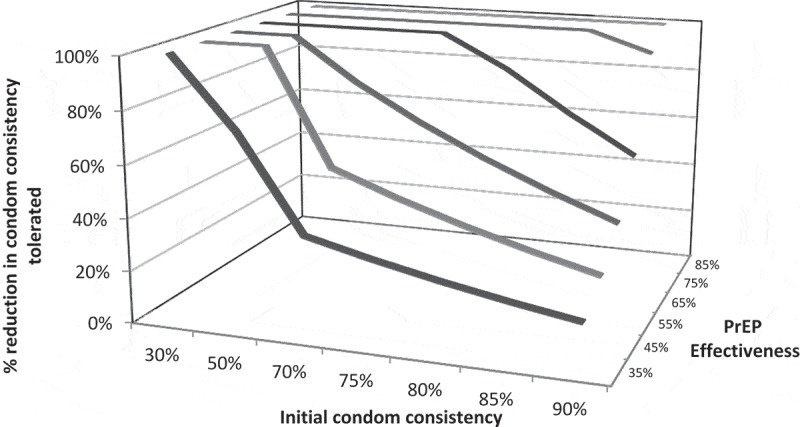
Reductions in condom use could be tolerated by FSWs with lower baseline condom use (65%). For scenarios where 75% PrEP effectiveness is attained, 50% HIV-risk reduction on PrEP would be possible even with 100% reduction in condom use from consistent condom use as high as 70% with clients. Increased exposure to STIs through reductions in condom use had limited effect on the reductions in condom use tolerated for HIV risk not to increase on PrEP.
PrEP is likely to be of benefit in reducing HIV risk, even if reductions in condom use do occur. Efforts to promote consistent condom use will be critical for FSWs with high initial levels of condom use, but with challenges in adhering to PrEP.
口服暴露前预防(PrEP)是一种针对最易感染 HIV 的人群的有前景的新预防方法。然而,人们担心行为抑制,特别是避孕套使用减少,可能会限制 PrEP 的保护效果。本研究以南非约翰内斯堡的性工作者(FSWs)为例,评估在 PrEP 引入后避孕套使用减少是否可能限制 HIV 风险降低。
我们开发了一种 HIV 风险的静态模型,并比较了 PrEP 引入前后的 HIV 风险估计,以确定在 HIV 风险不发生变化的情况下,与常规伴侣和客户发生性行为时可耐受的最大避孕套使用减少量。该模型纳入了由于避孕套使用减少而导致的性传播感染(STI)暴露增加的影响。鉴于与常规伴侣使用避孕套的情况普遍较低,我们还估计了仅与客户发生性行为时可耐受的避孕套使用减少量,以在 PrEP 上仍能实现 50%和 90%的风险降低。该模型使用来自约翰内斯堡希尔布劳的数据分析进行参数化。进行了敏感性分析以确定我们结果的稳健性。
基线避孕套使用率较低(65%)的 FSWs 可以耐受避孕套使用减少。对于达到 75%PrEP 有效性的情况,即使与客户发生性行为时避孕套使用率从高达 70%的持续使用减少 100%,仍有可能实现 PrEP 上 50%的 HIV 风险降低。由于避孕套使用减少而导致的 STI 暴露增加对 PrEP 上不增加 HIV 风险可耐受的避孕套使用减少量的影响有限。
即使避孕套使用减少,PrEP 也可能有助于降低 HIV 风险。促进与客户发生性行为时始终使用避孕套的努力对于初始避孕套使用率较高但坚持使用 PrEP 有挑战的 FSWs 至关重要。