Zapp Angela Alexandra, Fischer Eva Caroline, Deuschle Michael
Central Institute of Mental Health, Department of Psychiatry and Psychotherapy, University of Heidelberg, Faculty of Medicine Mannheim, J5, 68159, Mannheim, Germany.
University Hospital Würzburg, University of Würzburg, Würzburg, Germany.
J Med Case Rep. 2017 Sep 28;11(1):275. doi: 10.1186/s13256-017-1438-5.
Sleep-related eating may occur in the context of mental illness, sleep disorders, or psychopharmacological treatment. Frequently, sleep-related eating leads to severe weight gain and, so far, there are no treatment options for the condition.
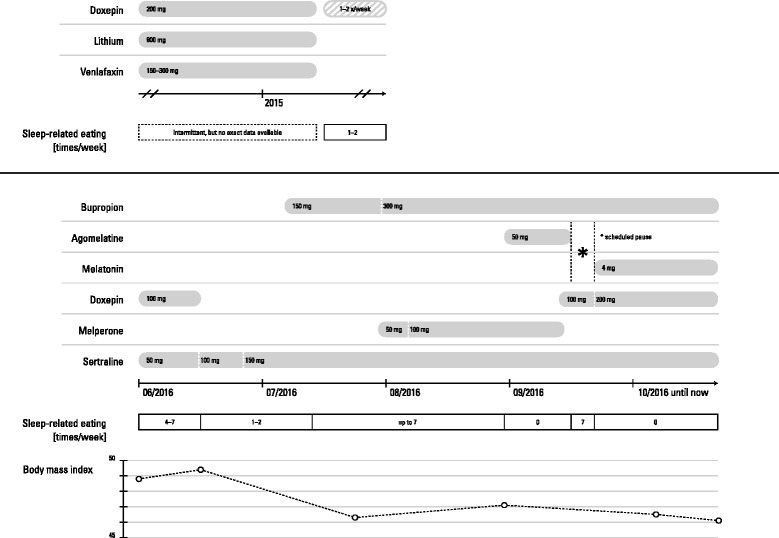
We report the case of a 54-year-old white woman with depression, panic disorder, and sleep apnea under treatment with various antidepressants who developed severe sleep-related eating. Her sleep-related eating completely vanished after addition of agomelatine, it reoccurred after cessation of agomelatine, and vanished again after her re-exposure to another melatonergic drug, extended melatonin.
This case suggests that melatonergic drugs lead to relief from sleep-related eating, even when the condition occurs in the context of physical and mental disorders as well as psychopharmacological treatment.
与睡眠相关的进食可能发生在精神疾病、睡眠障碍或心理药物治疗的背景下。通常,与睡眠相关的进食会导致严重体重增加,到目前为止,尚无针对该病症的治疗方法。
我们报告了一名54岁白人女性的病例,她患有抑郁症、惊恐障碍和睡眠呼吸暂停,正在接受多种抗抑郁药治疗,后来出现了严重的与睡眠相关的进食问题。在加用阿戈美拉汀后,她与睡眠相关的进食问题完全消失,停用阿戈美拉汀后又再次出现,在再次接触另一种褪黑素能药物——长效褪黑素后又再次消失。
该病例表明,即使与睡眠相关的进食发生在身心疾病以及心理药物治疗的背景下,褪黑素能药物也可缓解这一问题。