Department of Hypertensiology, Angiology and Internal Medicine, Poznań University of Medical Sciences, Długa 1/2 Str., 61-848, Poznan, Poland.
Cell Mol Life Sci. 2018 Feb;75(3):509-525. doi: 10.1007/s00018-017-2663-1. Epub 2017 Sep 27.
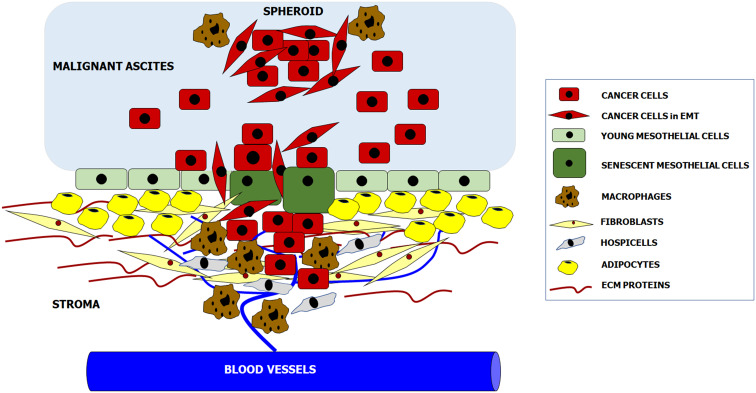
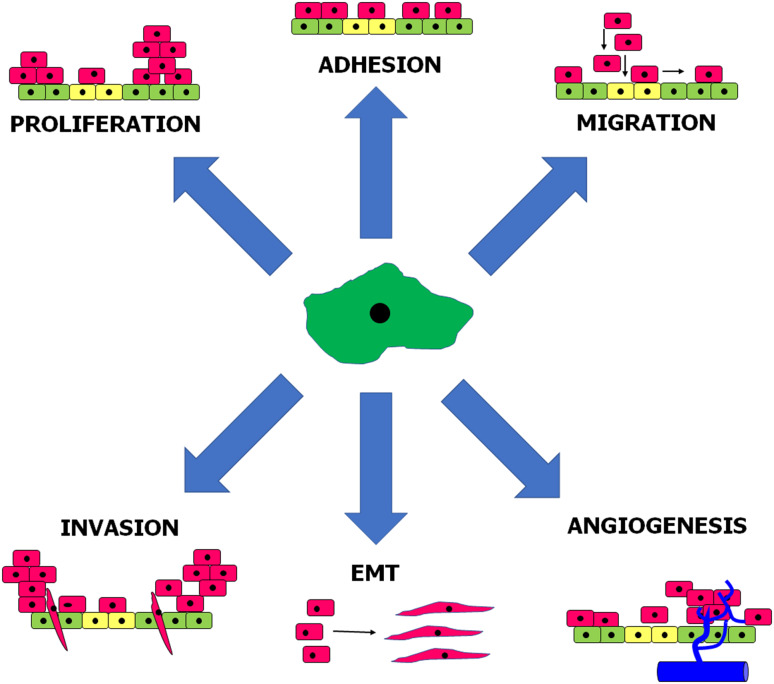
Various types of tumors, particularly those originating from the ovary and gastrointestinal tract, display a strong predilection for the peritoneal cavity as the site of metastasis. The intraperitoneal spread of a malignancy is orchestrated by a reciprocal interplay between invading cancer cells and resident normal peritoneal cells. In this review, we address the current state-of-art regarding colonization of the peritoneal cavity by ovarian, colorectal, pancreatic, and gastric tumors. Particular attention is paid to the pro-tumoral role of various kinds of peritoneal cells, including mesothelial cells, fibroblasts, adipocytes, macrophages, the vascular endothelium, and hospicells. Anatomo-histological considerations on the pro-metastatic environment of the peritoneal cavity are presented in the broader context of organ-specific development of distal metastases in accordance with Paget's "seed and soil" theory of tumorigenesis. The activity of normal peritoneal cells during pivotal elements of cancer progression, i.e., adhesion, migration, invasion, proliferation, EMT, and angiogenesis, is discussed from the perspective of well-defined general knowledge on a hospitable tumor microenvironment created by the cellular elements of reactive stroma, such as cancer-associated fibroblasts and macrophages. Finally, the paper addresses the unique features of the peritoneal cavity that predispose this body compartment to be a niche for cancer metastases, presents issues that are topics of an ongoing debate, and points to areas that still require further in-depth investigations.
各种类型的肿瘤,特别是源自卵巢和胃肠道的肿瘤,强烈倾向于将腹膜腔作为转移部位。恶性肿瘤的腹膜内扩散是由侵袭性癌细胞和驻留的正常腹膜细胞之间的相互作用协调的。在这篇综述中,我们讨论了卵巢癌、结直肠癌、胰腺癌和胃癌在腹膜腔内定植的最新进展。特别关注各种腹膜细胞,包括间皮细胞、成纤维细胞、脂肪细胞、巨噬细胞、血管内皮细胞和休眠细胞,对肿瘤的促瘤作用。根据 Paget 的肿瘤发生“种子与土壤”理论,在腹膜腔中有利于转移的环境的解剖组织学考虑,是在与器官特异性远处转移相关的更广泛背景下提出的。从反应性基质的细胞成分(如癌相关成纤维细胞和巨噬细胞)所创建的有利于肿瘤的微环境的明确的一般知识的角度,讨论了正常腹膜细胞在癌症进展的关键环节(即黏附、迁移、侵袭、增殖、EMT 和血管生成)中的活性。本文还讨论了腹膜腔的独特特征,这些特征使该体腔容易成为癌症转移的龛位,提出了正在讨论的问题,并指出了仍需要进一步深入研究的领域。