
跨膜螺旋是主要组织相容性复合体I类表位的一个被忽视的来源。
Transmembrane Helices Are an Overlooked Source of Major Histocompatibility Complex Class I Epitopes.
作者信息
Bianchi Frans, Textor Johannes, van den Bogaart Geert
机构信息
Department of Tumor Immunology, Radboud Institute for Molecular Life Sciences, Radboud University Medical Center, Nijmegen, Netherlands.
出版信息
Front Immunol. 2017 Sep 11;8:1118. doi: 10.3389/fimmu.2017.01118. eCollection 2017.
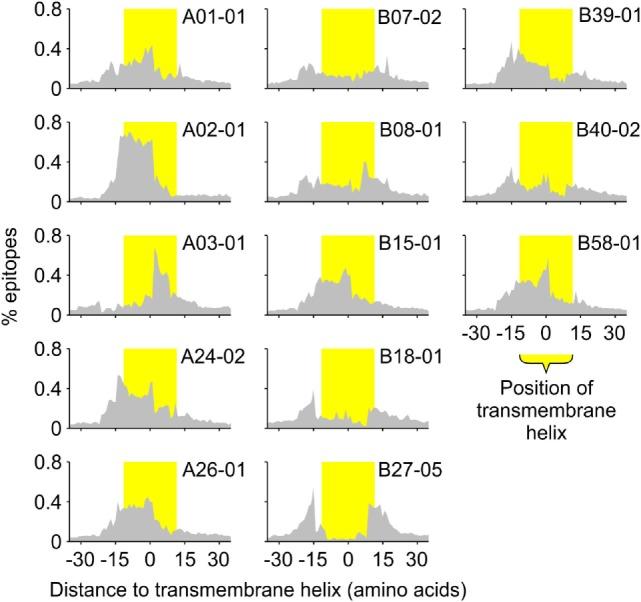
About a fourth of the human proteome is anchored by transmembrane helices (TMHs) to lipid membranes. TMHs require multiple hydrophobic residues for spanning membranes, and this shows a striking resemblance with the requirements for peptide binding to major histocompatibility complex (MHC) class I. It, therefore, comes as no surprise that bioinformatics analysis predicts an over-representation of TMHs among strong MHC class I (MHC-I) binders. Published peptide elution studies confirm that TMHs are indeed presented by MHC-I. This raises the question how membrane proteins are processed for MHC-I (cross-)presentation, with current research focusing on soluble antigens. The presentation of membrane-buried peptides is likely important in health and disease, as TMHs are considerably conserved and their presentation might prevent escape mutations by pathogens. Therefore, it could contribute to the disease correlations described for many human leukocyte antigen haplotypes.
约四分之一的人类蛋白质组通过跨膜螺旋(TMHs)锚定在脂质膜上。跨膜螺旋需要多个疏水残基来跨越膜,这与肽与主要组织相容性复合体(MHC)I类结合的要求惊人地相似。因此,生物信息学分析预测跨膜螺旋在强MHC I类(MHC-I)结合物中过度存在也就不足为奇了。已发表的肽洗脱研究证实跨膜螺旋确实由MHC-I呈递。这就提出了一个问题,即膜蛋白是如何被加工用于MHC-I(交叉)呈递的,目前的研究集中在可溶性抗原上。膜埋肽的呈递在健康和疾病中可能很重要,因为跨膜螺旋相当保守,它们的呈递可能会阻止病原体的逃逸突变。因此,它可能与许多人类白细胞抗原单倍型所描述的疾病相关性有关。



 Zotero 插件