Xu Ying, Liu Yu, Zhao Miaoxian, Chen Yunqing, Xie Cantao, Gong Mingxing, Deng Haohui, Li Xueying, Sun Jian, Hou Jinlin, Wu Hongkai, Wang Zhanhui
State Key Laboratory of Organ Failure Research, Guangdong Provincial Key Laboratory of Viral Hepatitis Research, Department of Infectious Diseases and Hepatology Unit, Nanfang Hospital, Southern Medical University, Guangzhou, China.
Department of Infectious Diseases, The First Hospital of Jiaxing, Jiaxing, China.
Front Immunol. 2017 Sep 14;8:1142. doi: 10.3389/fimmu.2017.01142. eCollection 2017.
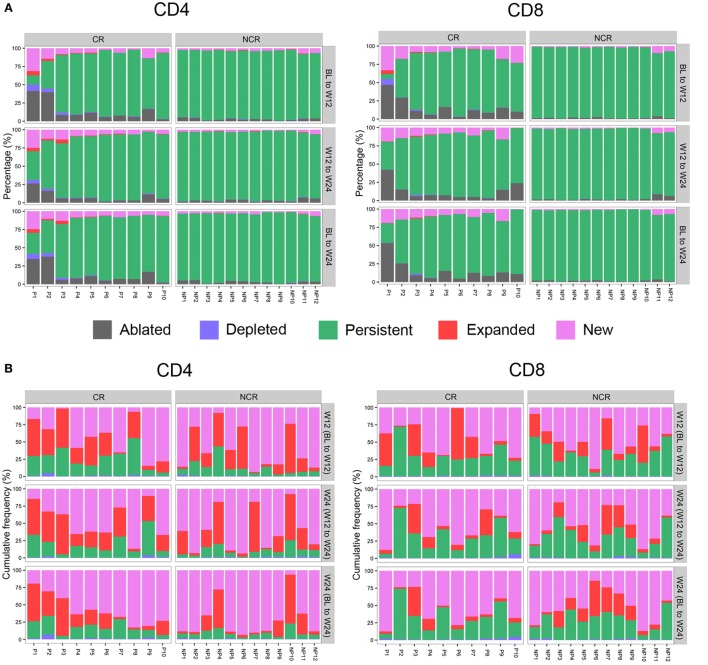
Long-term treatment with nucleos(t)ide analogs (NUCs) can improve the antiviral T cell response in chronic hepatitis B (CHB) patients. Whether and to what extent the T cell response is improved by NUCs in the early stage leading to hepatitis B e antigen (HBeAg) seroconversion remain to be clarified. A total of 22 CHB patients undergoing 2-year telbivudine-based therapy were enrolled, including 10 exhibiting a complete response (CR) and 12 exhibiting a non-complete response (NCR) according to HBeAg seroconversion at week 52. Peripheral CD4 and CD8 T cells were sorted at baseline, weeks 12, and 24. The T cell receptor β chain (TCRβ) complementarity-determining region 3 was analyzed by unbiased high-throughput sequencing. Compared with NCR group, patients in CR group had a much lower percentage of persistent clonotypes ( < 0.001) but remarkably higher percentages of new and expanded clonotypes ( < 0.05) between any two time points for both CD4 and CD8 subsets. The CD4 T cells exhibited a stronger response than CD8 population in the patients. The number of new and expanded clonotypes was inversely associated with the decline of viral antigen. In conclusion, NUC-based therapy induces a broad and vigorous T cell response with rapid decline of antigenemia during the early stage of treatment. A broad T cell expansion is crucial for HBeAg seroconversion. Our findings suggest that the potent suppression of hepatitis B virus replication by NUC monotherapy complemented with additional immunomodulatory strategies may increase the likelihood of a functional cure for CHB in the future.
核苷酸类似物(NUCs)长期治疗可改善慢性乙型肝炎(CHB)患者的抗病毒T细胞反应。在导致乙肝e抗原(HBeAg)血清学转换的早期阶段,NUCs是否以及在何种程度上改善T细胞反应仍有待阐明。本研究共纳入22例接受基于替比夫定的2年治疗的CHB患者,根据第52周时的HBeAg血清学转换情况,其中10例表现为完全应答(CR),12例表现为不完全应答(NCR)。在基线、第12周和第24周对外周血CD4和CD8 T细胞进行分选。通过无偏倚高通量测序分析T细胞受体β链(TCRβ)互补决定区3。与NCR组相比,CR组患者在CD4和CD8亚群的任意两个时间点之间,持续克隆型的百分比要低得多(<0.001),但新出现和扩增的克隆型百分比显著更高(<0.05)。患者的CD4 T细胞比CD8群体表现出更强的反应。新出现和扩增的克隆型数量与病毒抗原的下降呈负相关。总之,基于NUCs的治疗在治疗早期可诱导广泛而强烈的T细胞反应,并使抗原血症迅速下降。广泛的T细胞扩增对于HBeAg血清学转换至关重要。我们的研究结果表明,NUC单药治疗有效抑制乙肝病毒复制,并辅以额外的免疫调节策略,可能会增加未来CHB功能性治愈的可能性。