Zhang Tingting, Kingwell Elaine, Zhu Feng, Petkau John, Kastrukoff Lorne F, Marrie Ruth Ann, Tremlett Helen, Evans Charity
Department of Health Services, Policy and Practice, Brown University School of Public Health, Providence, Rhode Island, USA.
Department of Medicine (Neurology) and the Centre for Brain Health, University of British Columbia, Columbia, Canada.
BMJ Open. 2017 Sep 29;7(9):e018612. doi: 10.1136/bmjopen-2017-018612.
To examine the association between optimal adherence to the first-generation injectable immunomodulatory drugs (IMDs) for multiple sclerosis (MS) and subsequent disability accumulation.
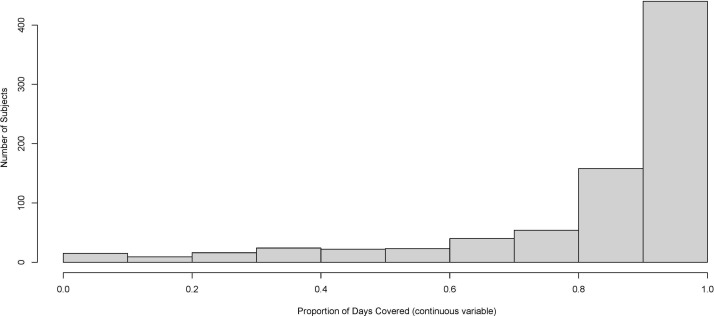
We accessed prospectively collected linked clinical and administrative health data from British Columbia, Canada. Subjects with MS treated with a first-generation injectable IMD at an MS clinic (1996-2004) were followed until their last clinic visit before 2009. Adherence was estimated using the proportion of days covered (PDC). The primary outcome was disability accumulation, defined as an increase in the Expanded Disability Status Scale (EDSS) score as recorded during each year of follow-up. Generalised estimating equation models, adjusted for baseline sex, age, EDSS and time between scores, were used to measure associations between optimal adherence (≥80% PDC) during the first year of treatment and subsequent disability accumulation. The relationship between early IMD adherence and the secondary outcome, time to sustained EDSS 6, was examined using Cox proportional hazards regression.
Among 801 subjects, 598 (74.7%) had optimal adherence over the first year of IMD treatment and 487 (39.0%) demonstrated one or more instances of disability accumulation. Early optimal adherence was not associated with disability accumulation (adjusted OR 0.94; 95% CI 0.78 to 1.15), nor with time to sustained EDSS 6 (adjusted HR 0.91; 95% CI 0.57 to 1.44).
Almost three-quarters of subjects with MS had optimal early adherence to their first-line injectable IMD. There was no evidence that this was associated with disability accumulation in the following years.
研究多发性硬化症(MS)患者对第一代注射用免疫调节药物(IMD)的最佳依从性与随后残疾累积之间的关联。
我们获取了加拿大不列颠哥伦比亚省前瞻性收集的关联临床和行政健康数据。在MS诊所接受第一代注射用IMD治疗的MS患者(1996 - 2004年)随访至2009年之前的最后一次诊所就诊。使用覆盖天数比例(PDC)估算依从性。主要结局是残疾累积,定义为随访每年记录的扩展残疾状态量表(EDSS)评分增加。使用广义估计方程模型,对基线性别、年龄、EDSS和评分间隔时间进行调整,以测量治疗第一年的最佳依从性(≥80% PDC)与随后残疾累积之间的关联。使用Cox比例风险回归研究早期IMD依从性与次要结局(持续EDSS 6的时间)之间的关系。
在801名受试者中,598名(74.7%)在IMD治疗的第一年有最佳依从性,487名(39.0%)出现了一次或多次残疾累积情况。早期最佳依从性与残疾累积无关(调整后的OR为0.94;95% CI为0.78至1.15),也与持续EDSS 6的时间无关(调整后的HR为0.91;95% CI为0.57至1.44)。
近四分之三的MS患者对一线注射用IMD有最佳早期依从性。没有证据表明这与随后几年的残疾累积有关。