Chen Li-Min, Song Tian-Jiao, Xiao Jian-Hong, Huang Zheng-Hui, Li Yong, Lin Ting-Yan
Department of Respiratory Medicine, Fujian Medical University Union Hospital, Fuzhou, Fujian 350001, People's Republic of China.
Department of Geriatrics, Fujian Medical University Union Hospital, Fuzhou, Fujian 350001, People's Republic of China.
Oncotarget. 2017 Jul 12;8(38):63911-63922. doi: 10.18632/oncotarget.19201. eCollection 2017 Sep 8.
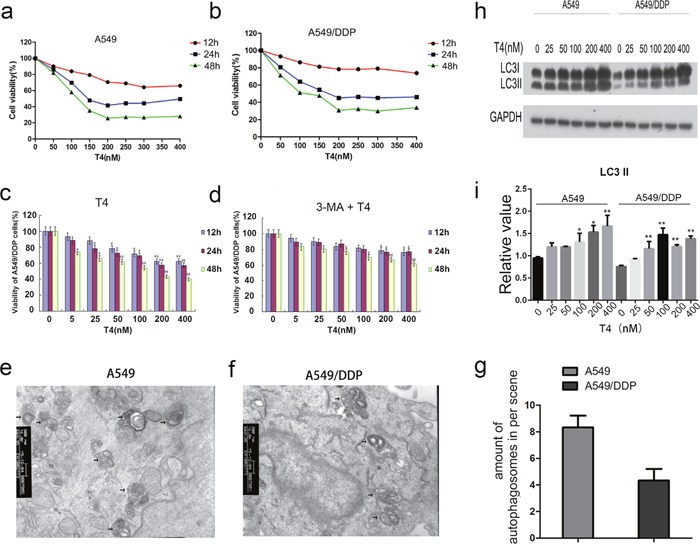
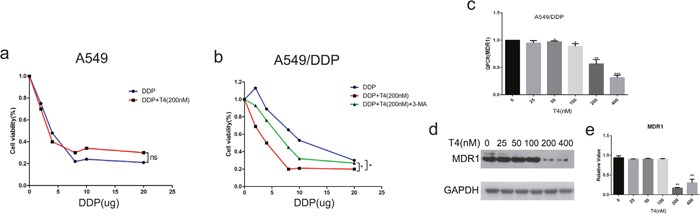
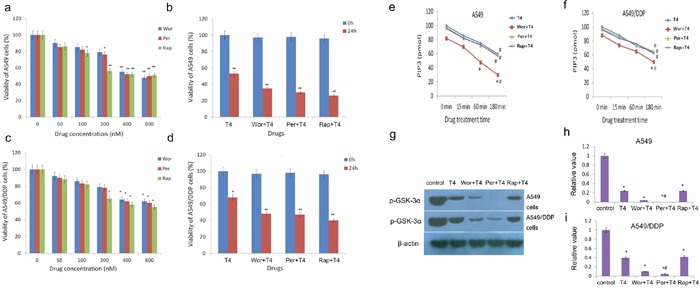
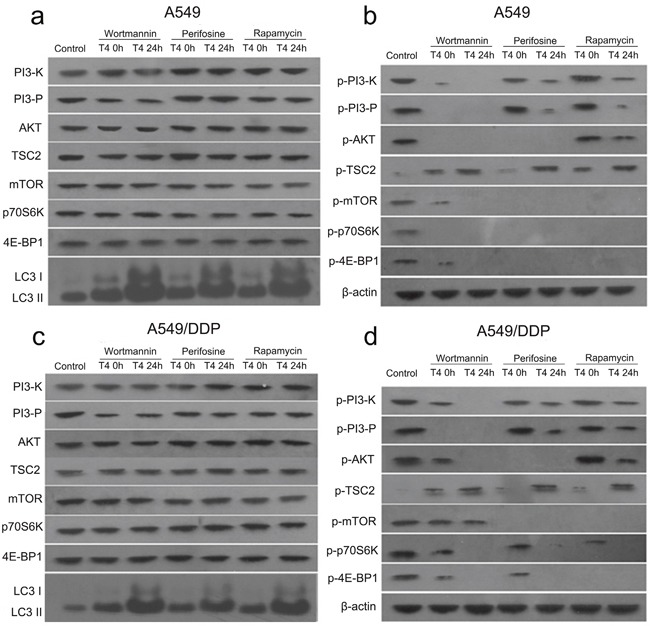
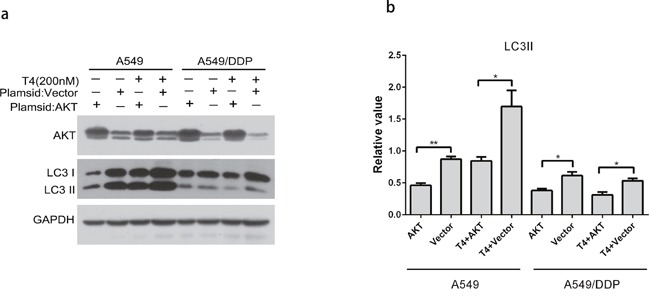
Tripchlorolide (T4) has been shown to induce A549 lung cancer cell death predominantly by activating an autophagy pathway. However, the underlying mechanism remains unclear. Herein, we demonstrated that compared with T4 treatment alone, pretreatment with wortmannin (an inhibitor of phosphatidylinositol 3-kinase), perifosine (an inhibitor of AKT) or rapamycin (an inhibitor of mTOR) combined with a subsequent T4 treatment significantly impaired the cell viability of A549 and A549/DDP lung cancer cells. We found that either treatment scheme markedly reduced the activity of P13K and AKT. Expression of LC3II increased in parallel to the increase of the T4 concentration in both A549 and A549/DDP cells and was repressed by overexpression of AKT. The expression levels of PI3-K, PI3-P, AKT, TSC2, mTOR, p70S6K and 4E-BP1 were minimally affected by the wortmannin, perifosine, or rapamycin plus T4 treatments, but their phosphorylated products were greatly affected in A549 lung cancer cells and slightly affected in A549/DDP lung cancer cells. These results indicate that T4 induces autophagy in lung cancer cells by inhibiting the PI3K/AKT/mTOR signaling pathway. We further found that T4 decreased expression of MDR1 and improved cisplatin sensitivity of A549/DDP cells. Altogether, these results have meaningful implications for tumor therapy in the future.
雷公藤氯内酯醇(T4)已被证明主要通过激活自噬途径诱导A549肺癌细胞死亡。然而,其潜在机制仍不清楚。在此,我们证明,与单独使用T4处理相比,用渥曼青霉素(磷脂酰肌醇3激酶抑制剂)、哌立福新(AKT抑制剂)或雷帕霉素(mTOR抑制剂)预处理并随后进行T4处理,显著损害了A549和A549/DDP肺癌细胞的细胞活力。我们发现,这两种处理方案均显著降低了P13K和AKT的活性。在A549和A549/DDP细胞中,LC3II的表达均随T4浓度的增加而平行增加,并被AKT的过表达所抑制。渥曼青霉素、哌立福新或雷帕霉素加T4处理对PI3-K、PI3-P、AKT、TSC2、mTOR、p70S6K和4E-BP1的表达水平影响最小,但它们的磷酸化产物在A549肺癌细胞中受到极大影响,而在A549/DDP肺癌细胞中受到轻微影响。这些结果表明,T4通过抑制PI3K/AKT/mTOR信号通路诱导肺癌细胞自噬。我们进一步发现,T4降低了MDR1的表达,并提高了A549/DDP细胞对顺铂的敏感性。总之,这些结果对未来的肿瘤治疗具有重要意义。