Wolfson Centre for Age-Related Diseases, Institute of Psychiatry, Psychology and Neuroscience, King's College London, London, UK.
Br J Pharmacol. 2017 Dec;174(24):4812-4825. doi: 10.1111/bph.14063. Epub 2017 Oct 29.
Bortezomib (Velcade®) is a breakthrough treatment for multiple myeloma, significantly improving patient survival. However, its use is limited by painful neuropathy often resulting in dose reduction/cessation of first-line treatment due to lack of treatment. The aim of this study was to characterize a clinically relevant rat model of bortezomib-induced painful neuropathy, using established evoked measures and novel ethological techniques, to aid drug discovery.
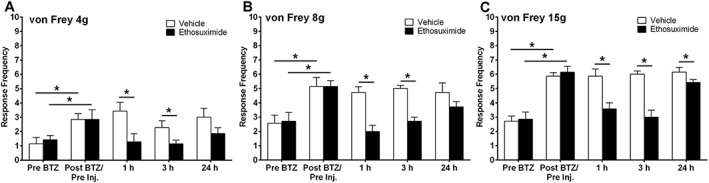
Adult male Sprague-Dawley rats were injected i.p. with 0.1 and 0.2 mg·kg bortezomib, or its vehicle, on days 0, 3, 7 and 10. Multiple behavioural approaches were utilized: mechanical hypersensitivity, cold allodynia, heat hypersensitivity, motor co-ordination, burrowing and voluntary wheel running. At maximal bortezomib-induced mechanical hypersensitivity, 200 mg·kg ethosuximide/vehicle and 100 mg·kg phenyl N-tert-butylnitrone (PBN)/vehicle were administered i.p. in separate experiments, and mechanical hypersensitivity assessed 1, 3 and 24 h later.
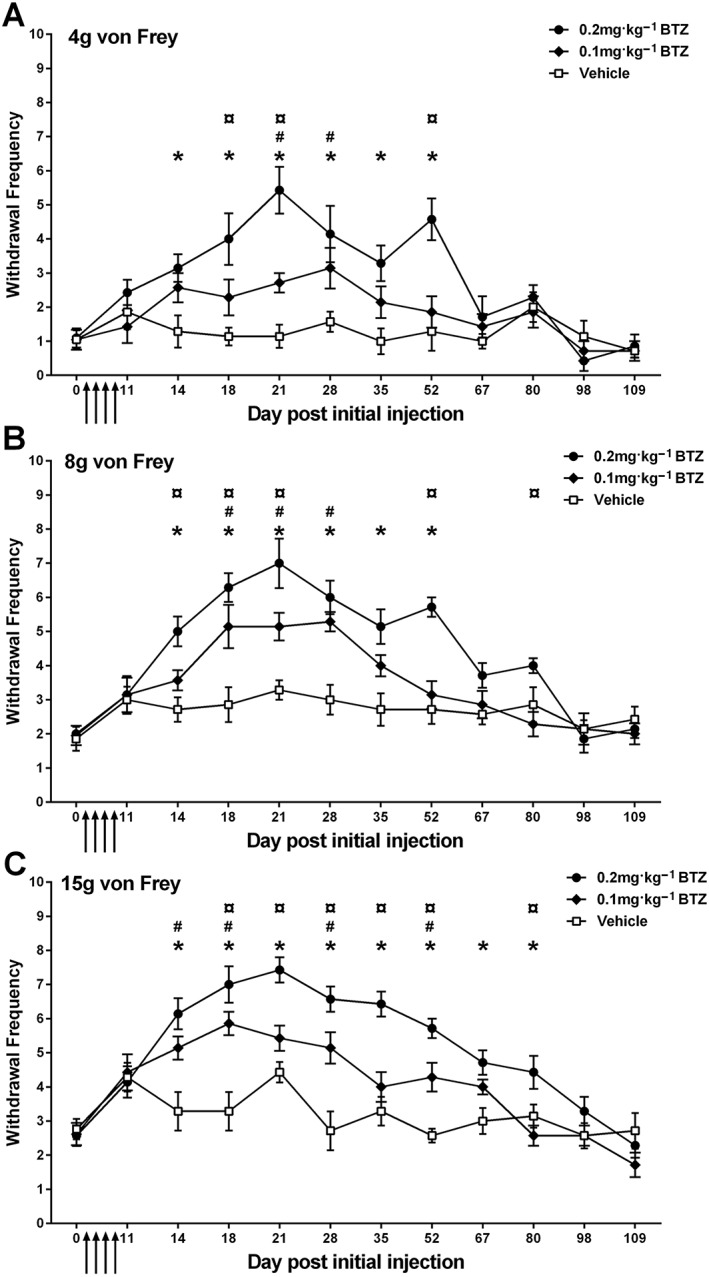
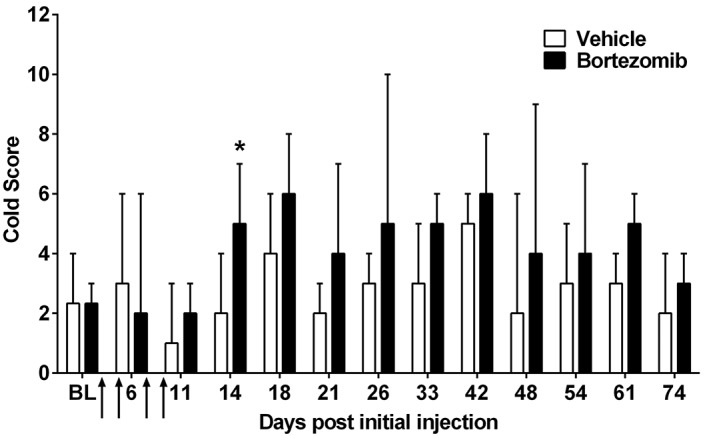
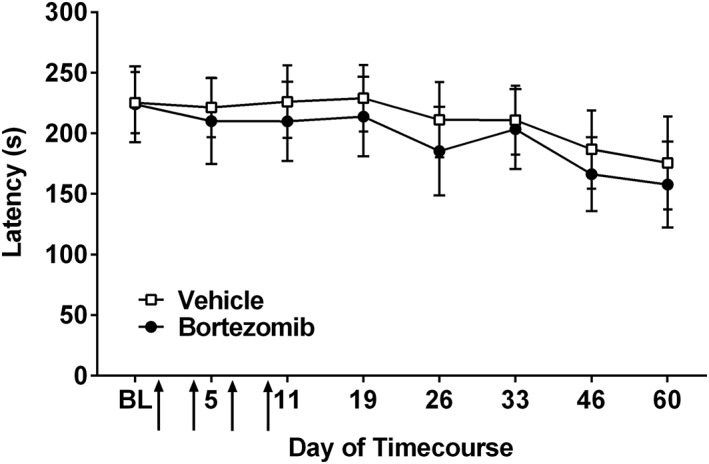
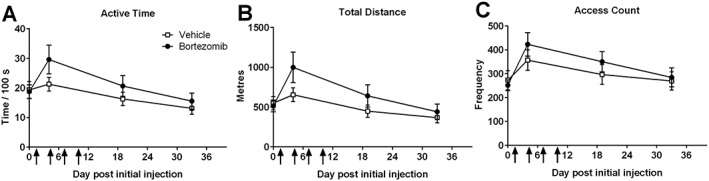
Bortezomib induced dose-related mechanical hypersensitivity for up to 80 days. Bortezomib induced short-term cold allodynia, but no significant change in heat hypersensitivity, motor co-ordination, voluntary wheel running and burrowing behaviour compared to vehicle-treated controls. Systemic PBN and ethosuximide significantly ameliorated bortezomib-induced mechanical hypersensitivity.
These data characterize a reproducible rat model of clinical-grade bortezomib-induced neuropathy demonstrating long-lasting pain behaviours to evoked stimuli. Inhibition by ethosuximide and PBN suggests involvement of calcium and/or ROS in bortezomib-induced painful neuropathy. These drugs could be used as preclinical positive controls to assess novel analgesics. As ethosuximide is widely used clinically, translation to the clinic to treat bortezomib-induced painful neuropathy may be possible.
硼替佐米(万珂)是多发性骨髓瘤的突破性治疗方法,显著提高了患者的生存率。然而,由于缺乏治疗方法,其使用受到常导致剂量减少/停止一线治疗的疼痛性神经病的限制。本研究的目的是使用已建立的诱发测量和新的行为技术来表征硼替佐米诱导的疼痛性神经病的临床相关大鼠模型,以辅助药物发现。
成年雄性 Sprague-Dawley 大鼠在 0、3、7 和 10 天腹腔注射 0.1 和 0.2 mg·kg 硼替佐米或其载体。利用多种行为方法:机械性超敏反应、冷感觉过敏、热感觉过敏、运动协调、挖掘和自愿轮跑。在最大的硼替佐米诱导的机械性超敏反应时,在单独的实验中腹腔注射 200 mg·kg 乙琥胺/载体和 100 mg·kg 对叔丁基硝酮(PBN)/载体,并在 1、3 和 24 小时后评估机械性超敏反应。
硼替佐米诱导剂量相关的机械性超敏反应长达 80 天。硼替佐米诱导短暂的冷感觉过敏,但与载体处理的对照组相比,对热感觉过敏、运动协调、自愿轮跑和挖掘行为没有显著变化。系统给予 PBN 和乙琥胺可显著改善硼替佐米诱导的机械性超敏反应。
这些数据描述了一种可重现的临床级硼替佐米诱导的神经病大鼠模型,该模型表现出对诱发刺激的持久疼痛行为。乙琥胺和 PBN 的抑制作用表明钙和/或 ROS 参与了硼替佐米诱导的疼痛性神经病。这些药物可作为临床前阳性对照物,用于评估新型镇痛药。由于乙琥胺在临床上广泛应用,因此可能可以将其转化为治疗硼替佐米诱导的疼痛性神经病的临床方法。