Amselem S, Nunes V, Vidaud M, Estivill X, Wong C, d'Auriol L, Vidaud D, Galibert F, Baiget M, Goossens M
INSERM U.91 Hôpital Henri Mondor, Créteil, France.
Am J Hum Genet. 1988 Jul;43(1):95-100.
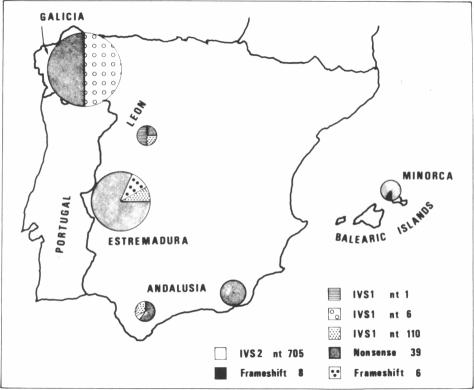
We have delineated the molecular lesions causing beta-thalassemia in Spain, a country that has witnessed the passage of different Mediterranean populations over the centuries, in order to evaluate the extent of heterogeneity of these mutations and to make possible simplified prenatal diagnosis of the disorder in that country. The use of the polymerase chain-reaction (PCR) technique to preferentially amplify beta-globin DNA sequences that contain the most frequent beta-thalassemia mutations in Mediterraneans enabled us to rapidly analyze 58 beta-thalassemia alleles in a dot-blot format either by hybridization with allele-specific radiolabeled oligonucleotide probes or by direct sequence analysis of the amplification product. The Spanish population carries seven different beta-thalassemia mutations; the nonsense codon 39 is predominant (64%), whereas the IVS1 position 110 mutation, the most common cause of beta-thalassemia in the eastern part of the Mediterranean basin, is underrepresented (8.5%). The IVS1 mutation at position 6 accounts for 15% of the defects and leads to a more severe form of beta+-thalassemia than originally described in most of the patients we studied. In this study, we demonstrate further the usefulness of the dot-blot hybridization of PCR-amplified genomic DNA in both rapid population surveys and prenatal diagnosis of beta-thalassemia.
我们已经明确了西班牙β地中海贫血的分子病变情况。在过去几个世纪里,西班牙见证了不同地中海人群的迁徙。目的是评估这些突变的异质性程度,并使该国β地中海贫血的简化产前诊断成为可能。利用聚合酶链反应(PCR)技术优先扩增包含地中海地区最常见β地中海贫血突变的β珠蛋白DNA序列,使我们能够通过与等位基因特异性放射性标记寡核苷酸探针杂交或对扩增产物进行直接序列分析,以斑点杂交形式快速分析58个β地中海贫血等位基因。西班牙人群携带七种不同的β地中海贫血突变;无义密码子39占主导地位(64%),而在地中海盆地东部β地中海贫血最常见病因的IVS1第110位突变占比相对较少(8.5%)。IVS1第6位突变占缺陷的15%,并且在我们研究的大多数患者中导致了比最初描述的更严重形式的β+地中海贫血。在本研究中,我们进一步证明了PCR扩增基因组DNA的斑点杂交在β地中海贫血快速人群调查和产前诊断中的实用性。