Jiang Wen, Liu Ke, Guo Qing, Cheng Ji, Shen Liming, Cao Yinghao, Wu Jing, Shi Jianguo, Cao Heng, Liu Bo, Tao Kaixiong, Wang Guobin, Cai Kailin
Department of Gastrointestinal Surgery, Union Hospital, Tongji Medical College, Huazhong University of Science and Technology, Wuhan, China.
Department of Pediatrics, Union Hospital, Tongji Medical College, Huazhong University of Science and Technology, Wuhan, China.
Oncotarget. 2017 May 3;8(37):62312-62329. doi: 10.18632/oncotarget.17602. eCollection 2017 Sep 22.
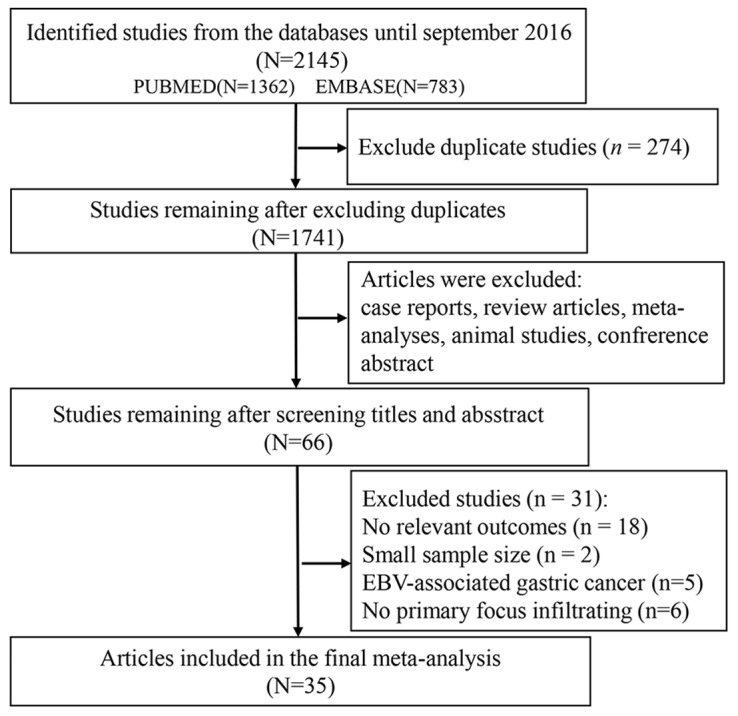
Tumor-infiltrating immune cells are a pivotal component of the tumor microenvironment (TME), but their indicative role remains poorly defined. A meta-analysis was performed to reveal the prognostic efficiency of tumor-infiltrating immune cells in gastric cancer (GC). By searching PubMed and Embase, we identified a total of 35 eligible articles that involved 4888 patients. Random or fixed effect models were employed to extract pooled hazard ratios (HRs) with 95% confidence intervals (CIs). Our results indicated that high CD3+ lymphocyte infiltration in all the locations (AG), the tumor nest (TN), and the tumor stroma (TS) predicted better overall survival (OS) (HR=0.71, 95% CI=0.57-0.90; HR=0.58, 95% CI=0.42-0.80; and HR=0.50, 95% CI=0.37-0.68, respectively). CD8+ T cell infiltration in AG and FoxP3+ regulatory T cells (Tregs) in the tumor invasive margin (TM) were also associated with improved OS (HR=0.90, 95% CI=0.83-0.97; HR=0.65, 95% CI=0.48-0.87, respectively). However, contrasting results were found in the macrophage subset, with M2 in AG (HR=1.45, 95% CI=1.13-1.86) and the TN (HR=1.67, 95% CI=1.12-2.48) associated with worse OS. In summary, the combination of the densities and locations of tumor-infiltrating immune cells can be useful for predicting survival for GC patients, but additional research is needed to reinforce the reliability of this study's conclusions.
肿瘤浸润性免疫细胞是肿瘤微环境(TME)的关键组成部分,但其指示作用仍不明确。进行了一项荟萃分析以揭示肿瘤浸润性免疫细胞在胃癌(GC)中的预后效能。通过检索PubMed和Embase,我们共确定了35篇符合条件的文章,涉及4888例患者。采用随机或固定效应模型提取合并风险比(HRs)及95%置信区间(CIs)。我们的结果表明,所有部位(AG)、肿瘤巢(TN)和肿瘤基质(TS)中高CD3+淋巴细胞浸润预示着更好的总生存期(OS)(HR = 0.71,95% CI = 0.57 - 0.90;HR = 0.58,95% CI = 0.42 - 0.80;以及HR = 0.50,95% CI = 0.37 - 0.68)。AG中的CD8+ T细胞浸润和肿瘤浸润边缘(TM)中的FoxP3+调节性T细胞(Tregs)也与OS改善相关(HR = 0.90,95% CI = 0.83 - 0.97;HR = 0.65,95% CI = 0.48 - 0.87)。然而,在巨噬细胞亚群中发现了相反的结果,AG中的M2(HR = 1.45,95% CI = 1.13 - 1.86)和TN中的M2(HR = 1.67,95% CI = 1.12 - 2.48)与更差的OS相关。总之,肿瘤浸润性免疫细胞的密度和位置的组合可用于预测GC患者的生存期,但需要更多研究来加强本研究结论的可靠性。