
超重和肥胖对慢性阻塞性肺疾病急性加重的影响——台湾阻塞性肺病队列的亚组分析
Impact of overweight and obesity on acute exacerbations of COPD - subgroup analysis of the Taiwan Obstructive Lung Disease cohort.
作者信息
Wei Yu-Feng, Tsai Ying-Huang, Wang Chin-Chou, Kuo Ping-Hung
机构信息
Department of Internal Medicine, E-Da Hospital, I-Shou University, Kaohsiung.
Institute of Biotechnolog and Chemical Engineering, I-Shou University, Kaohsiung.
出版信息
Int J Chron Obstruct Pulmon Dis. 2017 Sep 12;12:2723-2729. doi: 10.2147/COPD.S138571. eCollection 2017.
PURPOSE
A low body mass index (BMI) is a poor prognostic marker of acute exacerbations and mortality in patients with COPD. However, the impact of overweight and obesity on COPD-related outcomes is uncertain. The aim of this study was to examine whether a high BMI is associated with the frequent exacerbator phenotype (≥2/year) in Taiwanese patients with COPD.
PATIENTS AND METHODS
Data were obtained from the Taiwan Obstructive Lung Disease study, a retrospective, observational nationwide survey of COPD patients conducted at 12 hospitals in Taiwan. Multivariate logistic regression models were used to explore the association between BMI and other factors with the frequency of COPD exacerbations in these patients.
RESULTS
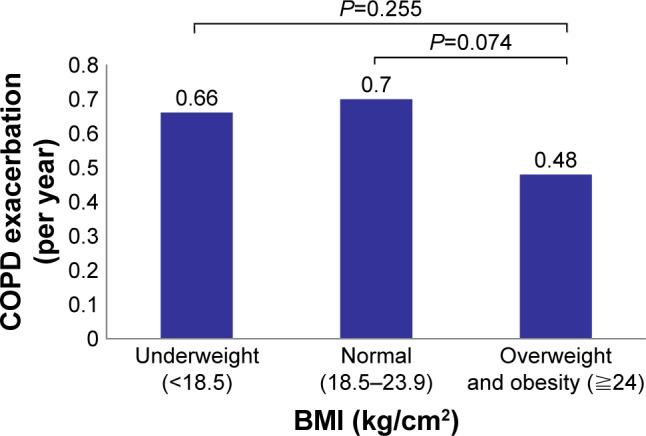
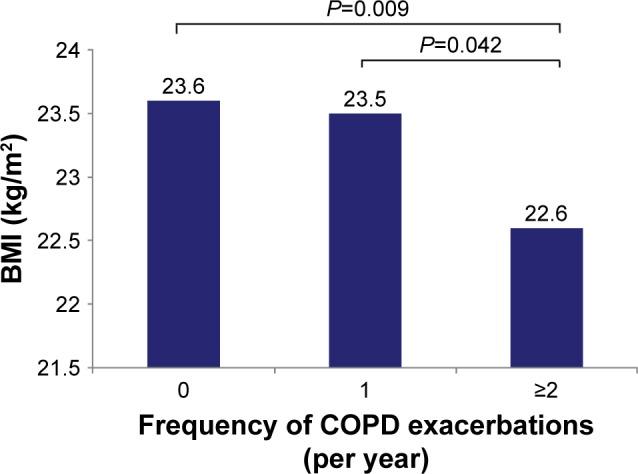
Among the whole study cohort (n=1,096), 735 (67.1%) had no exacerbations and 148 (13.5%) were frequent exacerbators in the previous year. The BMI values of the patients with 0, 1, and ≥2 exacerbations were 23.6, 23.5, and 22.6 kg/m, respectively. In all, 256 (23.4%) and 196 (17.9%) patients were overweight (27 kg/m > BMI ≥24 kg/m) and obese (BMI ≥27 kg/m), respectively. Even after adjusting for multiple factors, overweight and obesity were associated with the frequency of exacerbations (odds ratio [95% confidence interval] 0.49 [0.28-0.87, =0.015] and 0.49 [0.26-0.94, =0.033], respectively).
CONCLUSION
Our results suggest that overweight and obesity are associated with a lower frequency of COPD exacerbations in Taiwan.
目的
低体重指数(BMI)是慢性阻塞性肺疾病(COPD)患者急性加重和死亡的不良预后指标。然而,超重和肥胖对COPD相关结局的影响尚不确定。本研究旨在探讨高BMI是否与台湾COPD患者的频繁急性加重表型(≥2次/年)相关。
患者与方法
数据来自台湾阻塞性肺病研究,这是一项在台湾12家医院对COPD患者进行的回顾性全国性观察调查。使用多变量逻辑回归模型探讨BMI及其他因素与这些患者COPD急性加重频率之间的关联。
结果
在整个研究队列(n = 1096)中,735例(67.1%)患者无急性加重,148例(13.5%)患者在上一年为频繁急性加重者。急性加重次数为0次、1次和≥2次的患者BMI值分别为23.6、23.5和22.6kg/m²。总体而言,分别有256例(23.4%)和196例(17.9%)患者超重(27kg/m²>BMI≥24kg/m²)和肥胖(BMI≥27kg/m²)。即使在调整多个因素后,超重和肥胖仍与急性加重频率相关(优势比[95%置信区间]分别为0.49[0.28 - 0.87,P = 0.015]和0.49[0.26 - 0.94,P = 0.033])。
结论
我们的结果表明,超重和肥胖与台湾COPD患者较低的急性加重频率相关。
 Zotero 插件