Tsanov Marian
Trinity College Institute of Neuroscience, Trinity College DublinDublin, Ireland.
Front Syst Neurosci. 2017 Sep 20;11:67. doi: 10.3389/fnsys.2017.00067. eCollection 2017.
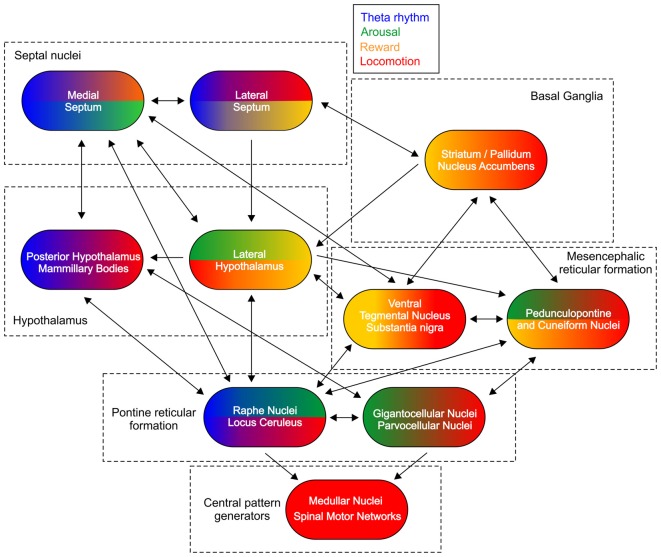
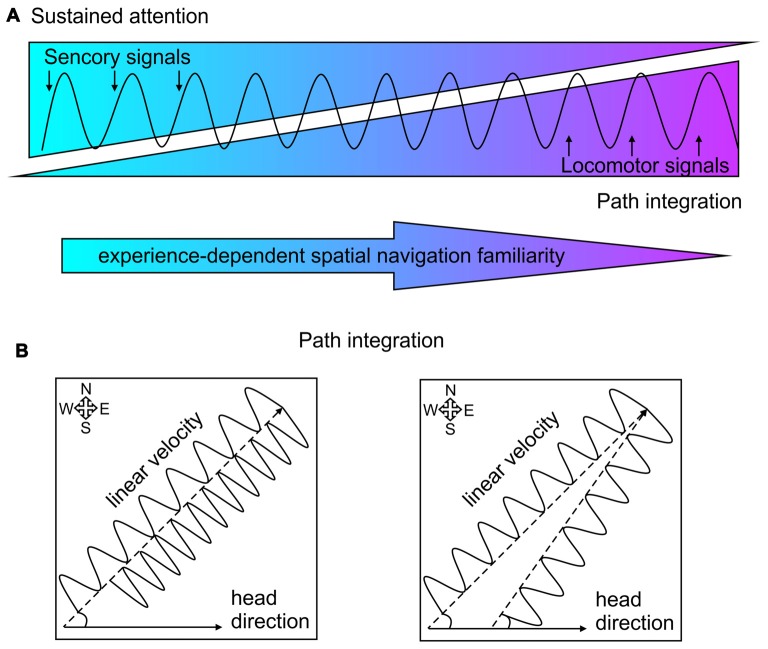
Several cortical and diencephalic limbic brain regions incorporate neurons that fire in correlation with the speed of whole-body motion, also known as linear velocity. Besides the field mapping and head-directional information, the linear velocity is among the major signals that guide animal's spatial navigation. Large neuronal populations in the same limbic regions oscillate with theta rhythm during spatial navigation or attention episodes; and the frequency of theta also correlates with linear velocity. A functional similarity between these brain areas is that their inactivation impairs the ability to form new spatial memories; whereas an anatomical similarity is that they all receive projections from medial septum-diagonal band of Broca complex. We review recent findings supporting the model that septal theta rhythm integrates different sensorimotor signals necessary for spatial navigation. The medial septal is described here as a circuitry that mediates experience-dependent balance of sustained attention and path integration during navigation. We discuss the hypothesis that theta rhythm serves as a key mechanism for the aligning of intrinsic spatial representation to: (1) rapid change of position in the spatial environment; (2) continuous alteration of sensory signals throughout navigation; and (3) adapting levels of attentional behavior. The synchronization of these spatial, somatosensory and neuromodulatory signals is proposed here to be anatomically and physiologically mediated by the medial septum.
几个皮质和间脑边缘脑区包含与全身运动速度(也称为线速度)相关联放电的神经元。除了场图和头部方向信息外,线速度是引导动物空间导航的主要信号之一。在空间导航或注意力集中期间,同一边缘区域的大量神经元群体以θ节律振荡;并且θ的频率也与线速度相关。这些脑区之间的功能相似性在于它们的失活会损害形成新空间记忆的能力;而解剖学相似性在于它们都接收来自内侧隔 - 布罗卡斜带复合体的投射。我们回顾了最近的研究结果,这些结果支持了内侧隔θ节律整合空间导航所需的不同感觉运动信号的模型。这里将内侧隔描述为一种在导航过程中介导依赖于经验的持续注意力和路径整合平衡的神经回路。我们讨论了这样一种假设,即θ节律作为一种关键机制,用于使内在空间表征与以下方面对齐:(1)空间环境中位置的快速变化;(2)整个导航过程中感觉信号的持续改变;以及(3)注意力行为的适应水平。这里提出这些空间、体感和神经调节信号的同步在解剖学和生理学上是由内侧隔介导的。