School of Medicine, Makerere University College of Health Sciences, Kampala, Uganda.
Infectious Diseases Research Collaboration, Kampala, Uganda.
Malar J. 2017 Oct 5;16(1):400. doi: 10.1186/s12936-017-2040-4.
Malaria in pregnancy has been associated with maternal morbidity, placental malaria, and adverse birth outcomes. However, data are limited on the relationships between longitudinal measures of malaria during pregnancy, measures of placental malaria, and birth outcomes.
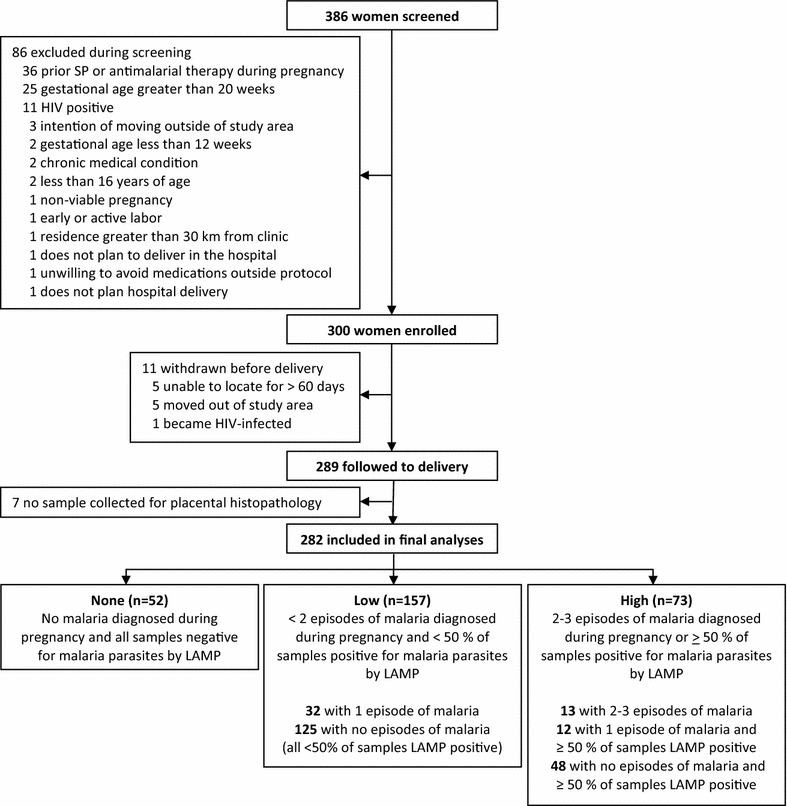
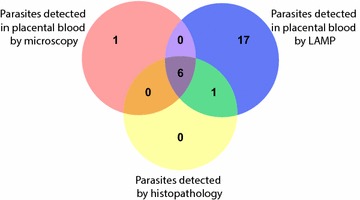
This is a nested observational study of data from a randomized controlled trial of intermittent preventive therapy during pregnancy among 282 participants with assessment of placental malaria and delivery outcomes. HIV-uninfected pregnant women were enrolled at 12-20 weeks of gestation. Symptomatic malaria during pregnancy was measured using passive surveillance and monthly detection of asymptomatic parasitaemia using loop-mediated isothermal amplification (LAMP). Placental malaria was defined as either the presence of parasites in placental blood by microscopy, detection of parasites in placental blood by LAMP, or histopathologic evidence of parasites or pigment. Adverse birth outcomes assessed included low birth weight (LBW), preterm birth (PTB), and small for gestational age (SGA) infants.
The 282 women were divided into three groups representing increasing malaria burden during pregnancy. Fifty-two (18.4%) had no episodes of symptomatic malaria or asymptomatic parasitaemia during the pregnancy, 157 (55.7%) had low malaria burden (0-1 episodes of symptomatic malaria and < 50% of samples LAMP+), and 73 (25.9%) had high malaria burden during pregnancy (≥ 2 episodes of symptomatic malaria or ≥ 50% of samples LAMP+). Women with high malaria burden had increased risks of placental malaria by blood microscopy and LAMP [aRR 14.2 (1.80-111.6) and 4.06 (1.73-9.51), respectively], compared to the other two groups combined. Compared with women with no malaria exposure during pregnancy, the risk of placental malaria by histopathology was higher among low and high burden groups [aRR = 3.27 (1.32-8.12) and aRR = 7.07 (2.84-17.6), respectively]. Detection of placental parasites by any method was significantly associated with PTB [aRR 5.64 (1.46-21.8)], and with a trend towards increased risk for LBW and SGA irrespective of the level of malaria burden during pregnancy.
Higher malaria burden during pregnancy was associated with placental malaria and together with the detection of parasites in the placenta were associated with increased risk for adverse birth outcomes. Trial Registration Current Controlled Trials Identifier NCT02163447.
妊娠疟疾与产妇发病率、胎盘疟疾和不良分娩结局有关。然而,关于妊娠期间疟疾的纵向测量、胎盘疟疾的测量和分娩结局之间的关系的数据有限。
这是一项嵌套观察性研究,对 282 名参与者进行了妊娠期间间歇性预防治疗的随机对照试验的数据进行了研究,这些参与者评估了胎盘疟疾和分娩结局。未感染艾滋病毒的孕妇在妊娠 12-20 周时入组。通过被动监测来衡量妊娠期间的疟疾症状,每月通过环介导等温扩增(LAMP)检测无症状的寄生虫血症。胎盘疟疾的定义是通过显微镜检查在胎盘血液中发现寄生虫,通过 LAMP 在胎盘血液中检测到寄生虫,或组织病理学上有寄生虫或色素的证据。评估的不良分娩结局包括低出生体重(LBW)、早产(PTB)和小于胎龄儿(SGA)。
这 282 名妇女分为三组,代表妊娠期间疟疾负担的增加。52 名(18.4%)孕妇在妊娠期间没有出现症状性疟疾或无症状寄生虫血症,157 名(55.7%)疟疾负担低(0-1 次症状性疟疾和<50%的样本 LAMP+),73 名(25.9%)妊娠期间疟疾负担高(≥2 次症状性疟疾或≥50%的样本 LAMP+)。与其他两组相比,疟疾负担高的妇女通过血液显微镜检查和 LAMP 检测有更高的胎盘疟疾风险[比值比(aRR)14.2(1.80-111.6)和 4.06(1.73-9.51)]。与妊娠期间无疟疾暴露的妇女相比,低和高负担组通过组织病理学检测到胎盘寄生虫的风险更高[aRR=3.27(1.32-8.12)和 aRR=7.07(2.84-17.6)]。任何方法检测到胎盘寄生虫均与 PTB 显著相关[aRR 5.64(1.46-21.8)],并且无论妊娠期间疟疾负担水平如何,LBW 和 SGA 的风险均呈增加趋势。
妊娠期间疟疾负担较高与胎盘疟疾有关,与胎盘寄生虫的检测一起与不良分娩结局的风险增加有关。
试验注册 当前对照试验标识符 NCT02163447。