Zhu Qingyun, Pan Xinting, Sun Yunbo, Wang Zhengbin, Liu Fuguo, Li Aiqin, Zhao Zhihui, Wang Yunlong, Li Kun, Mi Liangyu
The Affiliated Hospital of Qingdao University, Qingdao, China.
Nano New Material Key Laboratories of Qingdao University, Qingdao, China.
PLoS One. 2017 Oct 6;12(10):e0185507. doi: 10.1371/journal.pone.0185507. eCollection 2017.
Pancreatic cancer is one of the most common malignancies of the digestive system, and remains a clinical challenge. This study aimed to assess the effects of bovine serum albumin (BSA) nanoparticles carrying the hMDA-7 gene (BSA-NP-hMDA-7) in the treatment of pancreatic cancer.
BSA-NP-hMDA-7 was generated by nanotechnology and gene recombination technology. A total of 5 BXPC-3 or PANC-1 pancreatic cancer cell groups were examined, including Control, BSA-NPs, Empty vector, hMDA-7 plasmid, and hMDA-7 BSA-NPs groups, respectively. Proliferation and apoptosis of cultured cells were assessed by the MTT method and flow-cytometry, respectively. In addition, pancreatic cancer models were established with both cell lines in nude mice, and the expression profiles of hMDA-7 and VEGF in cancer tissues were measured by Western blot and immunohistochemistry.
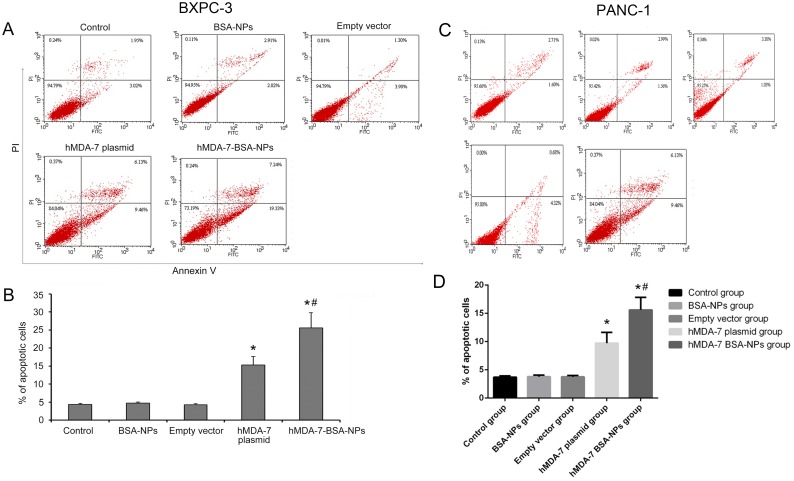
BSA-NP-hMDA-7 nanoparticles were successfully generated, and significantly inhibited the proliferation of BXPC-3 and PANC-1 cells; in addition, apoptosis rates were higher in both cell lines after treatment with BSA-NP-hMDA-7 (P<0.05). Nude mouse xenograft studies indicated that treatment with BSA-NP-hMDA-7 nanoparticles resulted in decreased tumor size. Moreover, the hMDA-7 protein was found in tumor tissues after hMDA-7 gene transfection, while BSA-NP-hMDA-7 significantly suppressed VEGF expression in tumor tissues. Similar results were obtained for both BXPC-3 and PANC-1 xenograft models.
BSA nanoparticles carrying the hMDA-7 gene effectively transfected BXPC-3 and PANC-1 pancreatic cancer cells, causing reduced cell proliferation and enhanced apoptosis in vitro. In mouse xenografts, BSA-NP-hMDA-7 treatment decreased tumor size and reduced VEGF expression. These findings indicated that BSA-NP-hMDA-7 might exert anticancer effects via VEGF suppression.
胰腺癌是消化系统最常见的恶性肿瘤之一,仍然是一项临床挑战。本研究旨在评估携带hMDA - 7基因的牛血清白蛋白(BSA)纳米颗粒(BSA - NP - hMDA - 7)在胰腺癌治疗中的效果。
通过纳米技术和基因重组技术制备BSA - NP - hMDA - 7。共检测了5个BXPC - 3或PANC - 1胰腺癌细胞组,分别为对照组、BSA纳米颗粒组、空载体组、hMDA - 7质粒组和hMDA - 7 BSA纳米颗粒组。分别采用MTT法和流式细胞术评估培养细胞的增殖和凋亡情况。此外,用这两种细胞系在裸鼠中建立胰腺癌模型,通过蛋白质免疫印迹法和免疫组织化学法检测癌组织中hMDA - 7和VEGF的表达谱。
成功制备了BSA - NP - hMDA - 7纳米颗粒,其显著抑制了BXPC - 3和PANC - 1细胞的增殖;此外,用BSA - NP - hMDA - 7处理后,两种细胞系的凋亡率均较高(P<0.05)。裸鼠异种移植研究表明,用BSA - NP - hMDA - 7纳米颗粒治疗可使肿瘤大小减小。此外,在hMDA - 7基因转染后的肿瘤组织中发现了hMDA - 7蛋白,而BSA - NP - hMDA - 7显著抑制了肿瘤组织中VEGF的表达。BXPC - 3和PANC - 1异种移植模型均获得了类似结果。
携带hMDA - 7基因的BSA纳米颗粒有效地转染了BXPC - 3和PANC - 1胰腺癌细胞,在体外导致细胞增殖减少和凋亡增强。在小鼠异种移植模型中,BSA - NP - hMDA - 7治疗减小了肿瘤大小并降低了VEGF表达。这些发现表明,BSA - NP - hMDA - 7可能通过抑制VEGF发挥抗癌作用。