Zhang Qiong-You, He Xin, Zhao Liang
The Key Laboratory of Bioorganic Phosphorus Chemistry & Chemical Biology , Department of Chemistry , Tsinghua University , Beijing 100084 , China . Email:
Chem Sci. 2017 Aug 1;8(8):5662-5668. doi: 10.1039/c7sc00575j. Epub 2017 Jun 9.
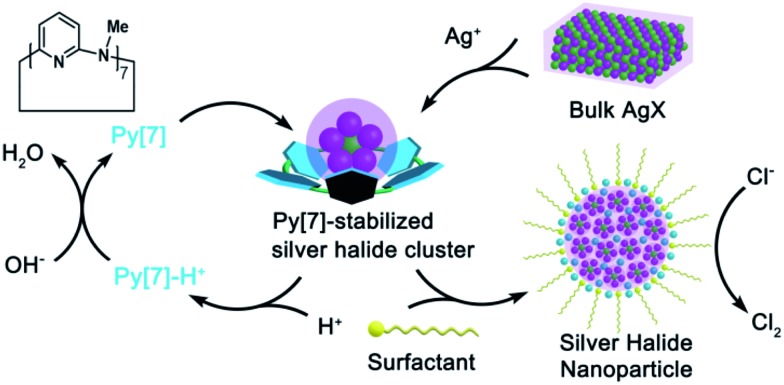
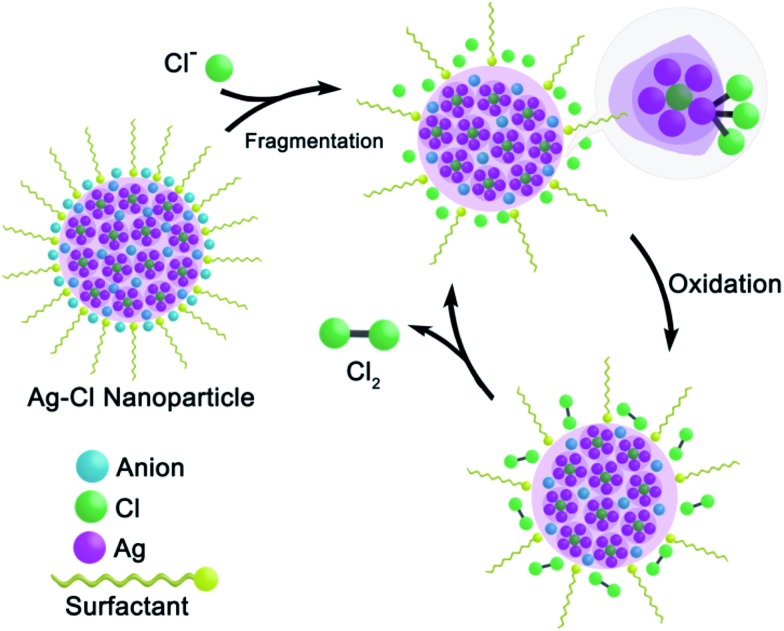
The electrocatalytic oxidation of chloride to chlorine is a fundamental and important electrochemical reaction in industry. Herein we report the synthesis of non-stoichiometric silver halide nanoparticles through a novel macrocycle-assisted bulk-to-cluster-to-nano transformation. The acquired positively charged nanoparticles expedite chloride transportation by electrostatic attraction and facilitate the formation of silver polychloride catalytic species on the surface, thus functioning as efficient and selective electrocatalysts for the chlorine evolution reaction (CER) at a very low overpotential and within a wide concentration range of chloride. The formation of uncommon non-stoichiometric nanoparticles prevents the formation of a AgCl precipitate and exposes more coordination unsaturated silver atoms to catalyze CER, finally causing a large enhancement of the atomic catalytic efficiency of silver. This study showcases a promising approach to achieve efficient catalysts from a bottom-up design.
氯离子电催化氧化生成氯气是工业中一种基本且重要的电化学反应。在此,我们报道了通过一种新型大环辅助的从体相到团簇再到纳米颗粒的转变来合成非化学计量比的卤化银纳米颗粒。所获得的带正电荷的纳米颗粒通过静电吸引加速氯离子传输,并促进表面上多氯化银催化物种的形成,从而在非常低的过电位和宽浓度范围的氯离子内作为析氯反应(CER)的高效且选择性电催化剂发挥作用。不常见的非化学计量比纳米颗粒的形成可防止氯化银沉淀的形成,并使更多配位不饱和银原子暴露以催化CER,最终导致银的原子催化效率大幅提高。这项研究展示了一种从自下而上设计实现高效催化剂的有前景的方法。