
LTBP-2 的中央生物活性区域通过 Akt 和 p38 信号通路刺激成纤维细胞中 TGF-β1 的表达。
A Central Bioactive Region of LTBP-2 Stimulates the Expression of TGF-β1 in Fibroblasts via Akt and p38 Signalling Pathways.
机构信息
Discipline of Anatomy and Pathology, School of Medicine, University of Adelaide, Adelaide, SA 5005, Australia.
Department of Physical Rehabilitation Sciences, Kulliyyah of Allied Health Sciences, International Islamic University Malaysia, 25200 Kuantan, Pahang, Malaysia.
出版信息
Int J Mol Sci. 2017 Oct 9;18(10):2114. doi: 10.3390/ijms18102114.
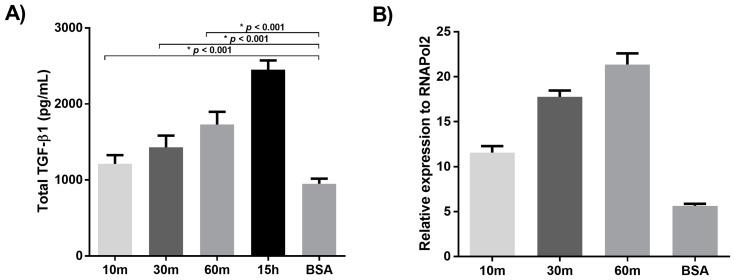
Latent transforming growth factor-β-1 binding protein-2 (LTBP-2) belongs to the LTBP-fibrillin superfamily of extracellular proteins. Unlike other LTBPs, LTBP-2 does not covalently bind transforming growth factor-β1 (TGF-β1) but appears to be implicated in the regulation of TGF-β1 bioactivity, although the mechanisms are largely unknown. In experiments originally designed to study the displacement of latent TGF-β1 complexes from matrix storage, we found that the addition of exogenous LTBP-2 to cultured human MSU-1.1 fibroblasts caused an increase in TGF-β1 levels in the medium. However, the TGF-β1 increase was due to an upregulation of TGF-β1 expression and secretion rather than a displacement of matrix-stored TGF-β1. The secreted TGF-β1 was mainly in an inactive form, and its concentration peaked around 15 h after addition of LTBP-2. Using a series of recombinant LTBP-2 fragments, the bioactivity was identified to a small region of LTBP-2 consisting of an 8-Cys motif flanked by four epidermal growth factor (EGF)-like repeats. The LTBP-2 stimulation of TGF-β expression involved the phosphorylation of both Akt and p38 mitogen-activated protein kinase (MAPK) signalling proteins, and specific inactivation of each protein individually blocked TGF-β1 increase. The search for the cell surface receptor mediating this LTBP-2 activity proved inconclusive. Inhibitory antibodies to integrins β1 and αVβ5 showed no reduction of LTBP-2 stimulation of TGF-β1. However, TGF-β1 upregulation was partially inhibited by anti-αVβ3 integrin antibodies, suggestive of a direct or indirect role for this integrin. Overall, the study indicates that LTBP-2 can directly upregulate cellular TGF-β1 expression and secretion by interaction with cells via a short central bioactive region. This may be significant in connective tissue disorders involving aberrant TGF-β1 signalling.
潜伏转化生长因子-β-1 结合蛋白-2(LTBP-2)属于细胞外蛋白的 LTBP-纤维连接素超家族。与其他 LTBP 不同,LTBP-2 不与转化生长因子-β1(TGF-β1)共价结合,但似乎参与 TGF-β1 生物活性的调节,尽管其机制在很大程度上尚不清楚。在最初设计用于研究从基质储存中置换潜伏 TGF-β1 复合物的实验中,我们发现向培养的人 MSU-1.1 成纤维细胞中添加外源性 LTBP-2 会导致培养基中 TGF-β1 水平升高。然而,TGF-β1 的增加是由于 TGF-β1 表达和分泌的上调,而不是基质储存的 TGF-β1 的置换。分泌的 TGF-β1 主要处于无活性形式,其浓度在添加 LTBP-2 后约 15 小时达到峰值。使用一系列重组 LTBP-2 片段,将生物活性鉴定为 LTBP-2 的一个小区域,该区域由一个 8-Cys 基序组成,该基序由四个表皮生长因子(EGF)样重复序列包围。LTBP-2 对 TGF-β 表达的刺激涉及 Akt 和 p38 丝裂原活化蛋白激酶(MAPK)信号蛋白的磷酸化,并且单独失活每种蛋白均可阻断 TGF-β1 的增加。寻找介导这种 LTBP-2 活性的细胞表面受体的研究没有定论。整合素β1 和αVβ5 的抑制性抗体对 LTBP-2 刺激 TGF-β1 没有减少。然而,抗αVβ3 整合素抗体部分抑制了 TGF-β1 的上调,提示该整合素可能发挥直接或间接作用。总的来说,该研究表明 LTBP-2 可以通过与细胞相互作用直接上调细胞内 TGF-β1 的表达和分泌,通过一个短的中心生物活性区域。这在涉及异常 TGF-β1 信号传导的结缔组织疾病中可能具有重要意义。




 Zotero 插件