Comerma-Steffensen Simon G, Carvacho Ingrid, Hedegaard Elise R, Simonsen Ulf
Department of Biomedicine, Pulmonary and Cardiovascular Pharmacology, Aarhus UniversityAarhus, Denmark.
Animal Physiology, Department of Biomedical Sciences, Veterinary Sciences Faculty, Central University of VenezuelaMaracay, Venezuela.
Front Pharmacol. 2017 Sep 20;8:660. doi: 10.3389/fphar.2017.00660. eCollection 2017.
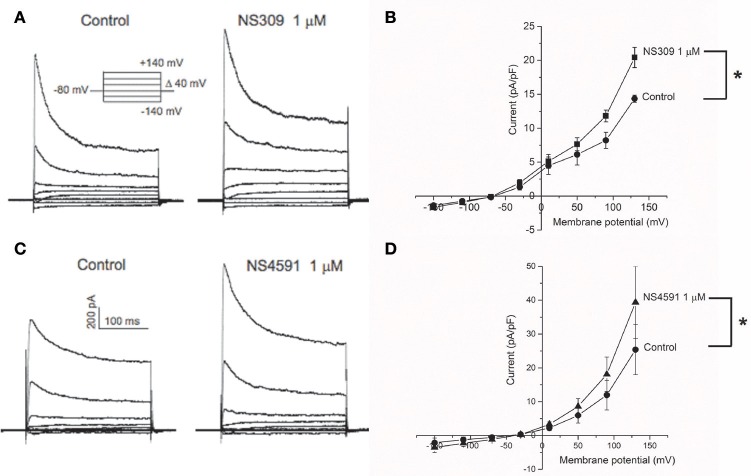
Modulation of endothelial calcium-activated potassium (K) channels has been proposed as an approach to restore endothelial function. The present study investigated whether novel openers of K channels with small (K2.x) and intermediate (K3.1) conductance, NS309 and NS4591, improve endothelium-dependent relaxation and erectile function. Rat (CC) strips were mounted for isometric tension recording and processed for immunoblotting. Mean arterial pressure (MAP), intracavernosal pressure (ICP), and electrocardiographic (ECG) measurements were conducted in anesthetized rats. Immunoblotting revealed the presence of K2.3 and large K conductance (K1.1) channels in the . NS309 and NS4591 increased current in CC endothelial cells in whole cell patch clamp experiments. Relaxation induced by NS309 (<1 μM) was inhibited by endothelial cell removal and high extracellular potassium. An inhibitor of nitric oxide (NO) synthase, and blockers of K2.x and K1.1 channels, apamin and iberiotoxin also inhibited NS309 relaxation. Incubation with NS309 (0.5 μM) markedly enhanced acetylcholine relaxation. Basal erectile function (ICP/MAP) increased during administration of NS309. Increases in ICP/MAP after cavernous nerve stimulation with NS309 were unchanged, whereas NS4591 significantly improved erectile function. Administration of NS309 and NS4591 caused small changes in the electrocardiogram, but neither arrhythmic events nor prolongation of the QTc interval were observed. The present study suggests that openers of K2.x and K3.1 channels improve endothelial and erectile function. The effects of NS309 and NS4591 on heart rate and ECG are small, but will require additional safety studies before evaluating whether activation of K2.3 channels has a potential for treatment of erectile dysfunction.
调节内皮钙激活钾(K)通道已被提议作为恢复内皮功能的一种方法。本研究调查了新型小电导(K2.x)和中电导(K3.1)K通道开放剂NS309和NS4591是否能改善内皮依赖性舒张和勃起功能。将大鼠海绵体(CC)条安装用于等长张力记录,并进行免疫印迹处理。在麻醉大鼠中进行平均动脉压(MAP)、海绵体内压(ICP)和心电图(ECG)测量。免疫印迹显示CC中存在K2.3和大电导(K1.1)通道。在全细胞膜片钳实验中,NS309和NS4591增加了CC内皮细胞中的电流。NS309(<1μM)诱导的舒张被内皮细胞去除和高细胞外钾抑制。一氧化氮(NO)合酶抑制剂以及K2.x和K1.1通道阻滞剂蜂毒明肽和iberiotoxin也抑制了NS309诱导的舒张。用NS309(0.5μM)孵育可显著增强乙酰胆碱诱导的舒张。在给予NS309期间,基础勃起功能(ICP/MAP)增加。用NS309进行海绵体神经刺激后ICP/MAP的增加没有变化,而NS4591显著改善了勃起功能。给予NS309和NS4591使心电图发生微小变化,但未观察到心律失常事件或QTc间期延长。本研究表明,K2.x和K3.1通道开放剂可改善内皮和勃起功能。NS309和NS4591对心率和心电图的影响较小,但在评估激活K2.3通道是否具有治疗勃起功能障碍的潜力之前,还需要进行额外的安全性研究。