Toh Desiree-Faye Kaixin, Patil Kiran M, Chen Gang
Division of Chemistry and Biological Chemistry, School of Physical and Mathematical Sciences, Nanyang Technological University.
Division of Chemistry and Biological Chemistry, School of Physical and Mathematical Sciences, Nanyang Technological University;
J Vis Exp. 2017 Sep 21(127):56221. doi: 10.3791/56221.
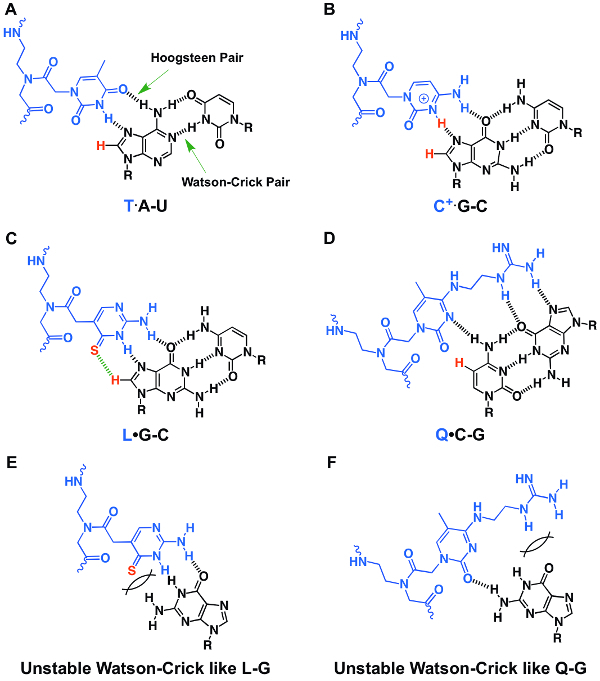
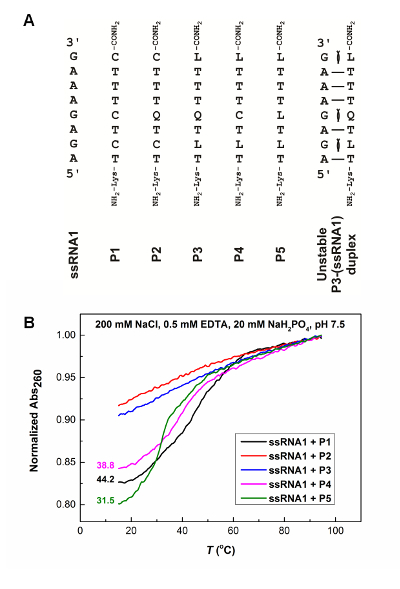
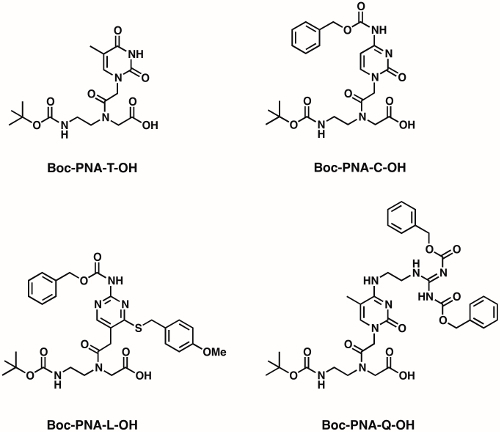
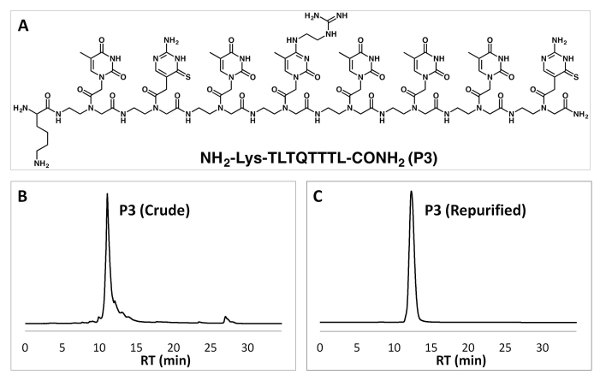
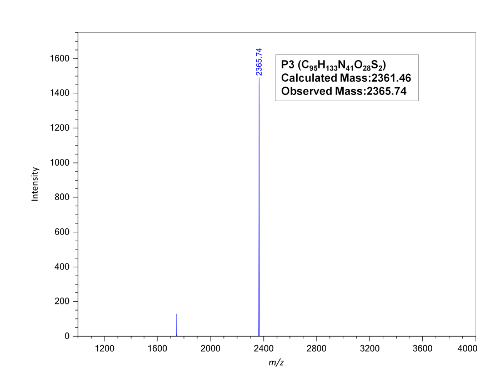
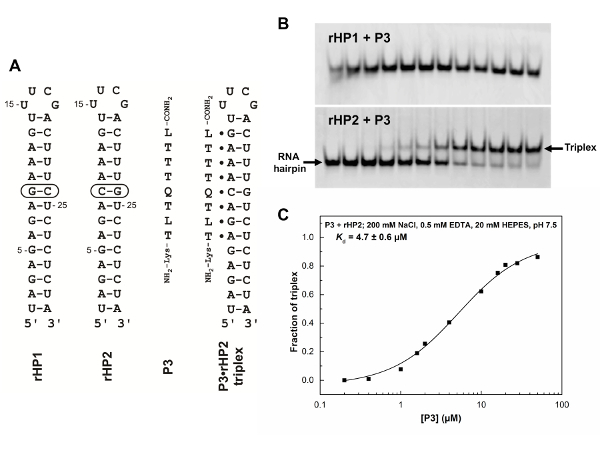
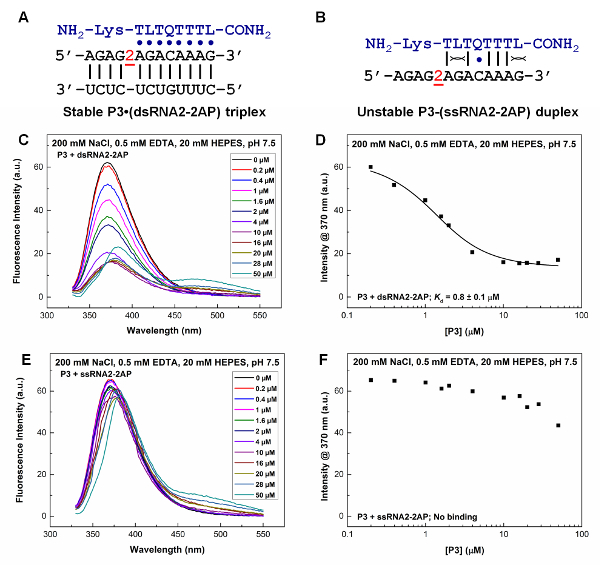
RNAs are emerging as important biomarkers and therapeutic targets. Thus, there is great potential in developing chemical probes and therapeutic ligands for the recognition of RNA sequence and structure. Chemically modified Peptide Nucleic Acid (PNA) oligomers have been recently developed that can recognize RNA duplexes in a sequence-specific manner. PNAs are chemically stable with a neutral peptide-like backbone. PNAs can be synthesized relatively easily by the manual Boc-chemistry solid-phase peptide synthesis method. PNAs are purified by reverse-phase HPLC, followed by molecular weight characterization by matrix-assisted laser desorption/ionization-time of flight (MALDI-TOF). Non-denaturing polyacrylamide gel electrophoresis (PAGE) technique facilitates the imaging of the triplex formation, because carefully designed free RNA duplex constructs and PNA bound triplexes often show different migration rates. Non-denaturing PAGE with ethidium bromide post staining is often an easy and informative technique for characterizing the binding affinities and specificities of PNA oligomers. Typically, multiple RNA hairpins or duplexes with single base pair mutations can be used to characterize PNA binding properties, such as binding affinities and specificities. 2-Aminopurine is an isomer of adenine (6-aminopurine); the 2-aminopurine fluorescence intensity is sensitive to local structural environment changes, and is suitable for the monitoring of triplex formation with the 2-aminopurine residue incorporated near the PNA binding site. 2-Aminopurine fluorescence titration can also be used to confirm the binding selectivity of modified PNAs towards targeted double-stranded RNAs (dsRNAs) over single-stranded RNAs (ssRNAs). UV-absorbance-detected thermal melting experiments allow the measurement of the thermal stability of PNA-RNA duplexes and PNA·RNA2 triplexes. Here, we describe the synthesis and purification of PNA oligomers incorporating modified residues, and describe biochemical and biophysical methods for characterization of the recognition of RNA duplexes by the modified PNAs.
RNA正成为重要的生物标志物和治疗靶点。因此,开发用于识别RNA序列和结构的化学探针和治疗配体具有巨大潜力。最近已开发出化学修饰的肽核酸(PNA)寡聚物,其能够以序列特异性方式识别RNA双链体。PNA具有化学稳定性,其骨架类似中性肽。PNA可通过手动Boc化学固相肽合成方法相对容易地合成。PNA通过反相高效液相色谱法纯化,随后通过基质辅助激光解吸/电离飞行时间(MALDI-TOF)进行分子量表征。非变性聚丙烯酰胺凝胶电泳(PAGE)技术有助于三链体形成的成像,因为精心设计的游离RNA双链体构建体和与PNA结合的三链体通常表现出不同的迁移率。用溴化乙锭后染色的非变性PAGE通常是一种用于表征PNA寡聚物结合亲和力和特异性的简单且信息丰富的技术。通常,具有单碱基对突变的多个RNA发夹或双链体可用于表征PNA的结合特性,如结合亲和力和特异性。2-氨基嘌呤是腺嘌呤(6-氨基嘌呤)的异构体;2-氨基嘌呤荧光强度对局部结构环境变化敏感,适用于监测在PNA结合位点附近掺入2-氨基嘌呤残基的三链体形成。2-氨基嘌呤荧光滴定也可用于确认修饰的PNA对靶向双链RNA(dsRNA)相对于单链RNA(ssRNA)的结合选择性。紫外吸收检测的热熔实验可测量PNA-RNA双链体和PNA·RNA2三链体的热稳定性。在此,我们描述了掺入修饰残基PNA寡聚物的合成和纯化,并描述了用于表征修饰的PNA对RNA双链体识别的生化和生物物理方法。