Pyra Maria, Haberer Jessica E, Heffron Renee, Kidoguchi Lara, Brown Elizabeth R, Bukusi Elizabeth A, Asiimwe Stephen, Celum Connie, Katabira Elly, Mugo Nelly R, Baeten Jared M
Global Health, University of Washington, Seattle, WA.
Massachusetts General Hospital Global Health and Harvard Medical School, Boston, MA.
J Acquir Immune Defic Syndr. 2018 Jan 1;77(1):41-45. doi: 10.1097/QAI.0000000000001561.
Pre-exposure prophylaxis (PrEP) is efficacious for African women at risk for HIV, but data on adherence outside clinical trials are sparse. We describe the persistence and execution of PrEP use among women participating in a large open-label PrEP demonstration project, particularly during periods of HIV risk.
Three hundred ten HIV-uninfected women in HIV serodiscordant couples in Kenya and Uganda were offered and accepted PrEP. Electronic monitoring caps were used to measure daily PrEP adherence. Time on PrEP while at risk for HIV (when the HIV-infected partner was on antiretroviral therapy <6 months) and weekly adherence while on PrEP were calculated and compared among older and younger (<25 years old) women.
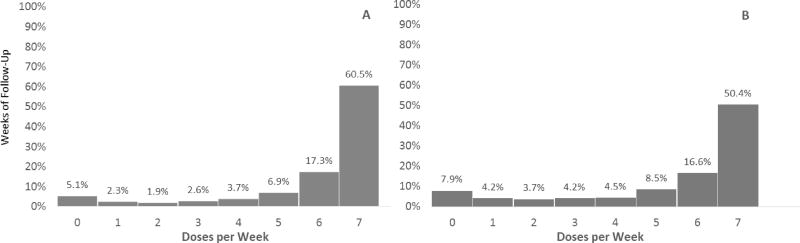
As defined above, women were at risk for HIV for an average of 361 days; 54% took PrEP during their entire risk period and 24% stopped but restarted PrEP during their risk period. While on PrEP, women took ≥6 doses/wk for 78% of weeks [67% of weeks for women aged <25 years, 80% of weeks for women aged ≥25 years (P < 0.001)], and ≥4 doses for 88% of weeks [80% for those <25, 90% for those ≥25, (P < 0.001)]. Compared with historical, risk-matched controls, HIV incidence was reduced 93% (95% confidence interval: 77% to 98%) for all women and 91% (95% confidence interval: 29% to 99%) among women aged <25 years.
Women, including young women, in HIV-serodiscordant couples took PrEP successfully over sustained periods of risk. Although young women had lower adherence than older women, they achieved strong protection, which suggests that women can align PrEP use to periods of risk and imperfect adherence can still provide substantial benefit.
暴露前预防(PrEP)对有感染HIV风险的非洲女性有效,但临床试验之外关于依从性的数据很少。我们描述了参与一个大型开放标签PrEP示范项目的女性中PrEP使用的持续性和执行情况,特别是在HIV风险期。
在肯尼亚和乌干达,向310名处于HIV血清学不一致伴侣关系中的未感染HIV的女性提供并接受了PrEP。使用电子监测帽来测量每日PrEP依从性。计算并比较了年龄较大和较年轻(<25岁)女性在有HIV感染风险时(即HIV感染伴侣接受抗逆转录病毒治疗<6个月时)的PrEP使用时间以及PrEP使用期间的每周依从性。
如上所定义,女性平均有361天处于HIV感染风险中;54%的女性在整个风险期都服用PrEP,24%的女性停止服用但在风险期内又重新开始服用PrEP。在服用PrEP期间,女性78%的周数服用≥6剂/周[<25岁的女性为67%的周数,≥25岁的女性为80%的周数(P<0.001)],88%的周数服用≥4剂[<25岁的女性为80%,≥25岁的女性为90%,(P<0.001)]。与历史上风险匹配的对照组相比,所有女性的HIV发病率降低了93%(95%置信区间:77%至98%),<25岁女性的HIV发病率降低了91%(95%置信区间:29%至99%)。
处于HIV血清学不一致伴侣关系中的女性,包括年轻女性,在持续的风险期内成功服用了PrEP。虽然年轻女性的依从性低于年长女性,但她们获得了强有力的保护,这表明女性可以根据风险期调整PrEP的使用,不完全依从性仍可带来显著益处。