Department of Biology, Huck Institutes of Life Sciences, Pennsylvania State University, University park, PA, 16802, USA.
School of Life Science, South China Normal University, Guangzhou, 510631, China.
Mol Neurodegener. 2017 Oct 10;12(1):73. doi: 10.1186/s13024-017-0213-9.
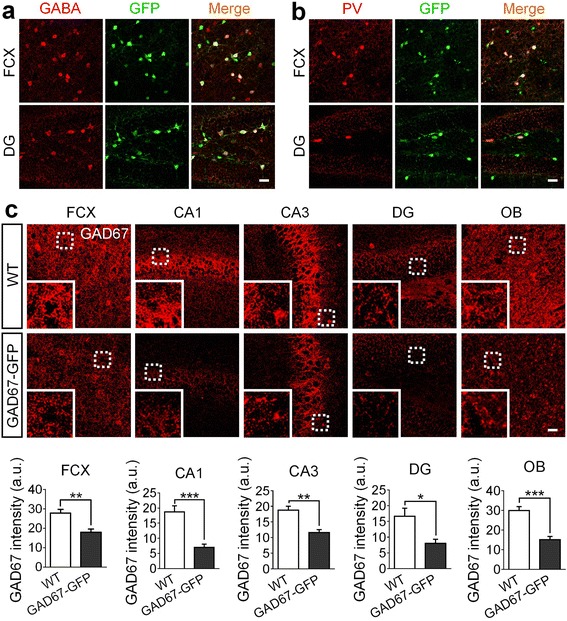
Alzheimer's disease (AD) is the most common age-related neurodegenerative disorder, affecting millions of people worldwide. Although dysfunction of multiple neurotransmitter systems including cholinergic, glutamatergic and GABAergic systems has been associated with AD progression the underlying mechanisms remain elusive. We and others have recently found that GABA content is elevated in AD brains and linked to cognitive deficits in AD mouse models. The glutamic acid decarboxylase 67 (GAD67) is the major enzyme converting glutamate into GABA and has been implied in a number of neurological disorders such as epilepsy and schizophrenia. However, whether Gad67 is involved in AD pathology has not been well studied. Here, we investigate the functional role of GAD67 in an AD mouse model with Gad67 haploinsufficiency that is caused by replacing one allele of Gad67 with green fluorescent protein (GFP) gene during generation of GAD67-GFP mice.
To genetically reduce GAD67 in AD mouse brains, we crossed the Gad67 haploinsufficient mice (GAD67-GFP) with 5xFAD mice (harboring 5 human familial AD mutations in APP and PS1 genes) to generate a new line of bigenic mice. Immunostaining, ELISA, electrophysiology and behavior test were applied to compare the difference between groups.
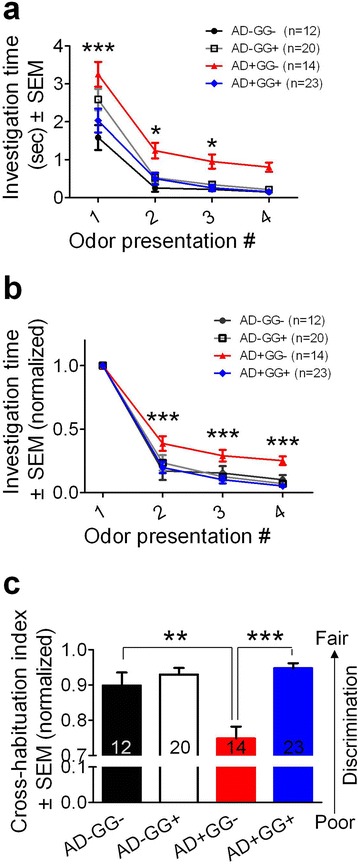
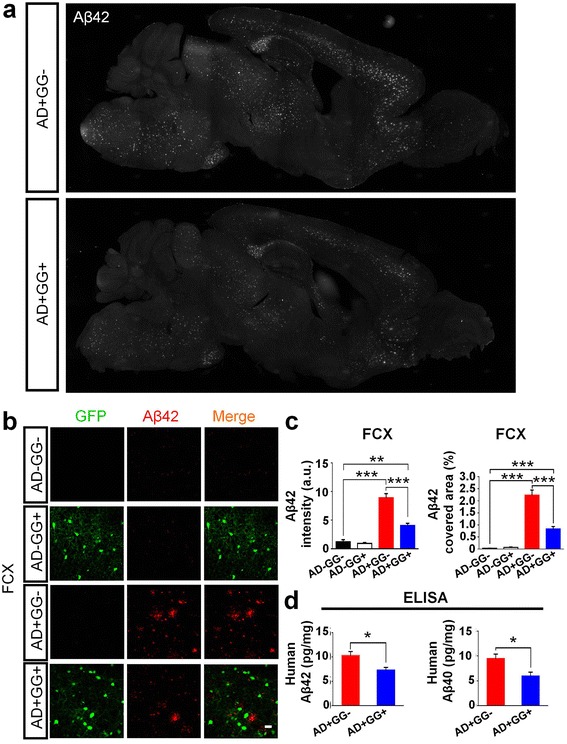
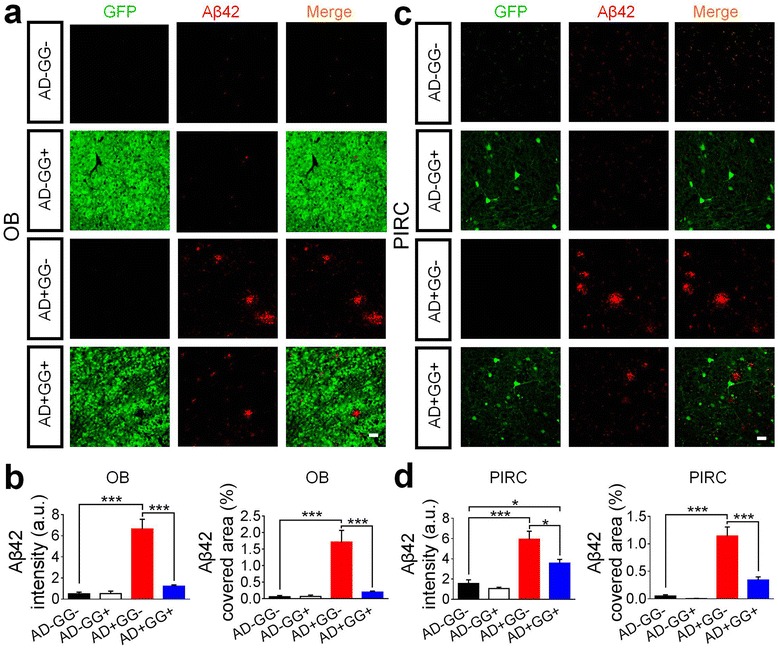
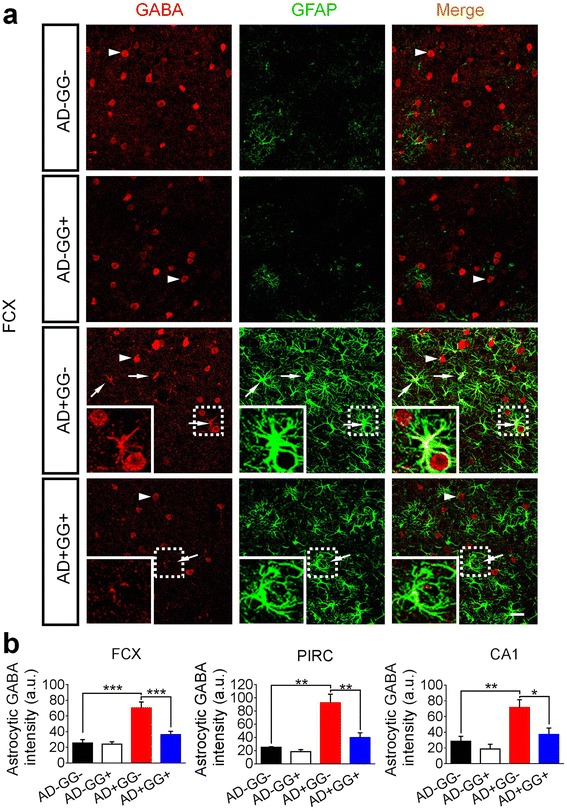
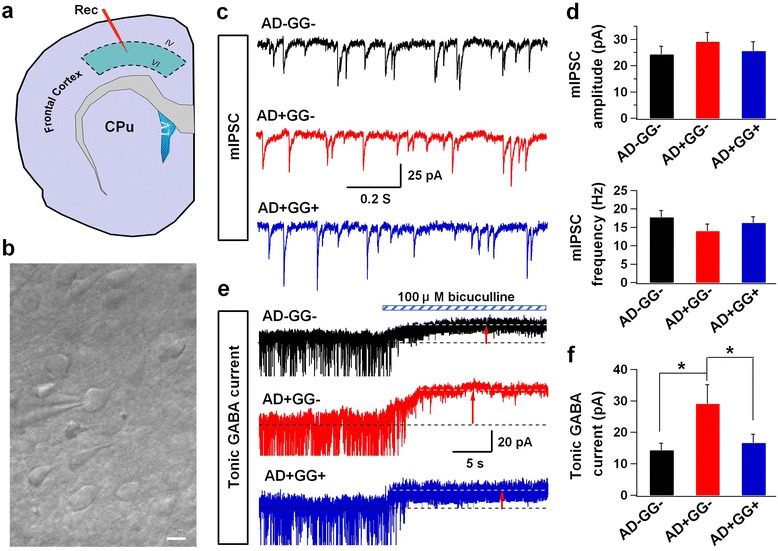
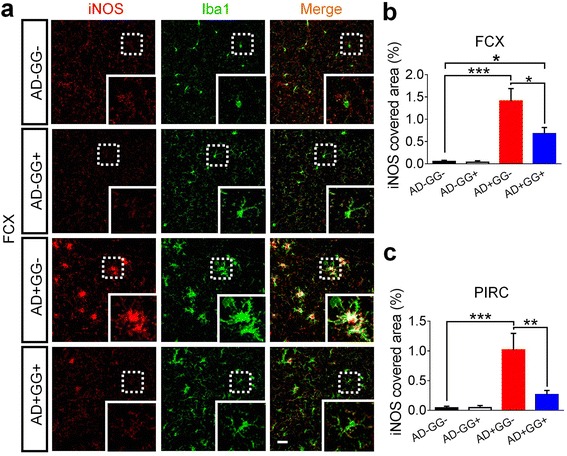
We found that reduction of GAD67 resulted in a significant decrease of amyloid β production in 5xFAD mice. Concurrently, the abnormal astrocytic GABA and tonic GABA currents, as well as the microglial reactivity were significantly reduced in the 5xFAD mice with Gad67 haploinsufficiency. Importantly, the olfactory memory deficit of 5xFAD mice was rescued by Gad67 haploinsufficiency.
Our results demonstrate that GAD67 plays an important role in AD pathology, suggesting that GAD67 may be a potential drug target for modulating the progress of AD.
阿尔茨海默病(AD)是最常见的与年龄相关的神经退行性疾病,影响着全球数以百万计的人。尽管包括胆碱能、谷氨酸能和 GABA 能系统在内的多种神经递质系统的功能障碍与 AD 进展有关,但潜在机制仍不清楚。我们和其他人最近发现,AD 大脑中的 GABA 含量升高,并与 AD 小鼠模型中的认知缺陷有关。谷氨酸脱羧酶 67(GAD67)是将谷氨酸转化为 GABA 的主要酶,已被涉及到多种神经疾病,如癫痫和精神分裂症。然而,Gad67 是否参与 AD 病理学尚未得到很好的研究。在这里,我们研究了 GAD67 基因敲低在 AD 小鼠模型中的功能作用,该模型是通过在 GAD67-GFP 小鼠的生成过程中将 Gad67 的一个等位基因替换为绿色荧光蛋白(GFP)基因而导致 Gad67 半合子不足。
为了在 AD 小鼠大脑中遗传降低 GAD67,我们将 Gad67 半合子不足的小鼠(GAD67-GFP)与 5xFAD 小鼠(在 APP 和 PS1 基因中携带 5 个人类家族性 AD 突变)杂交,产生了一种新的双基因小鼠。应用免疫染色、ELISA、电生理学和行为测试来比较组间的差异。
我们发现,降低 GAD67 可导致 5xFAD 小鼠中淀粉样蛋白β的产生显著减少。同时,在 Gad67 半合子不足的 5xFAD 小鼠中,异常的星形胶质细胞 GABA 和紧张性 GABA 电流以及小胶质细胞反应性显著降低。重要的是,Gad67 半合子不足可挽救 5xFAD 小鼠的嗅觉记忆缺陷。
我们的结果表明,GAD67 在 AD 病理学中起重要作用,提示 GAD67 可能是调节 AD 进展的潜在药物靶点。