Arin Rosa M, Gorostidi Adriana, Navarro-Imaz Hiart, Rueda Yuri, Fresnedo Olatz, Ochoa Begoña
Department of Physiology, Faculty of Medicine and Nursing, University of the Basque Country (UPV/EHU)Leioa, Spain.
Front Physiol. 2017 Sep 22;8:737. doi: 10.3389/fphys.2017.00737. eCollection 2017.
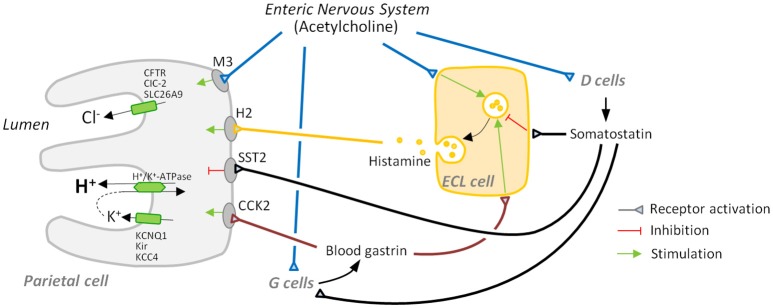
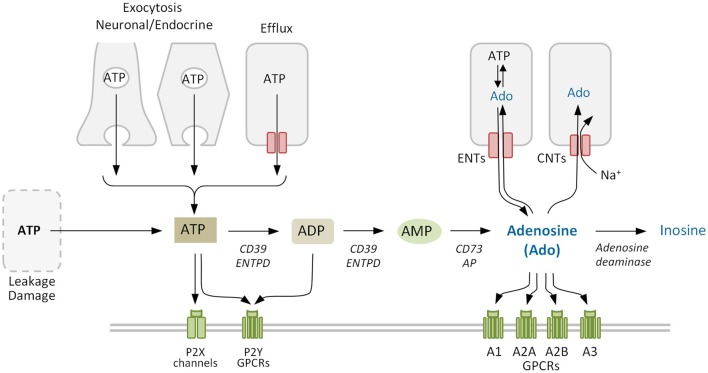
Composed by a molecule of adenine and a molecule of ribose, adenosine is a paradigm of recyclable nucleoside with a multiplicity of functions that occupies a privileged position in the metabolic and regulatory contexts. Adenosine is formed continuously in intracellular and extracellular locations of all tissues. Extracellular adenosine is a signaling molecule, able to modulate a vast range of physiologic responses in many cells and organs, including digestive organs. The adenosine A1, A2A, A2B, and A3 receptors are P1 purinergic receptors, G protein-coupled proteins implicated in tissue protection. This review is focused on gastric acid secretion, a process centered on the parietal cell of the stomach, which contains large amounts of H/K-ATPase, the proton pump responsible for proton extrusion during acid secretion. Gastric acid secretion is regulated by an extensive collection of neural stimuli and endocrine and paracrine agents, which act either directly at membrane receptors of the parietal cell or indirectly through other regulatory cells of the gastric mucosa, as well as mechanic and chemic stimuli. In this review, after briefly introducing these points, we condense the current body of knowledge about the modulating action of adenosine on the pathophysiology of gastric acid secretion and update its significance based on recent findings in gastric mucosa and parietal cells in humans and animal models.
腺苷由一分子腺嘌呤和一分子核糖组成,是一种具有多种功能的可循环利用核苷的典范,在代谢和调节环境中占据着特殊地位。腺苷在所有组织的细胞内和细胞外位置持续形成。细胞外腺苷是一种信号分子,能够调节包括消化器官在内的许多细胞和器官中的多种生理反应。腺苷A1、A2A、A2B和A3受体是P1嘌呤能受体,是与组织保护有关的G蛋白偶联蛋白。本综述聚焦于胃酸分泌,这一过程以胃壁细胞为中心,胃壁细胞含有大量H/K - ATP酶,即负责胃酸分泌过程中质子排出的质子泵。胃酸分泌受大量神经刺激、内分泌和旁分泌因子调节,这些因子要么直接作用于壁细胞的膜受体,要么通过胃黏膜的其他调节细胞间接作用,以及机械和化学刺激。在本综述中,在简要介绍这些要点之后,我们总结了目前关于腺苷对胃酸分泌病理生理学调节作用的知识体系,并根据人类和动物模型胃黏膜及壁细胞的最新研究结果更新其意义。