Kortland Lena-Marie, Knake Susanne, von Podewils Felix, Rosenow Felix, Strzelczyk Adam
Epilepsy Center Hessen, Philipps-University, Marburg, Germany.
Epilepsy Center Greifswald, Ernst-Moritz-Arndt-University, Greifswald, Germany.
Front Neurol. 2017 Sep 26;8:507. doi: 10.3389/fneur.2017.00507. eCollection 2017.
There is a lack of data concerning socioeconomic outcome and quality of life (QoL) in patients after status epilepticus (SE) in Germany.
Adult patients treated between 2011 and 2015 due to SE at the university hospitals in Frankfurt, Greifswald, and Marburg were asked to fill out a questionnaire regarding long-term outcome of at least 3 months after discharge. The SE cohort consisted of 25.9% patients with an acute symptomatic, 42% with a remote symptomatic and previous epilepsy, 22.2% with a new-onset remote symptomatic, and 9.9% with other or unknown etiology. A matched case-control analysis was applied for comparison with patients with drug refractory epilepsy and seizure remission, both not previously affected by SE.
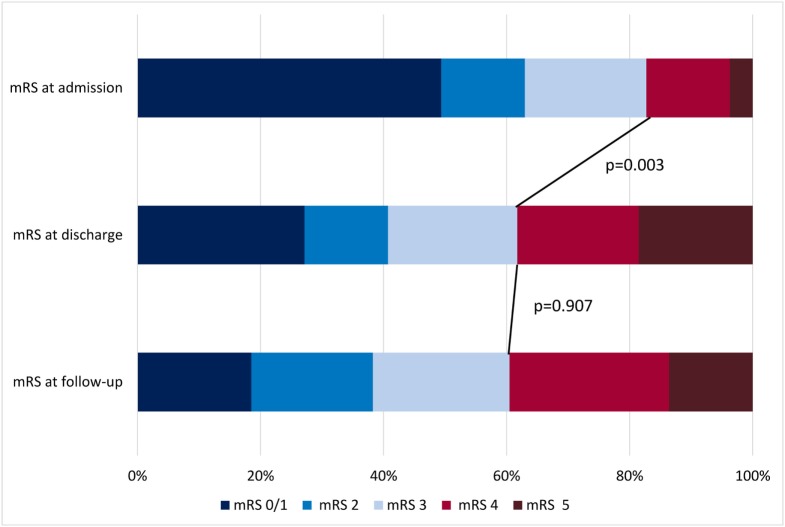
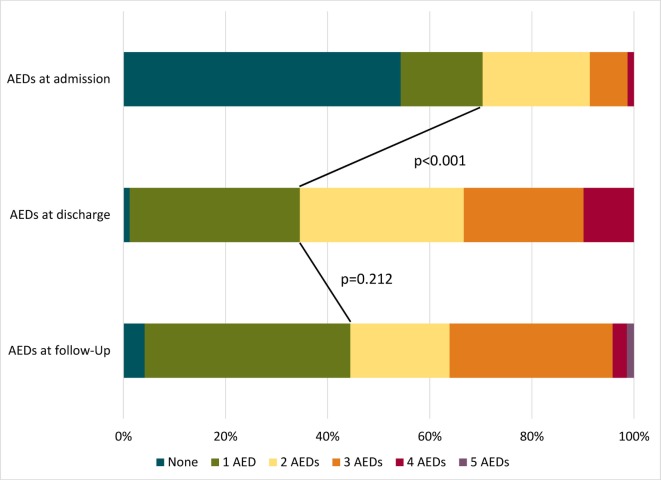
A total of 81 patients (mean age: 58.7 ± 18.0 years; 58% female) participated. A non-refractory course was present in 59.3%, while 27.2% had a refractory SE (RSE) and 13.6% had a superrefractory SE (SRSE). Before admission, a favorable modified Rankin Scale (mRS) of 0-3 was found in 82.7% (67/81), deteriorating to 38.3% (31/81) ( = 0.003) at discharge. The majority returned home [51.9% (42/81)], 32.1% entered a rehabilitation facility, while 12.3% were transferred to a nursing home and 3.7% to another hospital. The overall mRS at follow-up did not change; 61.8% (45/74) reached an mRS of 0-3. In RSE and SRSE, the proportion with a favorable mRS increased from 45.5% at discharge to 70% at follow-up, while QoL was comparable to a non-refractory SE course. Matched epilepsy controls in seizure remission were treated with a lower mean number of anticonvulsants (1.3 ± 0.7) compared to controls with drug refractory epilepsy (1.9 ± 0.8; < 0.001) or SE (1.9 ± 1.1; < 0.001). A major depression was found in 32.8% of patients with SE and in 36.8% of drug refractory epilepsy, but only in 20.3% of patients in seizure remission. QoL was reduced in all categories (QOLIE-31) in SE patients in comparison with patients in seizure remission, but was comparable to patients with drug refractory epilepsy.
Patients after SE show substantial impairments in their QoL and daily life activities. However, in the long term, patients with RSE and SRSE had a relatively favorable outcome comparable to that of patients with a non-refractory SE course. This underlines the need for efficient therapeutic options in SE.
在德国,关于癫痫持续状态(SE)患者的社会经济结局和生活质量(QoL)的数据匮乏。
2011年至2015年间在法兰克福、格赖夫斯瓦尔德和马尔堡的大学医院因SE接受治疗的成年患者被要求填写一份关于出院后至少3个月长期结局的问卷。SE队列包括25.9%的急性症状性患者、42%的既往有症状性和癫痫病史的患者、22.2%的新发远程症状性患者以及9.9%病因不明或其他病因的患者。采用匹配病例对照分析与药物难治性癫痫和癫痫发作缓解患者进行比较,这两组患者既往均未受SE影响。
共有81例患者(平均年龄:58.7±18.0岁;58%为女性)参与。59.3%为非难治性病程,27.2%为难治性SE(RSE),13.6%为超难治性SE(SRSE)。入院前,82.7%(67/81)的患者改良Rankin量表(mRS)评分为0 - 3,出院时降至38.3%(31/81)(P = 0.003)。大多数患者回家[51.9%(42/81)],32.1%进入康复机构,12.3%被转至养老院,3.7%转至其他医院。随访时总体mRS未改变;61.8%(45/74)的患者mRS评分为0 - 3。在RSE和SRSE患者中,mRS评分良好的比例从出院时的45.5%增至随访时的70%,而生活质量与非难治性SE病程相当。癫痫发作缓解的匹配癫痫对照组平均使用的抗惊厥药物数量(1.3±0.7)低于药物难治性癫痫对照组(1.9±0.8;P < 0.001)或SE对照组(1.9±1.1;P < 0.001)。32.8%的SE患者和36.8%的药物难治性癫痫患者存在重度抑郁,但癫痫发作缓解的患者中只有20.3%有重度抑郁。与癫痫发作缓解的患者相比,SE患者在所有类别(QOLIE - 31)中的生活质量均降低,但与药物难治性癫痫患者相当。
SE患者的生活质量和日常生活活动存在严重损害。然而,从长期来看,RSE和SRSE患者的结局相对较好,与非难治性SE病程的患者相当。这突出了SE有效治疗方案的必要性。