Cai Chunmei, Zhou Jie, Sun Xiaoqiang, Sun Tingzhe, Xie Weihong, Cui Jun
Key Laboratory of Gene Engineering of the Ministry of Education, State Key Laboratory of Biocontrol, School of Life Sciences, Sun Yat-sen University, Guangzhou, P. R. China.
Zhongshan School of Medicine, Sun Yat-sen University, Guangzhou, P. R. China.
PLoS One. 2017 Oct 11;12(10):e0186105. doi: 10.1371/journal.pone.0186105. eCollection 2017.
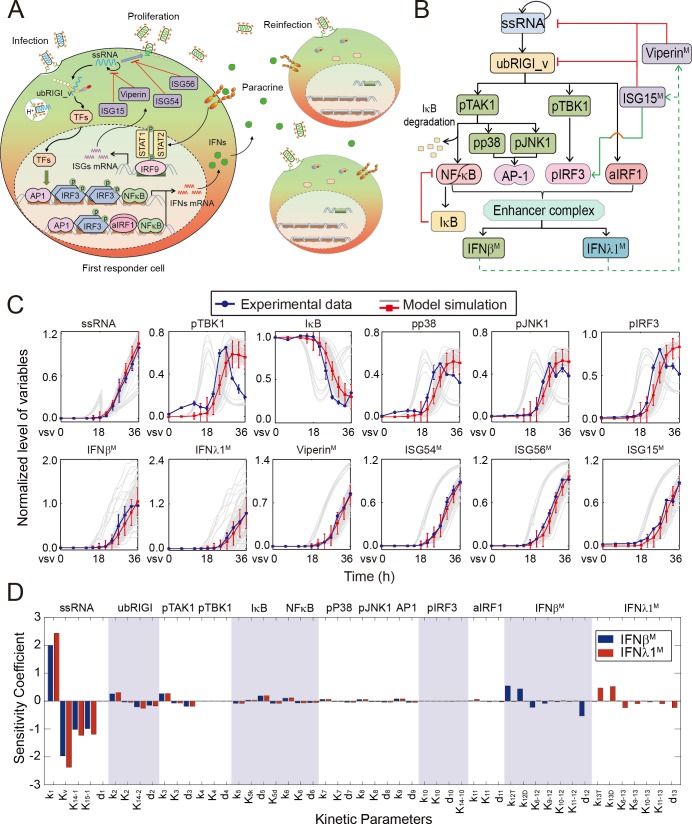
The interferons (IFNs) responses to viral infection are heterogeneous, while the underlying mechanisms for variability among cells are still not clear. In this study, we developed a hybrid model to systematically identify the sources of IFN induction heterogeneity. The experiment-integrated simulation demonstrated that the viral dose/type, the diversity in transcriptional factors activation and the intercellular paracrine signaling could strikingly shape the heterogeneity of IFN expression. We further determined that the IFNβ and IFNλ1 induced diverse dynamics of IFN-stimulated genes (ISGs) production. Collectively, our findings revealed the intracellular and intercellular mechanisms contributing to cell-to-cell variation in IFN induction, and further demonstrated the significant effects of IFN heterogeneity on antagonizing viruses.
干扰素(IFNs)对病毒感染的反应具有异质性,而细胞间这种变异性的潜在机制仍不清楚。在本研究中,我们开发了一种混合模型来系统地识别干扰素诱导异质性的来源。实验与模拟相结合的结果表明,病毒剂量/类型、转录因子激活的多样性以及细胞间旁分泌信号能够显著塑造干扰素表达的异质性。我们进一步确定,IFNβ和IFNλ1诱导了干扰素刺激基因(ISGs)产生的不同动态变化。总的来说,我们的研究结果揭示了细胞内和细胞间机制导致干扰素诱导的细胞间差异,并进一步证明了干扰素异质性在对抗病毒方面的显著作用。