Pat McPherson Centre for Pharmacogenetics & Pharmacogenomics, Division of Molecular & Clinical Medicine, University of Dundee, Ninewells Hospital and Medical School, Dundee DD19SY, UK.
Institute of Translation Medicine, University of Liverpool, Liverpool L69 3BX, UK.
Eur Heart J. 2017 Dec 21;38(48):3569-3575. doi: 10.1093/eurheartj/ehx467.
A genetic variant in LILRB5 (leukocyte immunoglobulin-like receptor subfamily-B) (rs12975366: T > C: Asp247Gly) has been reported to be associated with lower creatine phosphokinase (CK) and lactate dehydrogenase (LDH) levels. Both biomarkers are released from injured muscle tissue, making this variant a potential candidate for susceptibility to muscle-related symptoms. We examined the association of this variant with statin intolerance ascertained from electronic medical records in the GoDARTS study.
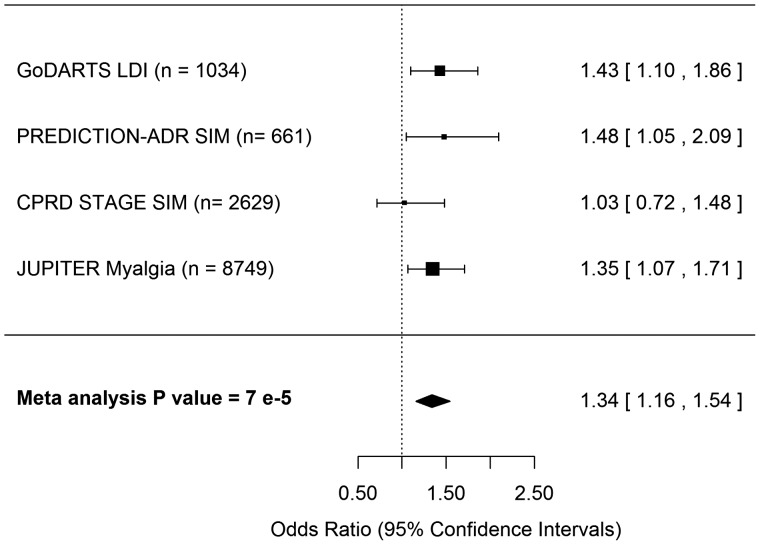
In the GoDARTS cohort, the LILRB5 Asp247 variant was associated with statin intolerance (SI) phenotypes; one defined as having raised CK and being non-adherent to therapy [odds ratio (OR) 1.81; 95% confidence interval (CI): 1.34-2.45] and the other as being intolerant to the lowest approved dose of a statin before being switched to two or more other statins (OR 1.36; 95% CI: 1.07-1.73). Those homozygous for Asp247 had increased odds of developing both definitions of intolerance. Importantly the second definition did not rely on CK elevations. These results were replicated in adjudicated cases of statin-induced myopathy in the PREDICTION-ADR consortium (OR1.48; 95% CI: 1.05-2.10) and for the development of myalgia in the JUPITER randomized clinical trial of rosuvastatin (OR1.35, 95% CI: 1.10-1.68). A meta-analysis across the studies showed a consistent association between Asp247Gly and outcomes associated with SI (OR1.34; 95% CI: 1.16-1.54).
This study presents a novel immunogenetic factor associated with statin intolerance, an important risk factor for cardiovascular outcomes. The results suggest that true statin-induced myalgia and non-specific myalgia are distinct, with a potential role for the immune system in their development. We identify a genetic group that is more likely to be intolerant to their statins.
白细胞免疫球蛋白样受体亚家族 B(LILRB5)(rs12975366:T>C:Asp247Gly)的一个遗传变异与较低的肌酸磷酸激酶(CK)和乳酸脱氢酶(LDH)水平有关。这两种生物标志物均来自受损的肌肉组织,因此该变体是对肌肉相关症状易感性的潜在候选者。我们在 GoDARTS 研究中通过电子病历检查了该变体与他汀类药物不耐受的关联。
在 GoDARTS 队列中,LILRB5 Asp247 变体与他汀类药物不耐受(SI)表型相关;一种定义为 CK 升高且不依从治疗[比值比(OR)1.81;95%置信区间(CI):1.34-2.45],另一种定义为在换用两种或更多种其他他汀类药物之前,对最低批准剂量的他汀类药物不耐受[OR 1.36;95%CI:1.07-1.73]。Asp247 纯合子的个体发生这两种不耐受定义的可能性增加。重要的是,第二个定义不依赖于 CK 升高。这些结果在 PREDICTION-ADR 联盟的他汀类药物诱导肌病的裁决案例中得到了复制(OR1.48;95%CI:1.05-2.10),并且在 JUPITER 罗苏伐他汀随机临床试验中也复制了肌痛的发生(OR1.35,95%CI:1.10-1.68)。对研究的荟萃分析显示,Asp247Gly 与 SI 相关的结局之间存在一致的关联(OR1.34;95%CI:1.16-1.54)。
本研究提出了一个与他汀类药物不耐受相关的新型免疫遗传因素,这是心血管结局的一个重要危险因素。结果表明,真正的他汀类药物诱导的肌痛和非特异性肌痛是不同的,免疫系统可能在其发展中起作用。我们确定了一个更容易对他汀类药物不耐受的遗传群体。