Yokoshiki Hisashi, Mitsuyama Hirofumi, Watanabe Masaya, Mitsuhashi Takeshi, Shimizu Akihiko
Department of Cardiovascular Medicine, Hokkaido University Graduate School of Medicine, Japan.
Cardiovascular Medicine, Jichi Medical University Saitama Medical Center, Japan.
J Arrhythm. 2017 Oct;33(5):410-416. doi: 10.1016/j.joa.2017.03.002. Epub 2017 Apr 21.
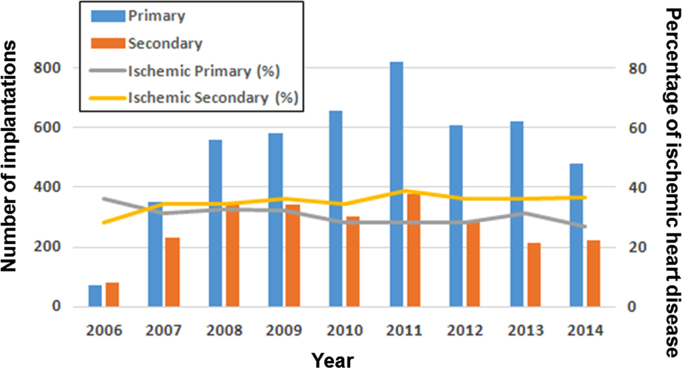
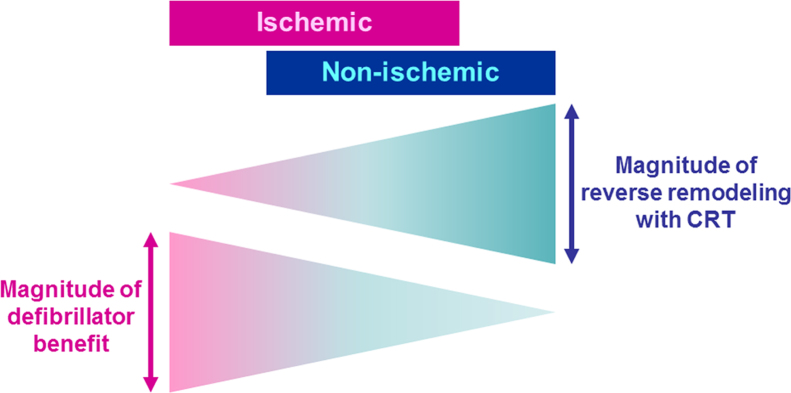
Cardiac resynchronization therapy (CRT) using a biventricular pacing system has been an effective therapeutic strategy in patients with symptomatic heart failure with a reduced left ventricular ejection fraction (LVEF) of 35% or less and a QRS duration of 130 ms or more. The etiology of heart failure can be classified as either ischemic or non-ischemic cardiomyopathy. Ischemic etiology of patients receiving CRT is prevalent predominantly in North America, moderately in Europe, and less so in Japan. CRT reduces mortality similarly in both ischemic and non-ischemic cardiomyopathy, whereas reverse structural left ventricular remodeling occurs more favorably in non-ischemic cardiomyopathy. Because the substrate for ventricular arrhythmias appears to be more severe in cases of ischemic as compared with non-ischemic cardiomyopathy, the use of an implantable cardioverter-defibrillator (ICD) backup method could prolong the long-term survival, especially of patients with ischemic cardiomyopathy, even in the presence of CRT. The aim of this review article is to summarize the effects of CRT on outcomes and the role of ICD backup in ischemic and non-ischemic cardiomyopathy.
使用双心室起搏系统的心脏再同步治疗(CRT)已成为左心室射血分数(LVEF)降低至35%或更低且QRS波时限为130毫秒或更长的有症状心力衰竭患者的有效治疗策略。心力衰竭的病因可分为缺血性或非缺血性心肌病。接受CRT治疗的患者中,缺血性病因在北美最为普遍,在欧洲次之,在日本则较少见。CRT在缺血性和非缺血性心肌病中降低死亡率的效果相似,而左心室结构逆向重塑在非缺血性心肌病中更为明显。由于与非缺血性心肌病相比,缺血性心肌病患者发生室性心律失常的基础似乎更为严重,因此即使在有CRT的情况下,使用植入式心脏复律除颤器(ICD)备用方法也可能延长长期生存率,尤其是缺血性心肌病患者。这篇综述文章的目的是总结CRT对预后的影响以及ICD备用在缺血性和非缺血性心肌病中的作用。