El-Chami Mikhael F, Matar Lea, Smith Paige, Casey Mary, Addish Maher A, Kelly Kimberly, Wood Carolyn, Merlino John, Goyal Abhinav, Leon Angel R, Merchant Faisal M
Department of Medicine Division of Cardiology-Section of Electrophysiology, Emory University School of Medicine, Atlanta, GA, United States.
Rollins School of Public Health, Emory University, Atlanta, GA, United States.
J Arrhythm. 2017 Oct;33(5):459-462. doi: 10.1016/j.joa.2017.05.002. Epub 2017 May 30.
The efficacy of implantable cardioverter-defibrillators (ICD) for primary prevention of sudden cardiac death (SCD) has not been studied in patients with end-stage renal disease (ESRD) and left ventricular dysfunction. We sought to identify predictors of long-term survival among ICD recipients with and without ESRD.
Patients implanted with an ICD at our institution from January 2006 to March 2014 were retrospectively identified. Clinical and demographic characteristics were collected. Patients were stratified by the presence of ESRD at the time of ICD implant. Mortality data were collected from the Social Security Death Index (SSDI).
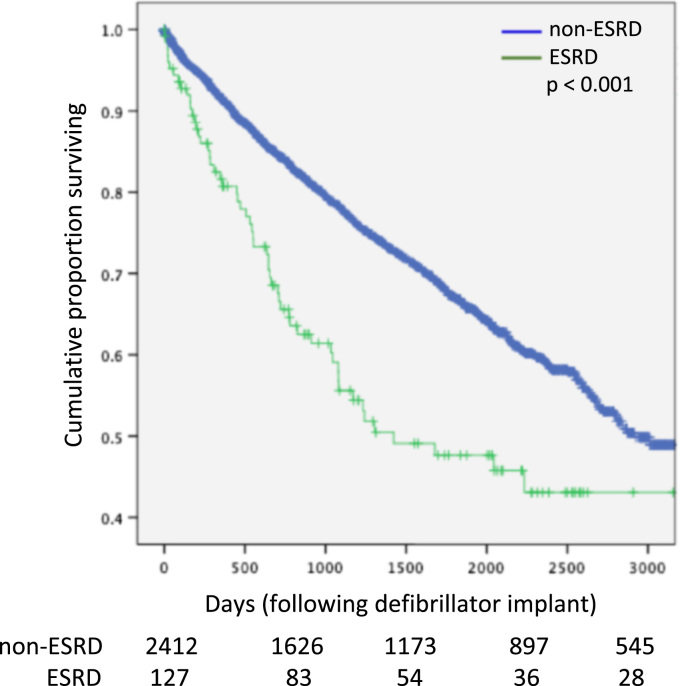
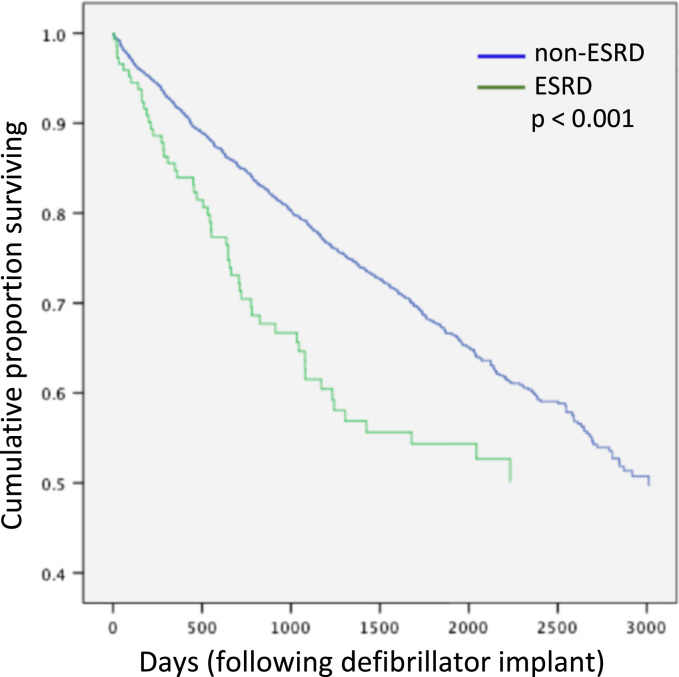
A total of 3453 patients received an ICD at our institution in the pre-specified time period, 184 (5.3%) of whom had ESRD. In general, ESRD patients were sicker and had more comorbidities. Kaplan Meier survival curve showed that ESRD patients had worse survival as compared with non-dialysis patients (<0.001). Following adjustment for differences in baseline characteristics, patients with ESRD remained at increased long-term mortality in the Cox model. The one-year mortality in the ESRD patients was 18.1%, as compared with 7.7% in the non-dialysis cohort (<0.001). The three-year mortality in ESRD patients was 43%, as compared with 21% in the non-dialysis cohort (<0.001).
ESRD patients are at significantly increased risk of mortality as compared with a non-dialysis cohort. While the majority of these patients survive more than one year post-diagnosis, the three-year mortality is high (43%). Randomized studies addressing the benefits of ICDs in ESRD patients are needed to better define their value for primary prevention of SCD.
对于终末期肾病(ESRD)合并左心室功能障碍的患者,植入式心脏复律除颤器(ICD)用于心脏性猝死(SCD)一级预防的疗效尚未得到研究。我们试图确定有或无ESRD的ICD植入患者长期生存的预测因素。
对2006年1月至2014年3月在我们机构植入ICD的患者进行回顾性识别。收集临床和人口统计学特征。根据ICD植入时是否存在ESRD对患者进行分层。从社会保障死亡指数(SSDI)收集死亡率数据。
在预先指定的时间段内,共有3453例患者在我们机构接受了ICD植入,其中184例(5.3%)患有ESRD。总体而言,ESRD患者病情更重,合并症更多。Kaplan Meier生存曲线显示,与非透析患者相比,ESRD患者的生存率更差(<0.001)。在对基线特征差异进行调整后,ESRD患者在Cox模型中仍具有较高的长期死亡率。ESRD患者的一年死亡率为18.1%,而非透析队列中的死亡率为7.7%(<0.001)。ESRD患者的三年死亡率为43%,而非透析队列中的死亡率为21%(<0.001)。
与非透析队列相比,ESRD患者的死亡风险显著增加。虽然这些患者中的大多数在诊断后存活超过一年,但三年死亡率很高(43%)。需要进行随机研究以探讨ICD对ESRD患者的益处,从而更好地确定其在SCD一级预防中的价值。