Lièvre Astrid, Ouine Bérèngere, Canet Jim, Cartier Aurélie, Amar Yael, Cacheux Wulfran, Mariani Odette, Guimbaud Rosine, Selves Janick, Lecomte Thierry, Guyetant Serge, Bieche Ivan, Berger Frédérique, de Koning Leanne
Service des maladies de l'appareil digestif, CHU Pontchaillou, 2 rue Henri Le Guilloux, Rennes cedex 09 35033, France.
Université Rennes 1, Faculté de médecine, 2 Avenue du Prof. Léon Bernard, Rennes 35043, France.
Br J Cancer. 2017 Dec 5;117(12):1819-1827. doi: 10.1038/bjc.2017.353. Epub 2017 Oct 12.
Metastatic colorectal cancer (mCRC) patients with mutant KRAS or NRAS are ineligible for anti-epidermal growth factor receptor (anti-EGFR) therapy, as RAS mutations activate downstream pathways independently of EGFR and induce primary resistance. However, even among RAS wild-type (WT) patients, only a fraction responds to anti-EGFR therapy, suggesting that other mechanisms of resistance exist. We hypothesise that different (epi)genetic alterations can lead to primary anti-EGFR resistance and that the crucial end point is the activation of protein signalling pathways.
We analysed the expression and activation of proteins involved in cell signalling, using reverse phase protein arrays, on a multicentre French cohort of RAS WT mCRC treated with anti-EGFR treatment.
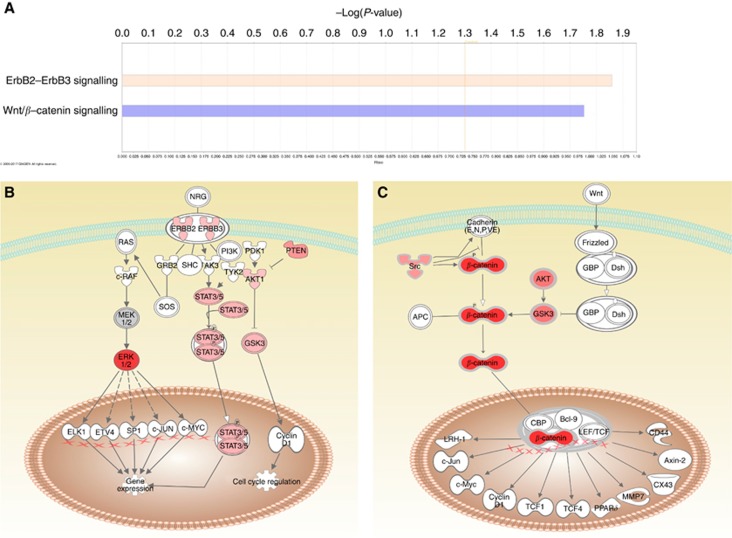
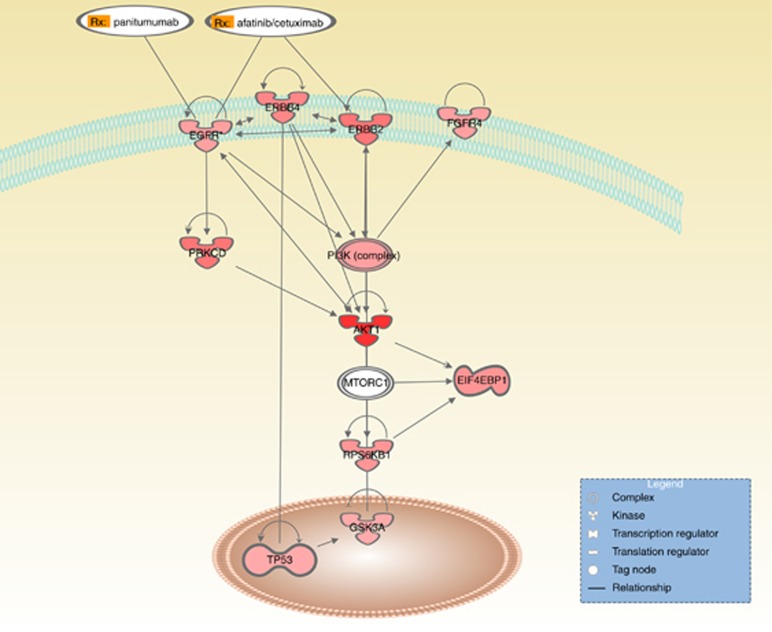
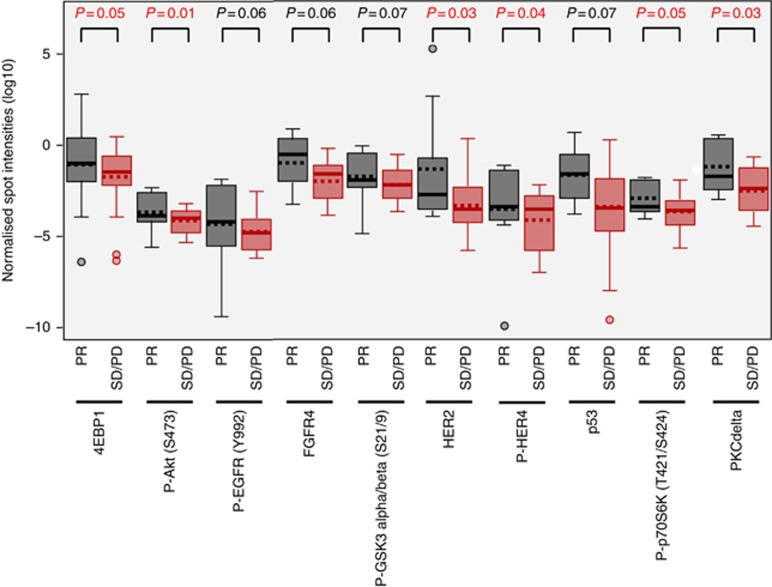
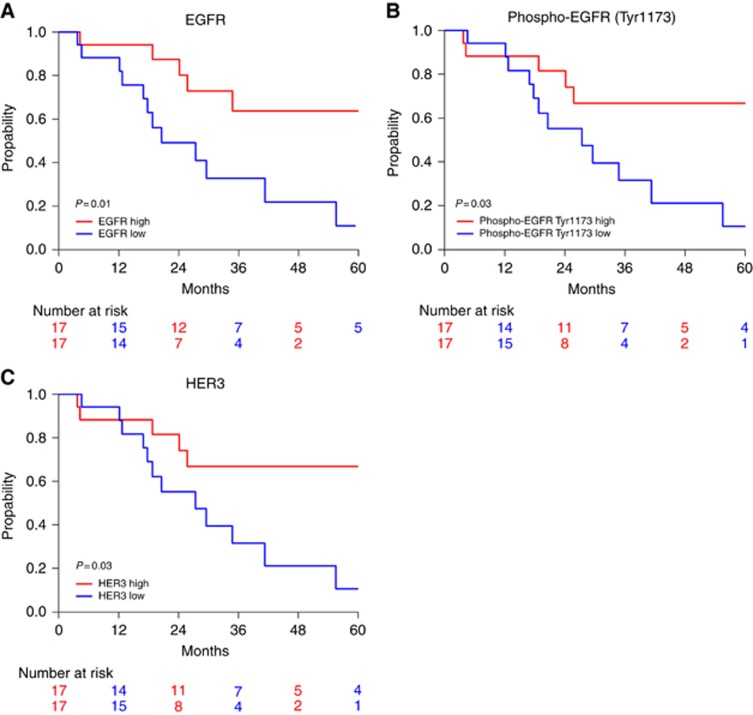
We identify activated EGFR and HER3 as protein biomarkers predictive for better overall survival. Active EGFR signalling and downstream PI3K, but not MAPK, pathway activation are associated with response to anti-EGFR treatment. Left-sided mCRC displays active ErbB2/3 and Wnt pathways and a better response to anti-EGFR therapy compared to right-sided mCRC.
We identify active EGFR and PI3K signalling as a key factor for response to anti-EGFR treatment in mCRC and highlight the importance of developing these biomarkers in clinical practice for the selection of RAS WT mCRC patients that would benefit from anti-EGFR treatment.
携带KRAS或NRAS突变的转移性结直肠癌(mCRC)患者不符合接受抗表皮生长因子受体(anti-EGFR)治疗的条件,因为RAS突变可独立于EGFR激活下游通路并诱导原发性耐药。然而,即使在RAS野生型(WT)患者中,也只有一部分对抗EGFR治疗有反应,这表明存在其他耐药机制。我们假设不同的(表观)遗传改变可导致原发性抗EGFR耐药,且关键终点是蛋白信号通路的激活。
我们使用反相蛋白阵列分析了参与细胞信号传导的蛋白的表达和激活情况,该分析基于一个接受抗EGFR治疗的法国多中心RAS WT mCRC队列。
我们确定激活的EGFR和HER3作为预测更好总生存期的蛋白生物标志物。活跃的EGFR信号传导以及下游PI3K而非MAPK通路的激活与抗EGFR治疗的反应相关。与右侧mCRC相比,左侧mCRC显示出活跃的ErbB2/3和Wnt通路,并且对抗EGFR治疗反应更好。
我们确定活跃的EGFR和PI3K信号传导是mCRC患者对抗EGFR治疗反应的关键因素,并强调在临床实践中开发这些生物标志物对于选择将从抗EGFR治疗中获益的RAS WT mCRC患者的重要性。