Department of Hematology, Nephrology, and Rheumatology, Akita University Graduate School of Medicine.
Division of Hematology/Oncology, Department of Medicine, Kameda Medical Center, Kamogawa, Japan.
Haematologica. 2018 Jan;103(1):126-135. doi: 10.3324/haematol.2017.177279. Epub 2017 Oct 12.
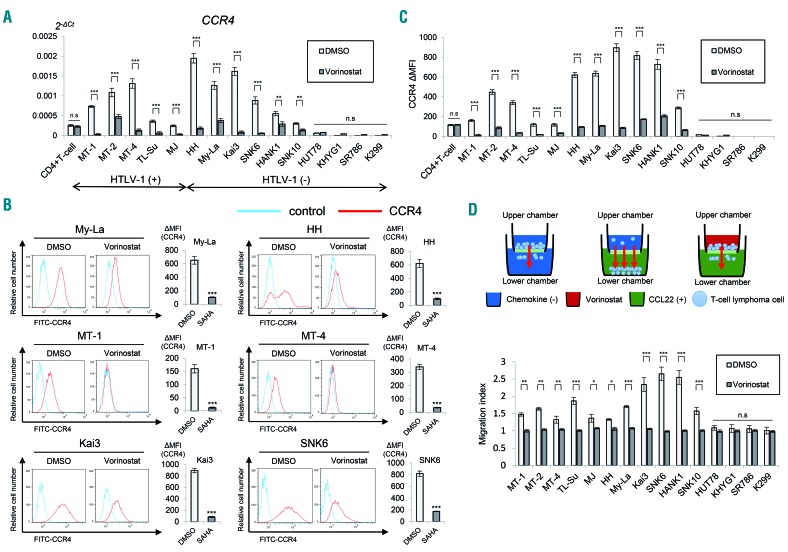
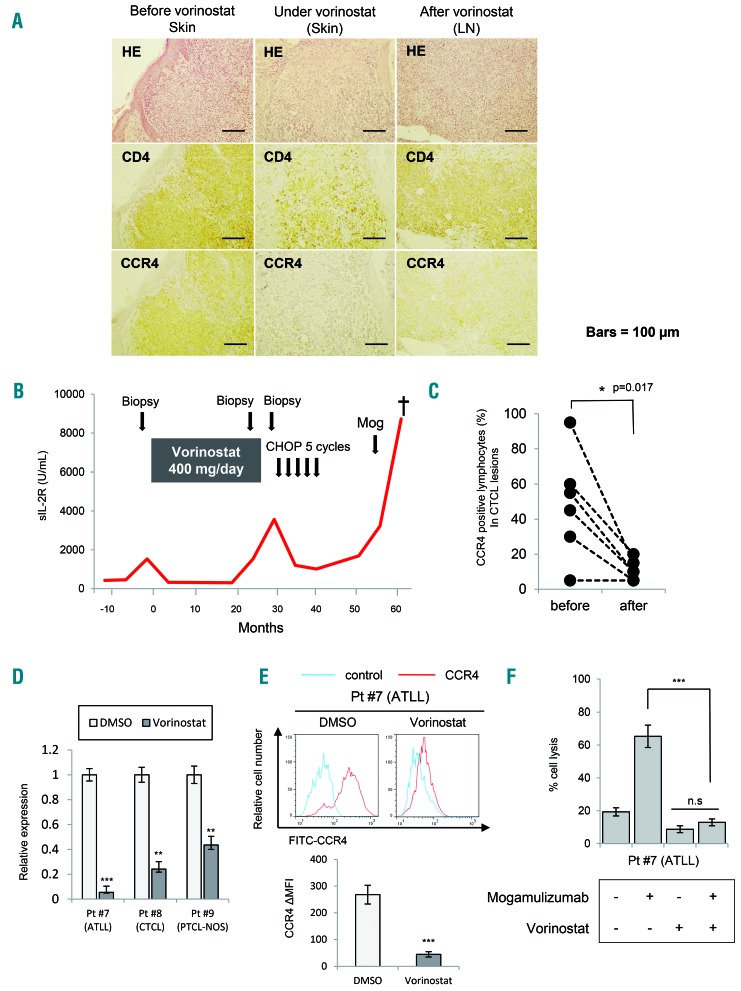
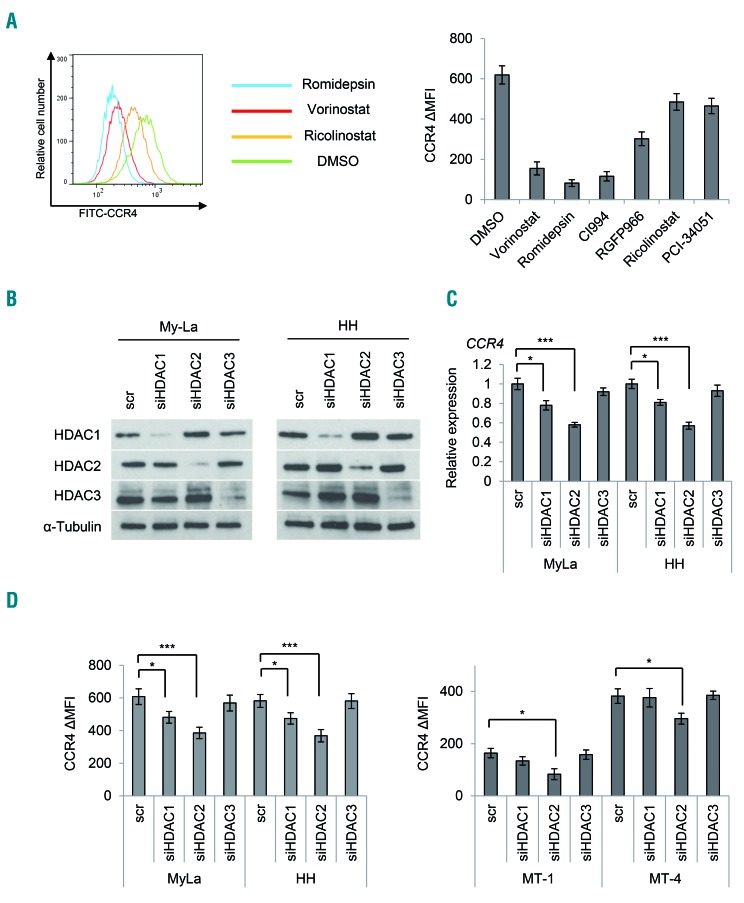
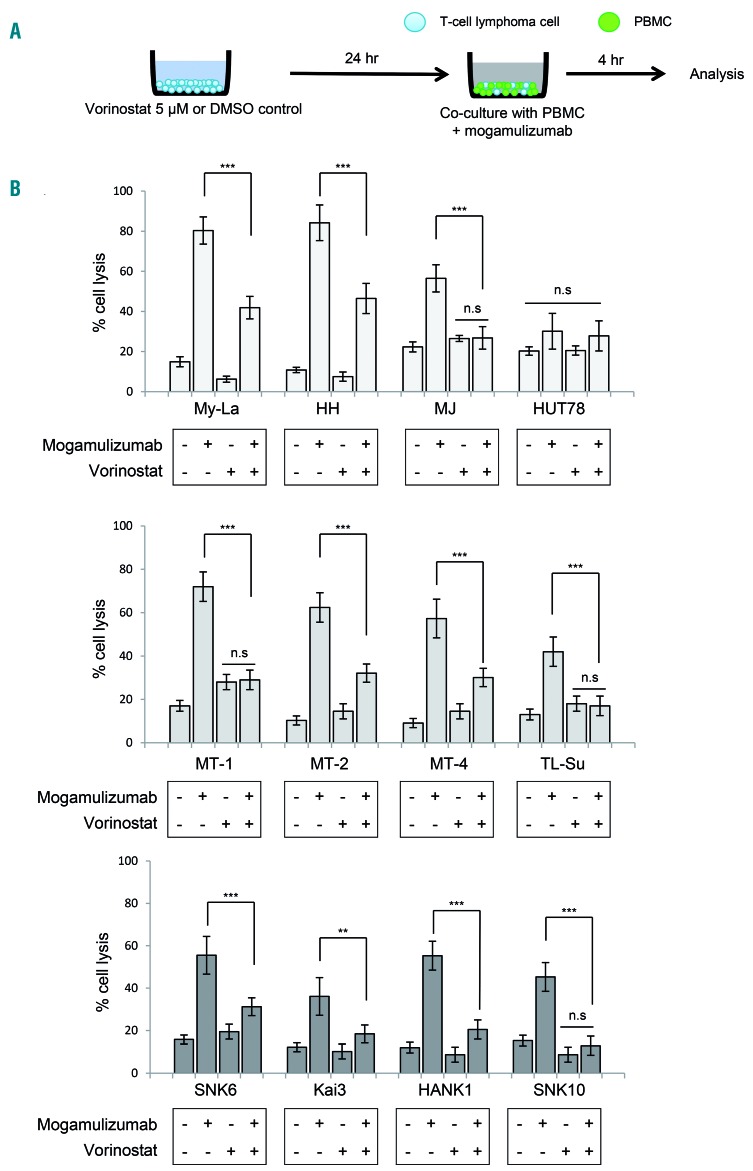
Histone deacetylase inhibitors are promising agents for various T-cell lymphomas, including cutaneous T-cell lymphoma, peripheral T-cell lymphoma, and adult T-cell lymphoma/leukemia. CCR4 is an important therapeutic target molecule because mogamulizumab, an anti-CCR4 antibody, has shown promising efficacy against various T-cell lymphomas. In this study, we examined the synergistic effects of mogamulizumab and histone deacetylase inhibitors against various T-cell lymphomas. First, we examined the expression of CCR4 mRNA and surface CCR4 in various T-cell lymphoma cell lines and found that it was downregulated upon treatment with vorinostat, a pan-histone deacetylase inhibitor. Next, we used isoform-specific histone deacetylase inhibitors and short-interfering RNA to determine the histone deacetylase isoform involved in the regulation of CCR4, and demonstrated that romidepsin, a class I selective histone deacetylase inhibitor, reduced CCR4 most efficiently. Moreover, among class I histone deacetylases, histone deacetylase 2 knockdown led to a reduction of CCR4 in lymphoma cells, suggesting that CCR4 expression is mainly regulated by histone deacetylase 2. When we examined the CCR4 expression in skin samples from primary cutaneous T-cell lymphoma, obtained from the same patients before and after vorinostat treatment, we found that CCR4 expression was greatly reduced after treatment. Finally, when we conducted an antibody-dependent cell-mediated cytotoxicity assay with mogamulizumab by using various lymphoma cells, we found that the efficacy of mogamulizumab was significantly reduced by pretreatment with vorinostat. Altogether, our results suggest that the primary use of histone deacetylase inhibitors before treatment with mogamulizumab might not be suitable to obtain synergistic effects. Moreover, these results have potential implications for optimal therapeutic sequences in various CCR4-positive T-cell lymphomas.
组蛋白去乙酰化酶抑制剂是各种 T 细胞淋巴瘤的有前途的药物,包括皮肤 T 细胞淋巴瘤、外周 T 细胞淋巴瘤和成人 T 细胞淋巴瘤/白血病。CCR4 是一个重要的治疗靶点分子,因为莫格珠单抗,一种抗 CCR4 抗体,对各种 T 细胞淋巴瘤显示出有希望的疗效。在这项研究中,我们研究了莫格珠单抗和组蛋白去乙酰化酶抑制剂对各种 T 细胞淋巴瘤的协同作用。首先,我们检查了各种 T 细胞淋巴瘤细胞系中 CCR4 mRNA 和表面 CCR4 的表达情况,发现伏立诺他(一种泛组蛋白去乙酰化酶抑制剂)处理后其表达下调。接下来,我们使用同工型特异性组蛋白去乙酰化酶抑制剂和短发夹 RNA 来确定参与 CCR4 调节的组蛋白去乙酰化酶同工型,结果表明,一种 I 类选择性组蛋白去乙酰化酶抑制剂罗米地辛最有效地降低 CCR4。此外,在 I 类组蛋白去乙酰化酶中,组蛋白去乙酰化酶 2 的敲低导致淋巴瘤细胞中 CCR4 的减少,表明 CCR4 的表达主要受组蛋白去乙酰化酶 2 的调节。当我们检查来自同一患者的原发性皮肤 T 细胞淋巴瘤的皮肤样本中的 CCR4 表达情况时,发现伏立诺他治疗后 CCR4 表达明显降低。最后,当我们用各种淋巴瘤细胞进行莫格珠单抗的抗体依赖性细胞介导的细胞毒性试验时,发现用伏立诺他预处理显著降低了莫格珠单抗的疗效。总的来说,我们的结果表明,在使用莫格珠单抗之前,原发性使用组蛋白去乙酰化酶抑制剂可能不适合获得协同作用。此外,这些结果对各种 CCR4 阳性 T 细胞淋巴瘤的最佳治疗顺序具有潜在意义。