Schapira Matthieu, Tyers Mike, Torrent Maricel, Arrowsmith Cheryl H
Structural Genomics Consortium, University of Toronto, Toronto, 101 College St, MaRS South Tower, Suite 700, Ontario M5G 1L7, Canada.
Department of Pharmacology and Toxicology, Medical Science Building, Room 4207, 1 King's College Circle, University of Toronto, Toronto, Ontario M5S 1A8, Canada.
Nat Rev Drug Discov. 2017 Nov;16(11):773-786. doi: 10.1038/nrd.2017.179. Epub 2017 Oct 13.
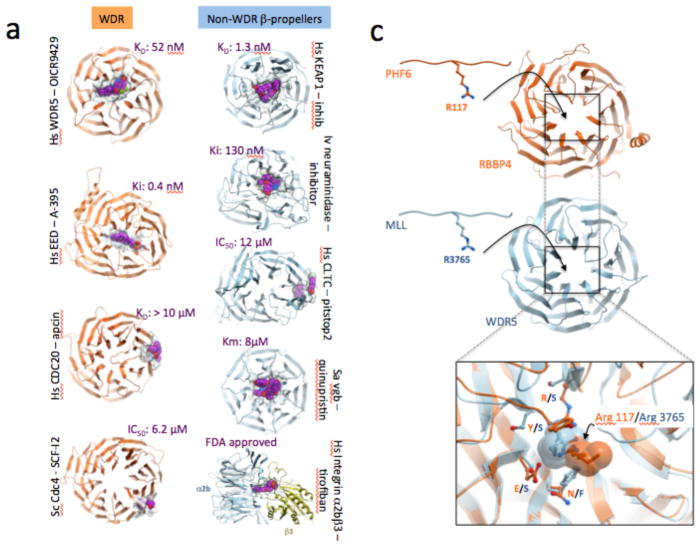
Antagonism of protein-protein interactions (PPIs) with small molecules is becoming more feasible as a therapeutic approach. Successful PPI inhibitors tend to target proteins containing deep peptide-binding grooves or pockets rather than the more common large, flat protein interaction surfaces. Here, we review one of the most abundant PPI domains in the human proteome, the WD40 repeat (WDR) domain, which has a central peptide-binding pocket and is a member of the β-propeller domain-containing protein family. Recently, two WDR domain-containing proteins, WDR5 and EED, as well as other β-propeller domains have been successfully targeted by potent, specific, cell-active, drug-like chemical probes. Could WDR domains be a novel target class for drug discovery? Although the research is at an early stage and therefore not clinically validated, cautious optimism is justified, as WDR domain-containing proteins are involved in multiple disease-associated pathways. The druggability and structural diversity of WDR domain binding pockets suggest that understanding how to target this prevalent domain class will open up areas of disease biology that have so far resisted drug discovery efforts.
利用小分子拮抗蛋白质-蛋白质相互作用(PPI)作为一种治疗方法正变得越来越可行。成功的PPI抑制剂往往靶向含有深肽结合凹槽或口袋的蛋白质,而非更常见的大的、扁平的蛋白质相互作用表面。在此,我们综述人类蛋白质组中最丰富的PPI结构域之一,WD40重复(WDR)结构域,它有一个中心肽结合口袋,是含β-螺旋桨结构域蛋白质家族的成员。最近,两种含WDR结构域的蛋白质,WDR5和EED,以及其他β-螺旋桨结构域已被强效、特异、具有细胞活性、类似药物的化学探针成功靶向。WDR结构域会成为药物研发的新型靶点类别吗?尽管该研究尚处于早期阶段,因此尚未经过临床验证,但谨慎的乐观态度是合理的,因为含WDR结构域的蛋白质参与多种疾病相关途径。WDR结构域结合口袋的可成药性和结构多样性表明,了解如何靶向这一普遍的结构域类别将开辟迄今为止药物研发努力尚未攻克的疾病生物学领域。