Drewes Carine C, Alves Aline de Cs, Hebeda Cristina B, Copetti Isabela, Sandri Silvana, Uchiyama Mayara K, Araki Koiti, Guterres Silvia S, Pohlmann Adriana R, Farsky Sandra H
Department of Clinical and Toxicological Analyses, School of Pharmaceutical Sciences, University of São Paulo, São Paulo.
Postgraduate Program in Pharmaceutical Sciences.
Int J Nanomedicine. 2017 Sep 27;12:7153-7163. doi: 10.2147/IJN.S140557. eCollection 2017.
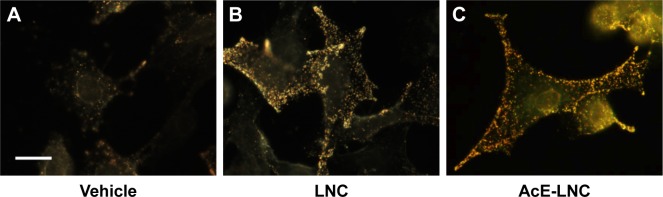
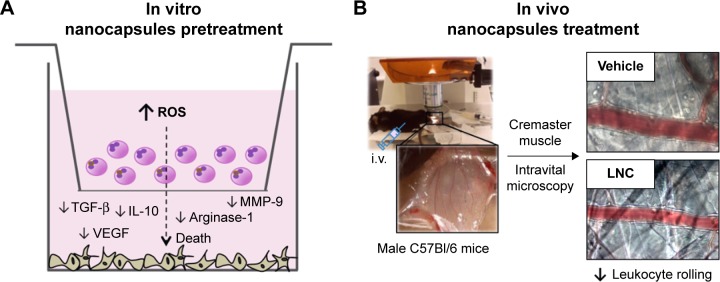
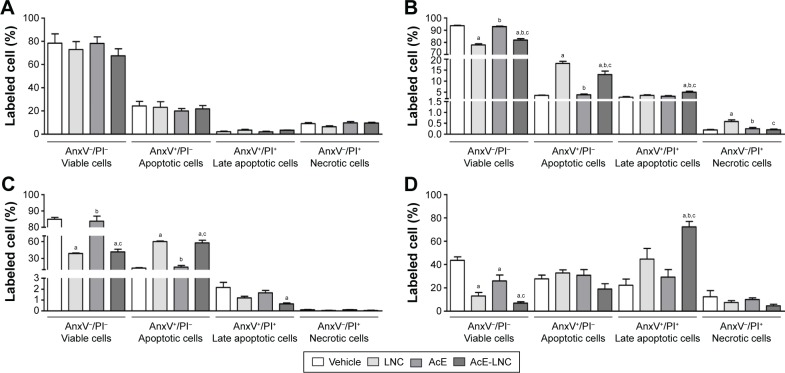
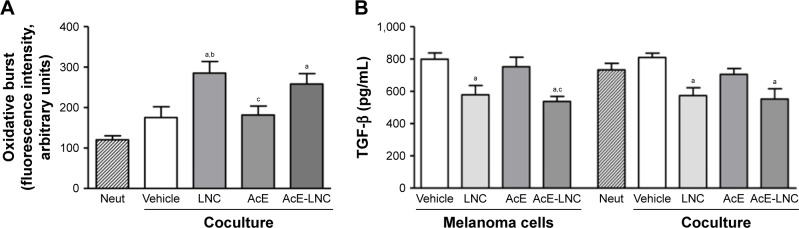
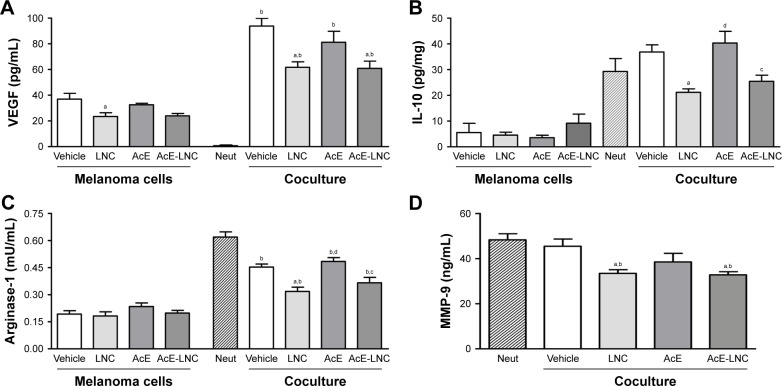
Metastatic melanoma is an aggressive cancer with increasing incidence and limited therapies in advanced stages. Systemic neutrophilia or abundant neutrophils in the tumor contribute toward its worst prognosis, and the interplay of cancer and the immune system has been shown in tumor development and metastasis. We recently showed the in vivo efficacy of poly(ε-caprolactone) lipid-core nanocapsule (LNC) or LNC loaded with acetyleugenol (AcE-LNC) to treat B16F10-induced melanoma in mice. In this study, we investigated whether LNC or AcE-LNC toxicity could involve modifications on crosstalk of melanoma cells and neutrophils. Therefore, melanoma cells (B16F10) were pretreated with vehicle, LNC, AcE or AcE-LNC for 24 h, washed and, further, cocultured for 18 h with peritoneal neutrophils obtained from C57Bl/6 mice. Melanoma cells were able to internalize the LNC or AcE-LNC after 2 h of incubation. LNC or AcE-LNC pretreatments did not cause melanoma cells death, but led melanoma cells to be more susceptible to death in serum deprivation or hypoxia or in the presence of neutrophils. Interestingly, the production of reactive oxygen species (ROS), which causes cell death, was increased by neutrophils in the presence of LNC- and AcE-LNC-pretreated melanoma cells. LNC or AcE-LNC treatments reduced the concentration of transforming growth factor-β (TGF-β) in the supernatant of melanoma cells, a known factor secreted by cancer cells to induce pro-tumoral actions of neutrophils in the tumor microenvironment. In addition, we found reduced levels of pro-tumoral chemical mediators VEGF, arginase-1, interleukin-10 (IL-10) and matrix metalloproteinase-9 (MMP-9) in the supernatant of LNC or AcE-LNC-pretreated melanoma cells and cocultured with neutrophils. Overall, our data show that the uptake of LNC or AcE-LNC by melanoma cells affects intracellular mechanisms leading to more susceptibility to death and also signals higher neutrophil antitumoral activity.
转移性黑色素瘤是一种侵袭性癌症,其发病率不断上升,晚期治疗方法有限。全身嗜中性粒细胞增多或肿瘤中大量嗜中性粒细胞会导致其预后最差,并且癌症与免疫系统之间的相互作用已在肿瘤发生和转移中得到证实。我们最近展示了聚(ε-己内酯)脂质核纳米胶囊(LNC)或负载乙酰丁香酚的LNC(AcE-LNC)在治疗小鼠B16F10诱导的黑色素瘤中的体内疗效。在本研究中,我们调查了LNC或AcE-LNC的毒性是否可能涉及黑色素瘤细胞与嗜中性粒细胞相互作用的改变。因此,黑色素瘤细胞(B16F10)用载体、LNC、乙酰丁香酚或AcE-LNC预处理24小时,洗涤后,再与从C57Bl/6小鼠获得的腹腔嗜中性粒细胞共培养18小时。孵育2小时后,黑色素瘤细胞能够内化LNC或AcE-LNC。LNC或AcE-LNC预处理不会导致黑色素瘤细胞死亡,但会使黑色素瘤细胞在血清剥夺、缺氧或存在嗜中性粒细胞的情况下更容易死亡。有趣的是,在存在LNC和AcE-LNC预处理的黑色素瘤细胞的情况下,嗜中性粒细胞会增加导致细胞死亡的活性氧(ROS)的产生。LNC或AcE-LNC处理降低了黑色素瘤细胞上清液中转化生长因子-β(TGF-β)的浓度,TGF-β是癌细胞分泌的一种已知因子,可以在肿瘤微环境中诱导嗜中性粒细胞的促肿瘤作用。此外,我们发现LNC或AcE-LNC预处理的黑色素瘤细胞与嗜中性粒细胞共培养的上清液中,促肿瘤化学介质血管内皮生长因子(VEGF)、精氨酸酶-1、白细胞介素-10(IL-10)和基质金属蛋白酶-9(MMP-9)的水平降低。总体而言,我们的数据表明,黑色素瘤细胞对LNC或AcE-LNC的摄取会影响细胞内机制,导致更容易死亡,同时也表明嗜中性粒细胞具有更高的抗肿瘤活性。