Institute of Integrative Biology, ETH Zurich, Zurich, Switzerland.
Division of Infectious Diseases and Hospital Epidemiology, University Hospital Zurich, Zurich, Switzerland.
Mol Biol Evol. 2018 Jan 1;35(1):27-37. doi: 10.1093/molbev/msx246.
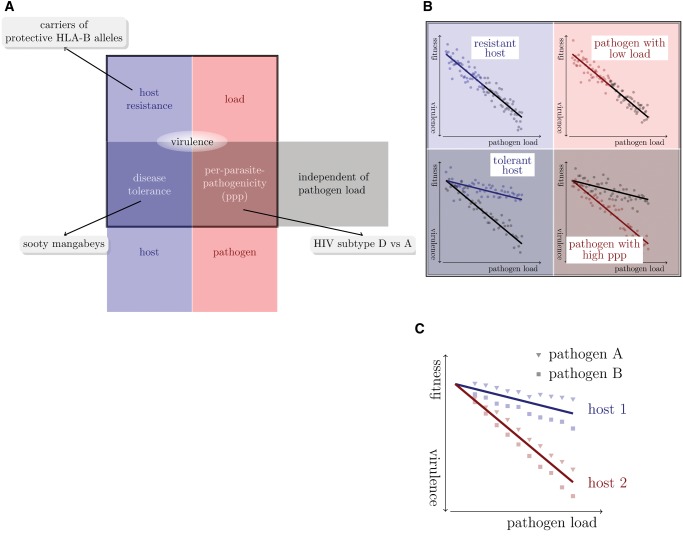
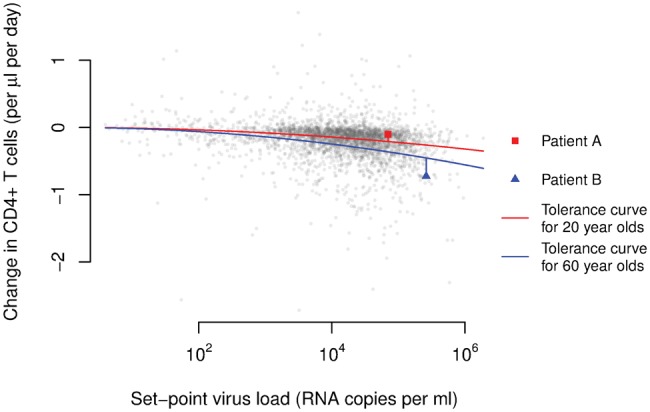
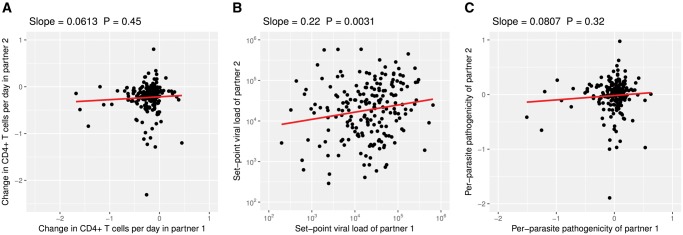
Pathogen strains may differ in virulence because they attain different loads in their hosts, or because they induce different disease-causing mechanisms independent of their load. In evolutionary ecology, the latter is referred to as "per-parasite pathogenicity". Using viral load and CD4+ T-cell measures from 2014 HIV-1 subtype B-infected individuals enrolled in the Swiss HIV Cohort Study, we investigated if virulence-measured as the rate of decline of CD4+ T cells-and per-parasite pathogenicity are heritable from donor to recipient. We estimated heritability by donor-recipient regressions applied to 196 previously identified transmission pairs, and by phylogenetic mixed models applied to a phylogenetic tree inferred from HIV pol sequences. Regressing the CD4+ T-cell declines and per-parasite pathogenicities of the transmission pairs did not yield heritability estimates significantly different from zero. With the phylogenetic mixed model, however, our best estimate for the heritability of the CD4+ T-cell decline is 17% (5-30%), and that of the per-parasite pathogenicity is 17% (4-29%). Further, we confirm that the set-point viral load is heritable, and estimate a heritability of 29% (12-46%). Interestingly, the pattern of evolution of all these traits differs significantly from neutrality, and is most consistent with stabilizing selection for the set-point viral load, and with directional selection for the CD4+ T-cell decline and the per-parasite pathogenicity. Our analysis shows that the viral genotype affects virulence mainly by modulating the per-parasite pathogenicity, while the indirect effect via the set-point viral load is minor.
病原体菌株在毒力上可能存在差异,因为它们在宿主中的载量不同,或者因为它们独立于载量诱导不同的致病机制。在进化生态学中,后者被称为“寄生虫每单位致病性”。利用来自瑞士艾滋病毒队列研究中 2014 年感染 HIV-1 亚型 B 的个体的病毒载量和 CD4+ T 细胞测量值,我们调查了作为 CD4+ T 细胞下降速度测量的毒力——以及寄生虫每单位致病性是否可以从供体遗传给受体。我们通过应用于 196 对先前确定的传播对的供体-受体回归,以及应用于从 HIV pol 序列推断的系统发育树的系统发育混合模型来估计遗传率。对传播对的 CD4+ T 细胞下降和寄生虫每单位致病性进行回归,并未得出显著不同于零的遗传率估计值。然而,通过系统发育混合模型,我们对 CD4+ T 细胞下降的遗传率的最佳估计值为 17%(5-30%),寄生虫每单位致病性的遗传率为 17%(4-29%)。此外,我们证实了设定点病毒载量是可遗传的,并且估计其遗传率为 29%(12-46%)。有趣的是,所有这些特征的进化模式与中性有很大不同,与设定点病毒载量的稳定选择以及与 CD4+ T 细胞下降和寄生虫每单位致病性的定向选择最一致。我们的分析表明,病毒基因型主要通过调节寄生虫每单位致病性来影响毒力,而通过设定点病毒载量的间接影响则较小。