Joshi Peter K, Pirastu Nicola, Kentistou Katherine A, Fischer Krista, Hofer Edith, Schraut Katharina E, Clark David W, Nutile Teresa, Barnes Catriona L K, Timmers Paul R H J, Shen Xia, Gandin Ilaria, McDaid Aaron F, Hansen Thomas Folkmann, Gordon Scott D, Giulianini Franco, Boutin Thibaud S, Abdellaoui Abdel, Zhao Wei, Medina-Gomez Carolina, Bartz Traci M, Trompet Stella, Lange Leslie A, Raffield Laura, van der Spek Ashley, Galesloot Tessel E, Proitsi Petroula, Yanek Lisa R, Bielak Lawrence F, Payton Antony, Murgia Federico, Concas Maria Pina, Biino Ginevra, Tajuddin Salman M, Seppälä Ilkka, Amin Najaf, Boerwinkle Eric, Børglum Anders D, Campbell Archie, Demerath Ellen W, Demuth Ilja, Faul Jessica D, Ford Ian, Gialluisi Alessandro, Gögele Martin, Graff MariaElisa, Hingorani Aroon, Hottenga Jouke-Jan, Hougaard David M, Hurme Mikko A, Ikram M Arfan, Jylhä Marja, Kuh Diana, Ligthart Lannie, Lill Christina M, Lindenberger Ulman, Lumley Thomas, Mägi Reedik, Marques-Vidal Pedro, Medland Sarah E, Milani Lili, Nagy Reka, Ollier William E R, Peyser Patricia A, Pramstaller Peter P, Ridker Paul M, Rivadeneira Fernando, Ruggiero Daniela, Saba Yasaman, Schmidt Reinhold, Schmidt Helena, Slagboom P Eline, Smith Blair H, Smith Jennifer A, Sotoodehnia Nona, Steinhagen-Thiessen Elisabeth, van Rooij Frank J A, Verbeek André L, Vermeulen Sita H, Vollenweider Peter, Wang Yunpeng, Werge Thomas, Whitfield John B, Zonderman Alan B, Lehtimäki Terho, Evans Michele K, Pirastu Mario, Fuchsberger Christian, Bertram Lars, Pendleton Neil, Kardia Sharon L R, Ciullo Marina, Becker Diane M, Wong Andrew, Psaty Bruce M, van Duijn Cornelia M, Wilson James G, Jukema J Wouter, Kiemeney Lambertus, Uitterlinden André G, Franceschini Nora, North Kari E, Weir David R, Metspalu Andres, Boomsma Dorret I, Hayward Caroline, Chasman Daniel, Martin Nicholas G, Sattar Naveed, Campbell Harry, Esko Tōnu, Kutalik Zoltán, Wilson James F
Centre for Global Health Research, Usher Institute for Population Health Sciences and Informatics, University of Edinburgh, Edinburgh, EH8 9AG, UK.
Centre for Cardiovascular Sciences, Queen's Medical Research Institute, University of Edinburgh, Edinburgh, EH16 4TJ, Scotland.
Nat Commun. 2017 Oct 13;8(1):910. doi: 10.1038/s41467-017-00934-5.
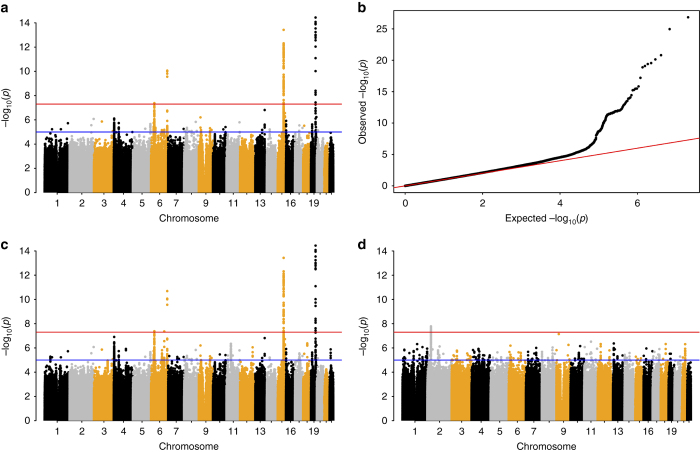
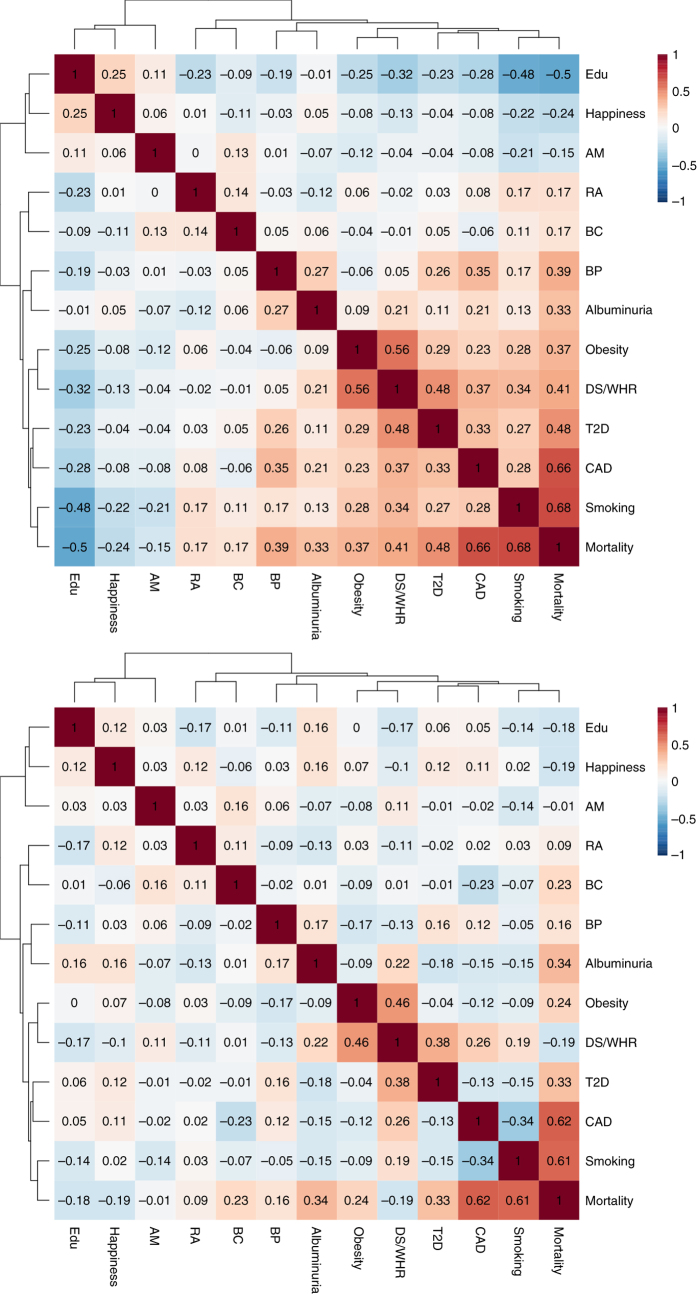
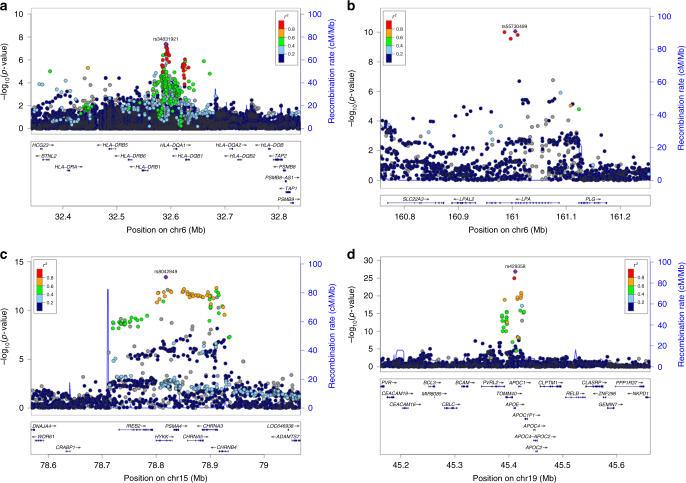
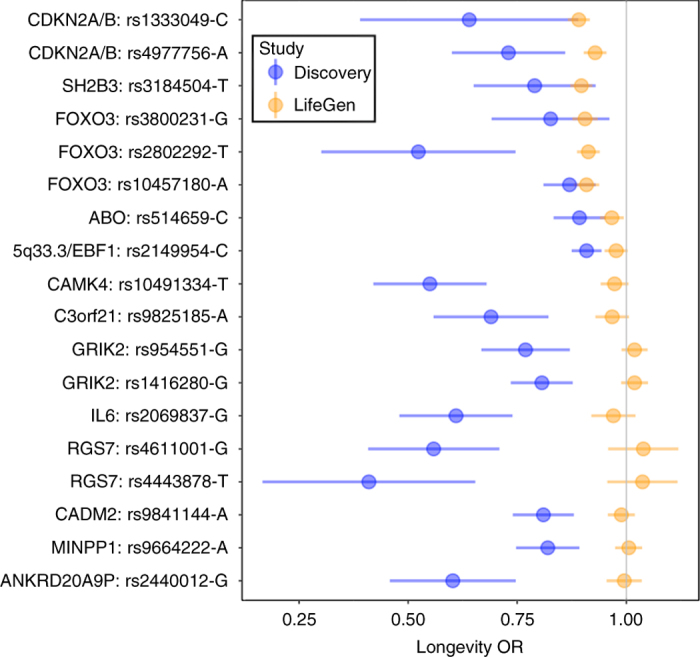
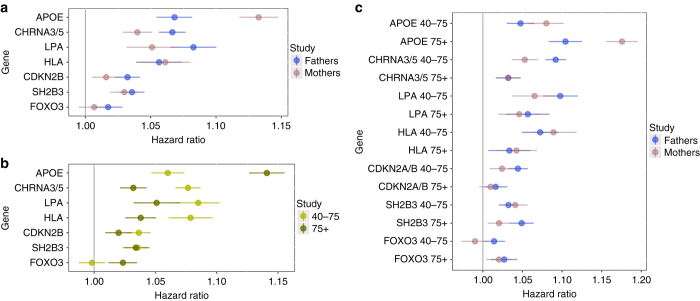
Genomic analysis of longevity offers the potential to illuminate the biology of human aging. Here, using genome-wide association meta-analysis of 606,059 parents' survival, we discover two regions associated with longevity (HLA-DQA1/DRB1 and LPA). We also validate previous suggestions that APOE, CHRNA3/5, CDKN2A/B, SH2B3 and FOXO3A influence longevity. Next we show that giving up smoking, educational attainment, openness to new experience and high-density lipoprotein (HDL) cholesterol levels are most positively genetically correlated with lifespan while susceptibility to coronary artery disease (CAD), cigarettes smoked per day, lung cancer, insulin resistance and body fat are most negatively correlated. We suggest that the effect of education on lifespan is principally mediated through smoking while the effect of obesity appears to act via CAD. Using instrumental variables, we suggest that an increase of one body mass index unit reduces lifespan by 7 months while 1 year of education adds 11 months to expected lifespan.Variability in human longevity is genetically influenced. Using genetic data of parental lifespan, the authors identify associations at HLA-DQA/DRB1 and LPA and find that genetic variants that increase educational attainment have a positive effect on lifespan whereas increasing BMI negatively affects lifespan.
长寿的基因组分析为阐明人类衰老生物学提供了可能。在此,我们对606,059名父母的生存情况进行全基因组关联荟萃分析,发现了两个与长寿相关的区域(HLA - DQA1/DRB1和LPA)。我们还验证了先前关于APOE、CHRNA3/5、CDKN2A/B、SH2B3和FOXO3A影响长寿的观点。接下来我们表明,戒烟、受教育程度、对新体验的开放性以及高密度脂蛋白(HDL)胆固醇水平与寿命呈最显著的正遗传相关性,而冠状动脉疾病(CAD)易感性、每日吸烟量、肺癌、胰岛素抵抗和体脂与寿命呈最显著的负相关性。我们认为,教育对寿命的影响主要通过吸烟介导,而肥胖的影响似乎通过CAD起作用。使用工具变量,我们表明体重指数每增加一个单位,寿命会缩短7个月,而接受1年教育会使预期寿命增加11个月。人类寿命的变异性受遗传影响。作者利用父母寿命的遗传数据,确定了HLA - DQA/DRB1和LPA的关联,并发现提高受教育程度的遗传变异对寿命有积极影响,而增加体重指数则对寿命有负面影响。