Lang Fabian, Wunderle Lydia, Pfeifer Heike, Schnittger Susanne, Bug Gesine, Ottmann Oliver G
Department of Hematology/Oncology, Goethe University Hospital, Frankfurt am Main, Germany.
MLL Munich Leukemia Laboratory, Munich, Germany.
Am J Case Rep. 2017 Oct 16;18:1099-1109. doi: 10.12659/ajcr.904956.
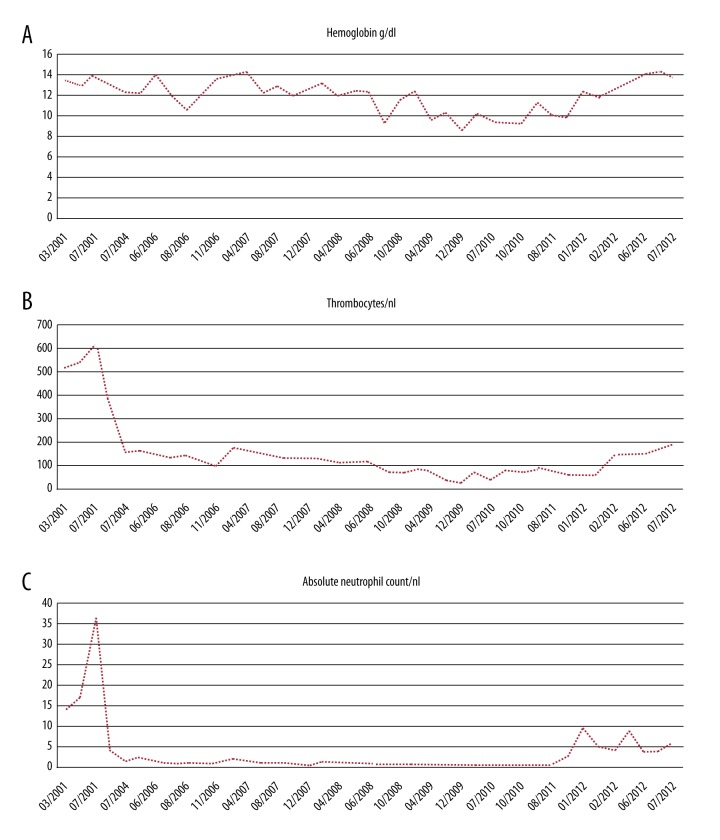
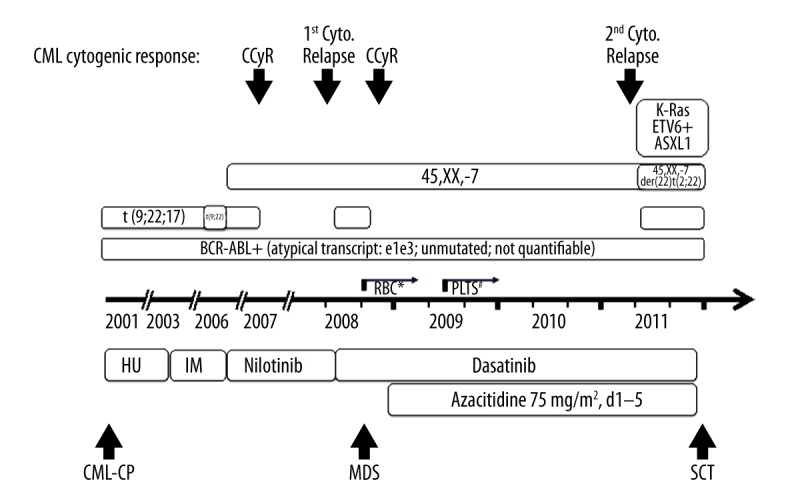
BACKGROUND CML presenting with a variant Philadelphia translocation, atypical BCR-ABL transcript, additional chromosomal aberrations, and evolving MDS is uncommon and therapeutically challenging. The prognostic significance of these genetic findings is uncertain, even as singular aberrations, with nearly no data on management and outcome when they coexist. MDS evolving during the course of CML may be either treatment-associated or an independently coexisting disease, and is generally considered to have an inferior prognosis. Tyrosine kinase inhibitors (TKI) directed against BCR-ABL are the mainstay of treatment for CML, whereas treatment modalities that may be utilized for MDS and CML include allogeneic stem cell transplant and - at least conceptually - hypomethylating agents. CASE REPORT Here, we describe the clinical course of such a patient, demonstrating that long-term combined treatment with dasatinib and azacitidine for coexisting CML and MDS is feasible and well tolerated, and may be capable of slowing disease progression. This combination therapy had no deleterious effect on subsequent potentially curative haploidentical bone marrow transplantation. CONCLUSIONS The different prognostic implications of this unusual case and new therapeutic options in CML are discussed, together with a review of the current literature on CML presenting with different types of genomic aberrations and the coincident development of MDS. Additionally, this case gives an example of long-term combined treatment of tyrosine kinase inhibitors and hypomethylating agents, which could be pioneering in CML treatment.
伴有变异型费城染色体易位、非典型BCR-ABL转录本、额外染色体畸变以及进展性骨髓增生异常综合征(MDS)的慢性髓性白血病(CML)并不常见,治疗上具有挑战性。这些基因发现的预后意义尚不确定,即使是单一畸变,当它们共存时,关于管理和结局的资料也几乎没有。CML病程中进展的MDS可能与治疗相关,也可能是独立并存的疾病,一般认为预后较差。针对BCR-ABL的酪氨酸激酶抑制剂(TKI)是CML治疗的主要手段,而可用于MDS和CML的治疗方式包括异基因干细胞移植以及——至少从概念上讲——去甲基化药物。病例报告:在此,我们描述了这样一位患者的临床病程,表明达沙替尼和阿扎胞苷联合长期治疗共存的CML和MDS是可行的,耐受性良好,并且可能能够减缓疾病进展。这种联合治疗对随后可能治愈的单倍体相合骨髓移植没有不良影响。结论:讨论了这一罕见病例的不同预后意义以及CML的新治疗选择,同时回顾了关于伴有不同类型基因组畸变及MDS同时发生的CML的当前文献。此外,该病例给出了酪氨酸激酶抑制剂和去甲基化药物联合长期治疗的实例,这在CML治疗中可能具有开创性。