Choudhuri Anirban Hom, Chakravarty Mitali, Uppal Rajeev
Department of Anaesthesiology and Intensive Care, GB Pant Institute of Postgraduate Medical Education and Research, New Delhi, India.
Saudi J Anaesth. 2017 Oct-Dec;11(4):402-407. doi: 10.4103/sja.SJA_230_17.
The prevalence of nosocomial infection is higher in the Intensive Care Unit (ICU) than other areas of the hospital. The present observational study was undertaken to describe the epidemiology and characteristics of nosocomial infections acquired in a tertiary care ICU and the impact of the various risk factors in their causation.
A retrospective study was conducted on the prospectively collected data of 153 consecutive patients admitted in a tertiary care ICU between July 2014 and December 2015. The primary objective was to assess the epidemiology of ICU-acquired bacterial infections in terms of the incidence of new infections, causative organism, and site. The secondary end point was to assess the risk factors for developing ICU-acquired infections.
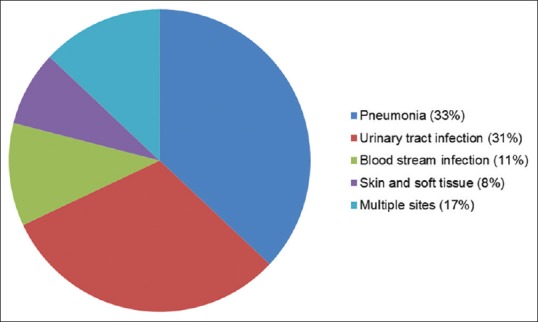
Out of the 153 patients enrolled in the study, 87 had an ICU-acquired nosocomial infection (58.86%). The most common organism responsible for infection was (37%), and the most common infection was pneumonia (33%). The duration of mechanical ventilation and length of ICU stay were significantly prolonged in patients developing nosocomial infections. There was no difference in mortality between the groups. The multivariate analyses identified intubation longer than 7 days, urinary catheterization >7 days, duration of mechanical ventilation more than 7 days, and ICU length of stay longer than 7 days as independent risk factors for nosocomial infections.
The study demonstrated a high incidence of nosocomial infection in the ICU and identified the risk factors for acquisition of nosocomial infections in the ICU.
重症监护病房(ICU)中医院感染的发生率高于医院的其他科室。本观察性研究旨在描述在一家三级医疗ICU中获得的医院感染的流行病学特征及相关特点,以及各种危险因素在其发病过程中的影响。
对2014年7月至2015年12月期间在一家三级医疗ICU连续收治的153例患者的前瞻性收集数据进行回顾性研究。主要目的是从新感染的发生率、病原体及感染部位方面评估ICU获得性细菌感染的流行病学情况。次要终点是评估发生ICU获得性感染的危险因素。
在纳入研究的153例患者中,87例发生了ICU获得性医院感染(58.86%)。引起感染最常见的病原体是……(37%),最常见的感染是肺炎(33%)。发生医院感染的患者机械通气时间和ICU住院时间显著延长。两组之间的死亡率无差异。多因素分析确定插管时间超过7天、导尿时间>7天、机械通气时间超过7天以及ICU住院时间超过7天是医院感染的独立危险因素。
该研究表明ICU中医院感染的发生率较高,并确定了ICU中获得医院感染的危险因素。