Grunau Anne, Escher Ulrike, Bereswill Stefan, Heimesaat Markus M
Charité - Universitätsmedizin Berlin, corporate member of Freie Universität Berlin, Humboldt-Universität zu Berlin, and Berlin Institute of Health, Department of Microbiology and Hygiene, Berlin, Germany.
Eur J Microbiol Immunol (Bp). 2017 Sep 11;7(3):210-219. doi: 10.1556/1886.2017.00023. eCollection 2017 Sep.
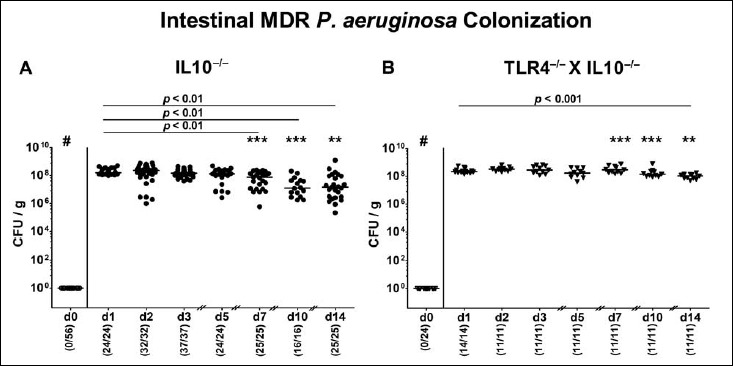
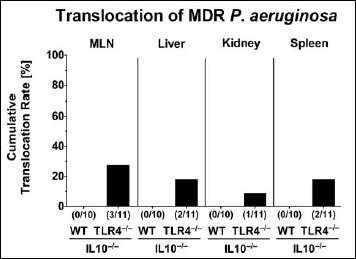
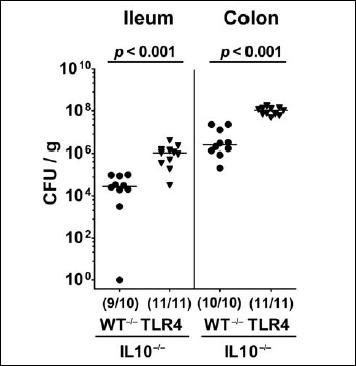
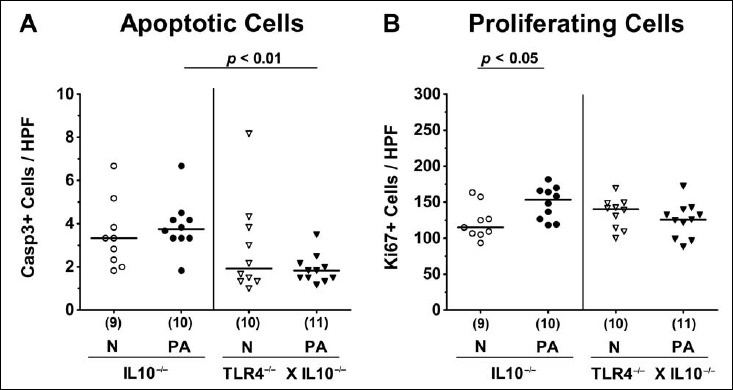
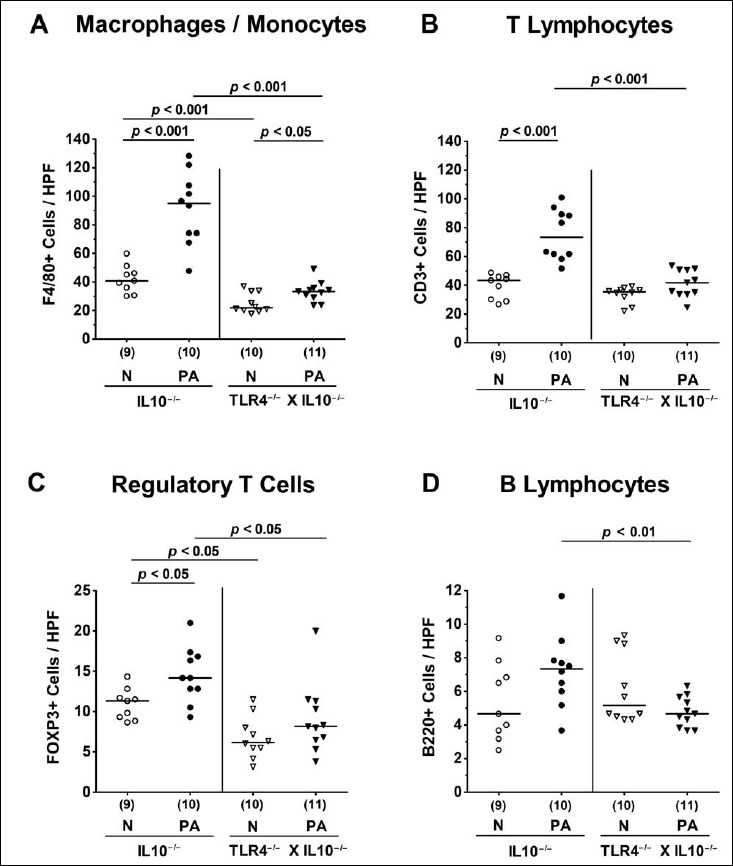
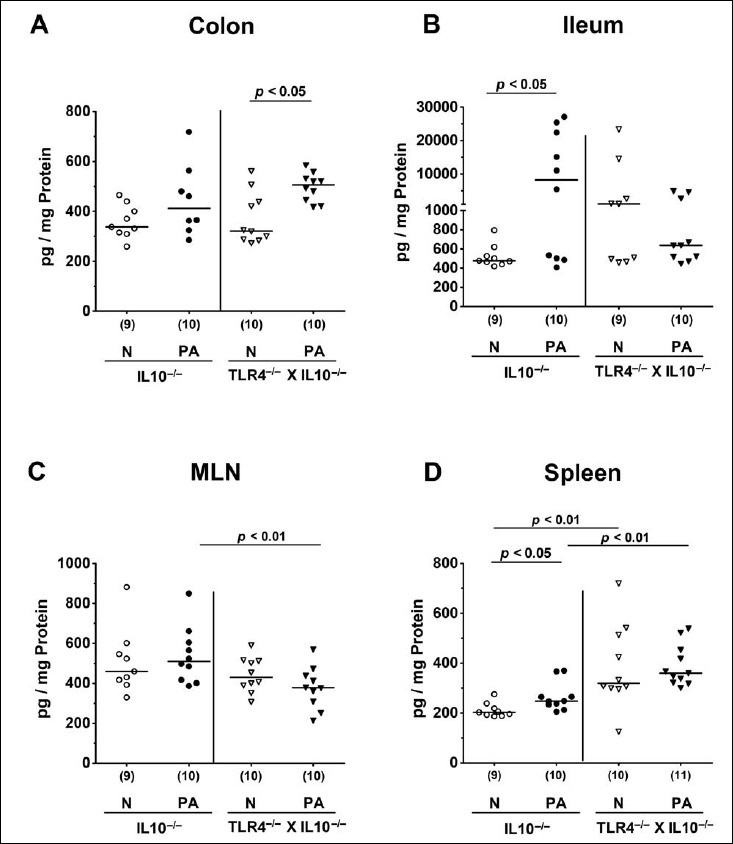
The rising incidences of infections with multidrug-resistant (MDR) Gram-negative bacteria including (PA) have gained increasing attention in medicine, but also in the general public and global health politics. The mechanisms underlying opportunistic pathogen-host interactions are unclear, however. To address this, we challenged secondary abiotic IL10 mice deficient for Toll-like receptor-4 (TLR4 × IL10), the main receptor of the Gram-negative cell wall constituent lipopolysaccharide, with a clinical MDR PA isolate. Despite higher intestinal colonization densities, apoptotic colonic epithelial cell numbers were lower in TLR4 × IL10 mice as compared to IL10 controls at day 14 postinfection (p.i.), whereas proliferating/regenerating cells had increased in the latter only. Furthermore, PA-colonized TLR4 × IL10 mice displayed less distinct innate and adaptive immune cell responses in the colon as compared to IL10 counterparts that were accompanied by lower nitric oxide concentrations in mesenteric lymph nodes in the former at day 14 p.i. Conversely, splenic NO levels were higher in both naive and PA-colonized TLR4-deficient IL10 mice versus IL10 controls. Remarkably, intestinal MDR PA was able to translocate to extra-intestinal including systemic compartments of TLR4 × IL10 mice only. Hence, MDR PA-induced intestinal and systemic immune responses observed in secondary abiotic IL10 mice are TLR4-dependent.
包括铜绿假单胞菌(PA)在内的多重耐药(MDR)革兰氏阴性菌感染发病率不断上升,这不仅在医学界受到越来越多的关注,在普通大众和全球卫生政策方面也是如此。然而,机会性病原体与宿主相互作用的潜在机制尚不清楚。为了解决这个问题,我们用一株临床多重耐药PA分离株对缺乏Toll样受体4(TLR4×IL10)的二级无菌IL10小鼠进行了攻击,TLR4是革兰氏阴性细胞壁成分脂多糖的主要受体。尽管肠道定植密度较高,但在感染后第14天(p.i.),与IL10对照组相比,TLR4×IL10小鼠的凋亡结肠上皮细胞数量较低,而只有后者的增殖/再生细胞有所增加。此外,与IL10对照组相比,PA定植的TLR4×IL10小鼠在结肠中表现出不太明显的先天性和适应性免疫细胞反应,在感染后第14天,前者肠系膜淋巴结中的一氧化氮浓度较低。相反,与IL10对照组相比,未感染和PA定植的TLR4缺陷型IL10小鼠脾脏中的NO水平均较高。值得注意的是,肠道多重耐药PA仅能转移到TLR4×IL10小鼠的肠外包括全身部位。因此,在二级无菌IL10小鼠中观察到的多重耐药PA诱导的肠道和全身免疫反应是TLR4依赖性的。