Tosato Valentina, West Nicole, Zrimec Jan, Nikitin Dmitri V, Del Sal Giannino, Marano Roberto, Breitenbach Michael, Bruschi Carlo V
Ulisse Biomed S.r.l., AREA Science Park, Trieste, Italy.
Faculty of Health Sciences, University of Primorska, Izola, Slovenia.
Front Oncol. 2017 Sep 29;7:231. doi: 10.3389/fonc.2017.00231. eCollection 2017.
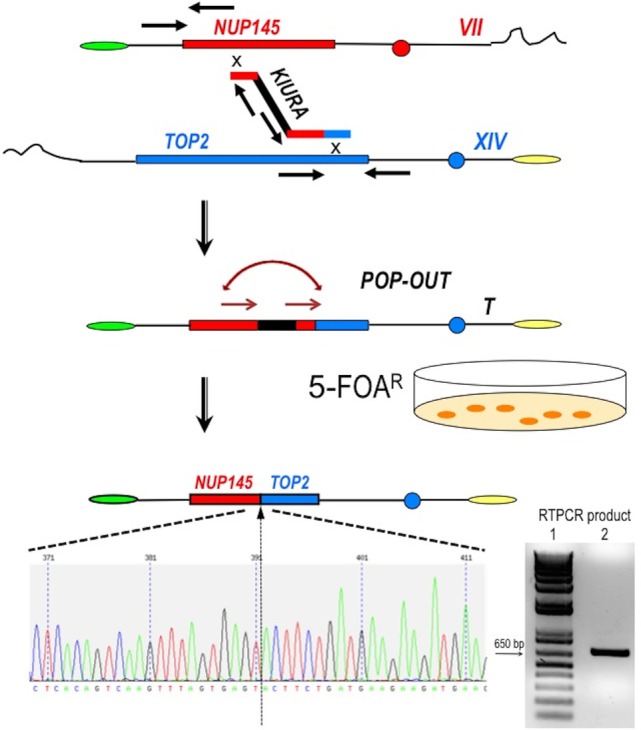
In mammalian organisms liquid tumors such as acute myeloid leukemia (AML) are related to spontaneous chromosomal translocations ensuing in gene fusions. We previously developed a system named bridge-induced translocation (BIT) that allows linking together two different chromosomes exploiting the strong endogenous homologous recombination system of the yeast . The BIT system generates a heterogeneous population of cells with different aneuploidies and severe aberrant phenotypes reminiscent of a cancerogenic transformation. In this work, thanks to a complex pop-out methodology of the marker used for the selection of translocants, we succeeded by BIT technology to precisely reproduce in yeast the peculiar chromosome translocation that has been associated with AML, characterized by the fusion between the human genes and . To shed light on the origin of the DNA fragility within , an extensive analysis of the curvature, bending, thermostability, and B-Z transition aptitude of the breakpoint region of and of its yeast ortholog has been performed. On this basis, a DNA cassette carrying homologous tails to the two genes was amplified by PCR and allowed the targeted fusion between and , leading to reproduce the chimeric transcript in a diploid strain of . The resulting translocated yeast obtained through BIT appears characterized by abnormal spherical bodies of nearly 500 nm of diameter, absence of external membrane and defined cytoplasmic localization. Since Nup98 is a well-known regulator of the post-transcriptional modification of P53 target genes, and mutations are occasionally reported in AML, this translocant yeast strain can be used as a model to test the constitutive expression of human . Although the abnormal phenotype of the translocant yeast was never rescued by its expression, an exogenous was recognized to confer increased vitality to the translocants, in spite of its usual and well-documented toxicity to wild-type yeast strains. These results obtained in yeast could provide new grounds for the interpretation of past observations made in leukemic patients indicating a possible involvement of in cell transformation toward AML.
在哺乳动物机体中,诸如急性髓系白血病(AML)之类的液体肿瘤与自发染色体易位有关,从而导致基因融合。我们之前开发了一种名为桥接诱导易位(BIT)的系统,该系统利用酵母强大的内源性同源重组系统将两条不同的染色体连接在一起。BIT系统产生了具有不同非整倍性和严重异常表型的异质细胞群体,这让人联想到致癌转化。在这项工作中,得益于用于选择易位体的标记物的复杂弹出方法,我们通过BIT技术成功地在酵母中精确重现了与AML相关的特殊染色体易位,其特征是人类基因与之间的融合。为了阐明内DNA脆性的起源,我们对和其酵母直系同源物的断点区域的曲率、弯曲、热稳定性和B-Z转变能力进行了广泛分析。在此基础上,通过PCR扩增了一个携带与这两个基因同源尾的DNA盒,并使与之间进行靶向融合,从而在的二倍体菌株中重现嵌合转录本。通过BIT获得的所得易位酵母的特征似乎是直径近500nm的异常球体,没有外膜且具有明确的细胞质定位。由于Nup98是P53靶基因转录后修饰的著名调节因子,并且在AML中偶尔会报道突变,这种易位酵母菌株可以用作测试人类组成型表达的模型。尽管易位酵母的异常表型从未因其表达而得到挽救,但尽管对外源野生型酵母菌株具有通常且有充分记录的毒性,但它被认为能赋予易位体增强的活力。在酵母中获得的这些结果可以为解释过去在白血病患者中所做的观察提供新的依据,表明可能参与了向AML的细胞转化。