Albany College of Pharmacy and Health Sciences, Albany, New York, USA
The Medicines Company, Parsippany, New Jersey, USA.
Antimicrob Agents Chemother. 2017 Dec 21;62(1). doi: 10.1128/AAC.01165-17. Print 2018 Jan.
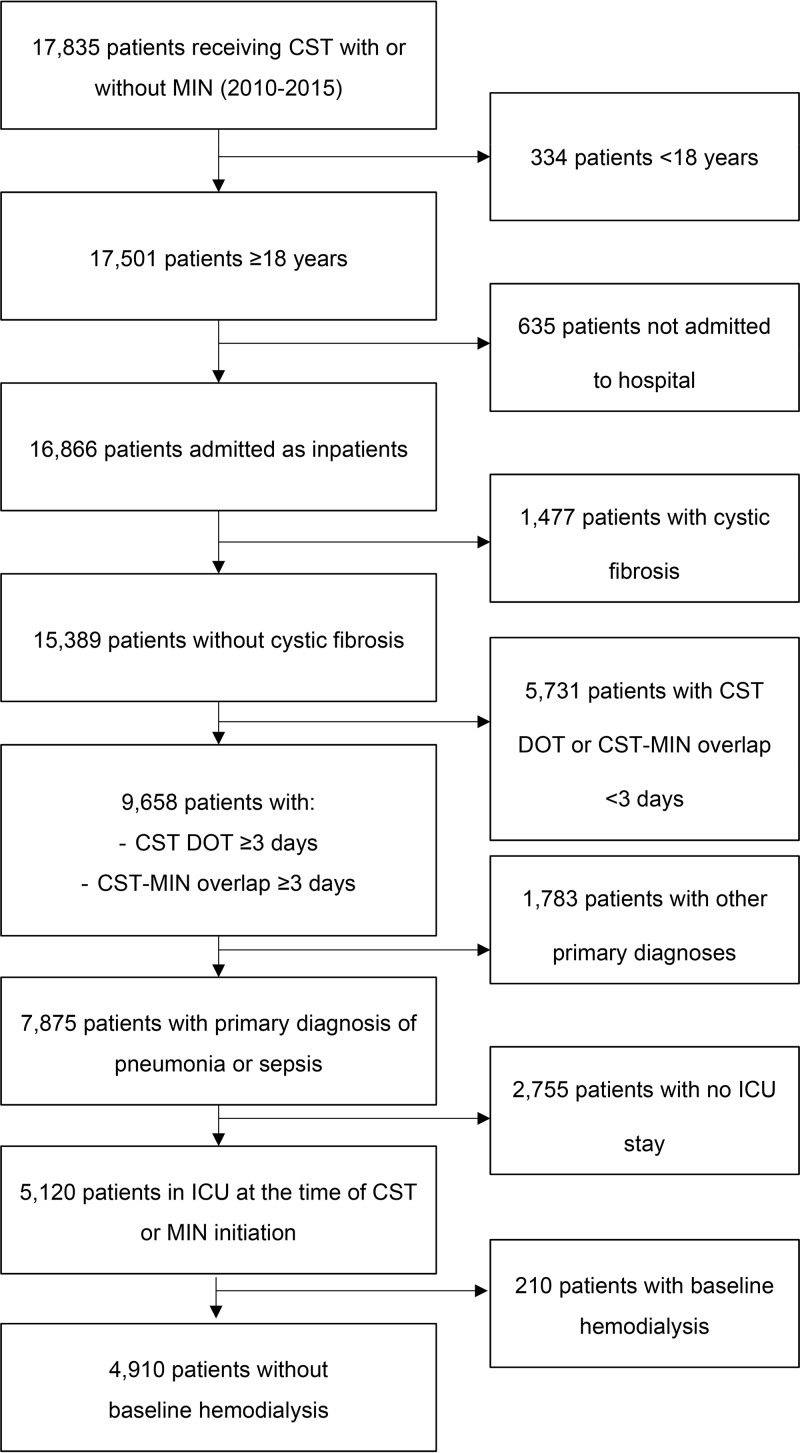
Nonclinical studies have suggested that oxidative damage, caspase-mediated apoptosis, and inducible nitric oxide synthase levels may be involved in the pathogenesis of colistin (CST)-associated acute renal failure. MIN inhibits caspase 1, caspase 3, and inducible nitric oxide synthase, leading to the hypothesis that coadministration of CST with MIN (CST-MIN) may reduce the incidence of acute renal failure as well as produce additive or synergistic antimicrobial effects. A multicenter retrospective cohort study was conducted using the Premier Research database to examine the impact of CST-MIN on acute renal failure. Inclusion criteria were as follows: age of ≥18 years, intensive care unit admission at CST initiation, primary International Classification of Diseases 9 (ICD-9) diagnosis of pneumonia or sepsis, nondialysis at hospital admission, and discharge between January 2010 and December 2015. ICD-9 code 584.XX or ICD-10 code N17 was used to define acute renal failure. Baseline comparisons, 1:8 propensity score matching, and confirmatory logistic regression analyses were conducted. In total, 4,817 patients received CST and met inclusion criteria; 93 received CST-MIN. Unadjusted frequency of acute renal failure was significantly lower in patients receiving CST-MIN than CST (11.8% versus 23.7%, = 0.007). Similar results were seen in propensity score matching (12.0% versus 22.3%, = 0.031) and logistic regression analyses (odds ratio of 0.403, = 0.006). Mortalities and 30-day readmission rates were similar between groups. The acute renal failure rate was not impacted by prevalence of baseline renal disease. CST-MIN in critically ill patients may reduce CST-associated acute renal failure. Further evaluation of this combination in prospective clinical studies is warranted.
非临床研究表明,氧化损伤、半胱天冬酶介导的细胞凋亡和诱导型一氧化氮合酶水平可能与多粘菌素(CST)相关性急性肾衰竭的发病机制有关。MIN 可抑制半胱天冬酶 1、3 和诱导型一氧化氮合酶,由此假设 CST 与 MIN 联合使用(CST-MIN)可能降低急性肾衰竭的发生率,并产生相加或协同的抗菌作用。一项多中心回顾性队列研究使用 Premier Research 数据库,考察了 CST-MIN 对急性肾衰竭的影响。纳入标准如下:年龄≥18 岁,CST 开始时入住重症监护病房,主要国际疾病分类第 9 版(ICD-9)诊断为肺炎或败血症,入院时无透析,2010 年 1 月至 2015 年 12 月出院。ICD-9 代码 584.XX 或 ICD-10 代码 N17 用于定义急性肾衰竭。进行了基线比较、1:8 倾向评分匹配和验证性逻辑回归分析。共有 4817 例患者接受 CST 并符合纳入标准;93 例患者接受 CST-MIN。未调整的急性肾衰竭发生率在接受 CST-MIN 治疗的患者中明显低于接受 CST 治疗的患者(11.8%比 23.7%, = 0.007)。在倾向评分匹配(12.0%比 22.3%, = 0.031)和逻辑回归分析(比值比为 0.403, = 0.006)中也观察到了相似的结果。两组死亡率和 30 天再入院率相似。急性肾衰竭发生率不受基线肾脏疾病患病率的影响。在危重症患者中 CST-MIN 可能降低 CST 相关性急性肾衰竭的发生率。需要进一步在前瞻性临床研究中评估这种联合用药。